
7 Top-Tier Alternative to React JS Frameworks for 2026

While React remains a dominant force in web development, the landscape is richer and more diverse than ever. Relying solely on one framework can mean missing out on significant performance gains, improved developer experiences, and better-suited architectures for specific projects. For founders migrating from no-code platforms like Bubble or Webflow, choosing the right technical foundation is a critical decision that impacts scalability, operational costs, and future growth.
A carefully selected alternative to React JS can offer a faster path to a production-grade application, aligning perfectly with your business goals. This is especially true for teams hitting the limits of Airtable or overspending on integration tools like Zapier, where a custom back-end and a well-chosen front-end framework become necessary for scaling efficiently. For non-technical founders preparing for VC fundraising, owning your intellectual property with a modern, secure stack is non-negotiable.
This guide explores seven powerful contenders to React, providing the practical insights you need to make an informed choice beyond the default. We will dive into each framework's unique strengths, ideal use cases, and migration considerations, helping you select the perfect tool to transition from your MVP and build a scalable, secure, and high-performance application.
1. Vue.js
Vue.js positions itself as a progressive and approachable alternative to React JS, focusing on an incrementally adoptable ecosystem that scales from simple widgets to complex Single-Page Applications (SPAs). The official website, vuejs.org
Key Features and Ecosystem
Vue stands out due to its strong, officially maintained ecosystem. Unlike React, where crucial tools like routing and state management are often handled by third-party libraries, Vue provides first-party solutions.
- Official Libraries: Vue Router for routing and Pinia for state management are maintained by the core team, ensuring seamless integration, consistent updates, and unified documentation.
- Developer Experience (DX): Vue's single-file components (.vue files) co-locate HTML, JavaScript, and CSS, creating a highly organized and intuitive development workflow.
- Performance: Its compiler-optimized rendering system and reactive data binding ensure efficient updates to the DOM, resulting in fast and responsive applications.
- Community and Resources: The official website links to a rich ecosystem of UI component libraries, plugins, developer tools, and job boards. For teams needing to get up to speed quickly, paid training partners like Vue School and Vue Mastery offer structured commercial courses.
Pricing and Migration Considerations
Vue.js is a free, open-source framework distributed under the MIT License. There are no licensing costs associated with using the core framework or its official libraries.
For non-technical founders or product leaders planning a migration from a no-code MVP, Vue presents a compelling path. Its gentle learning curve allows for faster developer onboarding, reducing initial engineering costs. The key is to start small by identifying a single, isolated feature of your no-code app (e.g., a dynamic pricing calculator or a user dashboard) and rebuilding it as a Vue component. This phased approach mitigates risk and provides immediate value, gradually replacing the no-code stack while maintaining business continuity. Learn more about how Vue compares to other top web frameworks on firstradicle.com.
2. Angular
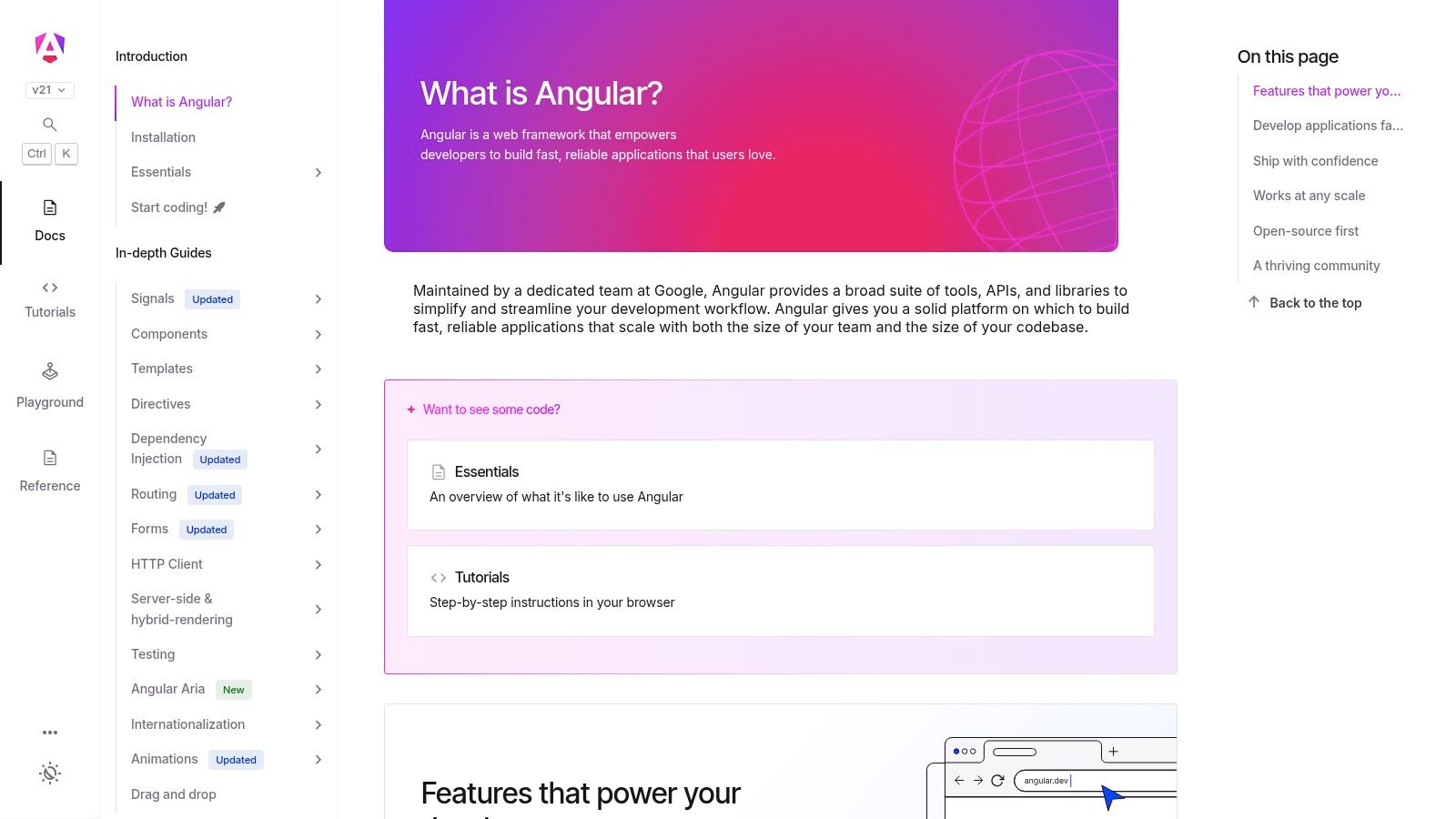
Angular positions itself as a comprehensive, "batteries-included" platform for building ambitious web applications. Maintained by Google, it provides an opinionated and structured alternative to React JS, designed for enterprise-scale projects where consistency and long-term support are paramount. The official website, angular.dev, serves as the central hub for documentation, tutorials, and an overview of its robust capabilities.
The framework’s all-in-one nature is its core strength. Unlike React, which requires developers to assemble an ecosystem of third-party libraries for routing, state management, and form handling, Angular includes these functionalities out of the box. This integrated approach ensures that all parts of the framework are designed to work together seamlessly, which is a major benefit for large teams needing standardized development practices and predictable release cycles.
Key Features and Ecosystem
Angular’s strength lies in its opinionated architecture and powerful, built-in tooling, which enforces best practices and enhances developer productivity at scale.
- Integrated Tooling: The Angular CLI is a powerful command-line interface that automates project setup, component generation, and build processes, now powered by Vite and esbuild for faster performance.
- Modern Reactivity: The recent introduction of Signals provides a fine-grained reactivity model that optimizes rendering performance, making applications faster and more efficient by default.
- Enterprise-Ready: Features like dependency injection, a robust routing module, and built-in internationalization (i18n) and security features make it ideal for complex, large-scale applications.
- Long-Term Support (LTS): Google provides predictable release schedules and a clear LTS policy, offering stability and automated migration tooling for major version updates.
Pricing and Migration Considerations
Angular is a free, open-source framework distributed under the MIT License. All its core packages and CLI tools are available at no cost.
For founders migrating from a no-code platform, Angular represents a significant step up in engineering discipline. Its steeper learning curve means a higher initial investment in developer training or hiring. However, for applications requiring complex business logic, strict architectural patterns, and scalability for a large team, this investment pays dividends. A migration strategy could involve isolating a complex workflow from a Webflow or Bubble app and rebuilding it as a self-contained Angular application, a process that requires a more structured approach than with lighter libraries. Learn more about the detailed planning required when converting a design into a coded application on firstradicle.com.
3. Svelte
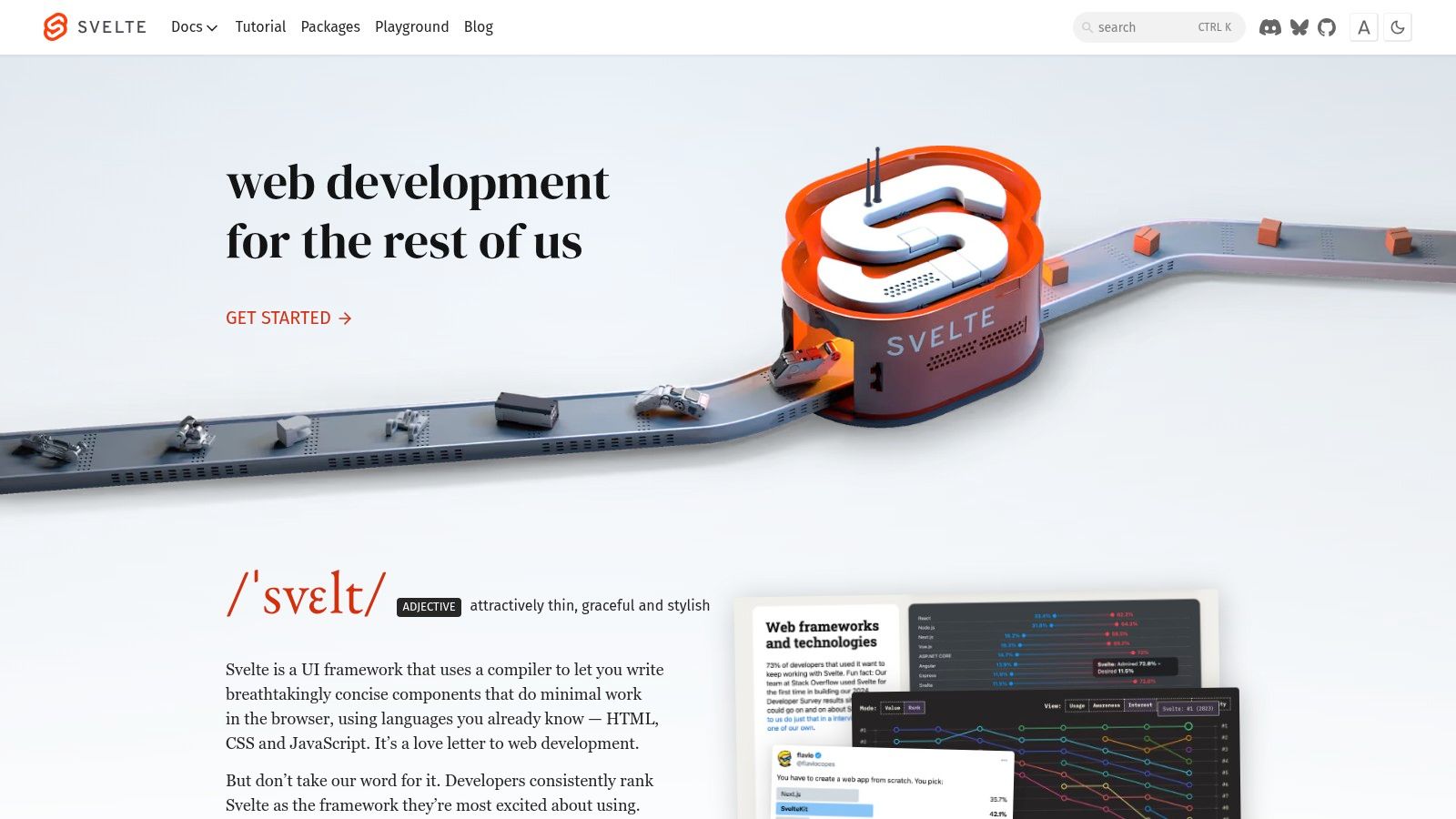
Svelte introduces a radical shift in how web frameworks operate, positioning itself as a compiler rather than a traditional library. This unique approach makes it a compelling alternative to React JS by moving the bulk of the work from the browser at runtime to the build step during development. The official website, svelte.dev, serves as the central hub for its excellent interactive tutorial, comprehensive documentation, and resources for its accompanying meta-framework, SvelteKit.
This compiler-first philosophy means there is no virtual DOM. Instead of shipping a framework library to the browser, Svelte compiles your components into highly optimized, vanilla JavaScript that directly manipulates the DOM. This results in significantly smaller bundle sizes and faster initial load times, making it an ideal choice for performance-critical projects or startups migrating from no-code tools who want their application to feel exceptionally snappy without a heavy runtime overhead.
Key Features and Ecosystem
Svelte's primary differentiator is its build-time compilation, which powers its most notable features and offers a distinct development experience. The ecosystem is rapidly maturing, with its meta-framework SvelteKit providing a complete solution for building modern web applications.
- No Virtual DOM: By compiling to surgical DOM updates, Svelte avoids the overhead of VDOM diffing, often leading to better performance benchmarks.
- Truly Reactive: State management is built into the language itself. Updating a variable automatically triggers a UI update without complex hooks or boilerplate.
- SvelteKit: An official, full-featured meta-framework for building robust applications with server-side rendering (SSR), routing, and optimized production builds.
- Developer Experience (DX): Components written in
.sveltefiles are extremely concise, combining HTML, CSS, and JavaScript in a way that feels closer to vanilla web development.
Pricing and Migration Considerations
Svelte is a free and open-source project distributed under the permissive MIT License, meaning there are no costs to use the framework or SvelteKit in commercial projects.
For a startup transitioning from a no-code MVP, Svelte's small bundle size and high performance present a significant advantage. The concise syntax can lead to faster development cycles once the team is familiar with its conventions. A sound migration strategy would involve rebuilding a self-contained, performance-sensitive feature, like an interactive map or a complex data visualization widget, as a Svelte component. This isolated approach allows you to demonstrate immediate performance gains to stakeholders while planning the next steps for building scalable web applications on firstradicle.com.
4. SolidJS
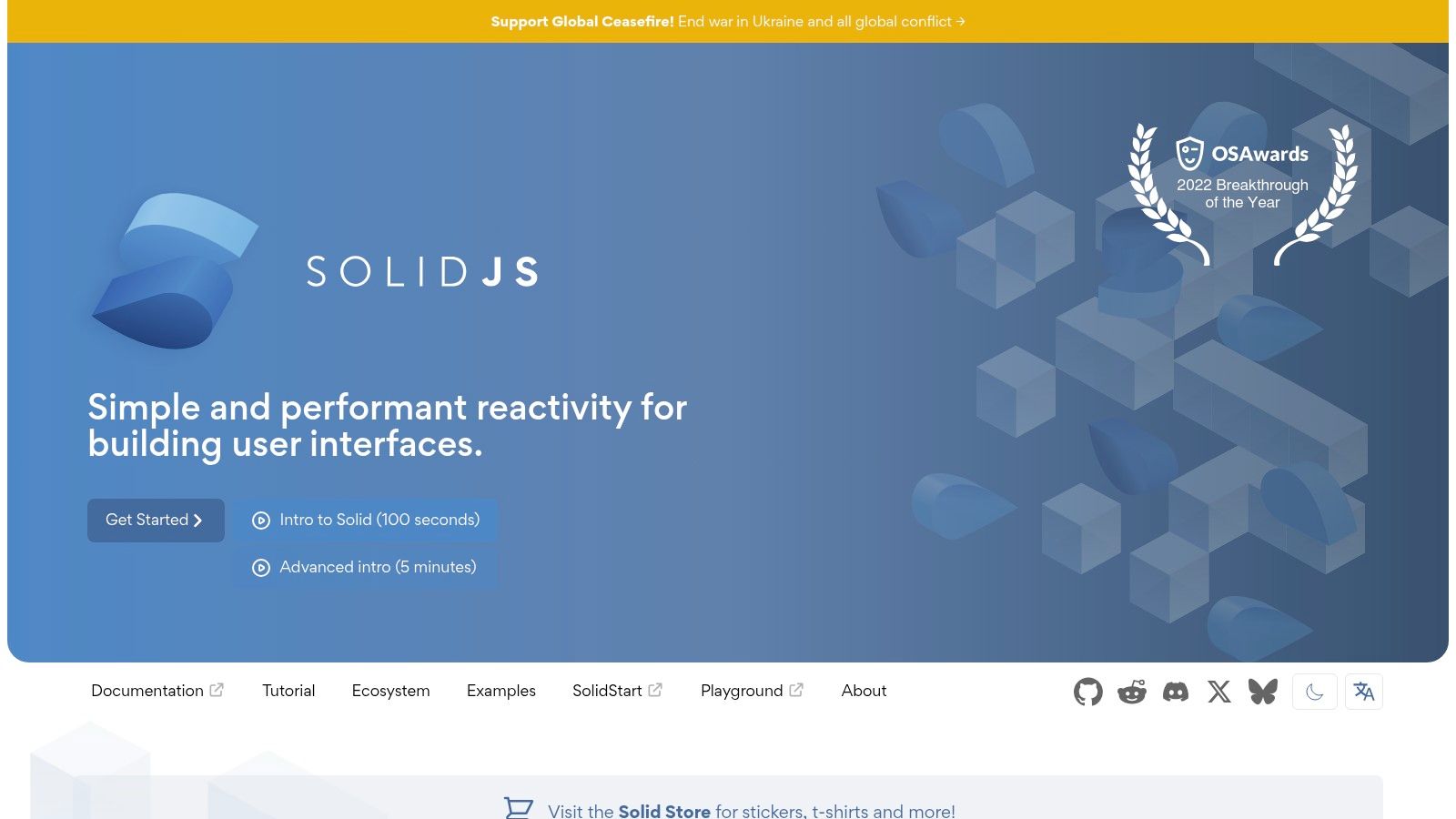
SolidJS presents itself as a high-performance, declarative JavaScript library for building user interfaces, making it a compelling alternative to React JS. Its core philosophy revolves around fine-grained reactivity and compiling JSX directly to efficient, vanilla JavaScript DOM operations, eliminating the need for a Virtual DOM. The official website, solidjs.com, serves as a comprehensive hub with documentation, tutorials, and starter templates to get developers productive quickly.
The framework's primary appeal is its 'render-once' mental model. Unlike React, where components re-render when state or props change, Solid components run only once to set up the view. Subsequent updates are handled surgically through a reactive system of 'signals', resulting in exceptional runtime performance that often benchmarks near the speed of non-framework JavaScript. This approach provides the familiar, declarative JSX syntax of React while delivering superior speed and a smaller bundle size.
Key Features and Ecosystem
SolidJS balances a modern feature set with a lean core, focusing on providing primitives that enable powerful patterns. The development experience is intentionally similar to modern React, which helps reduce the learning curve for teams already familiar with its concepts.
- Fine-Grained Reactivity: At its heart are 'signals', which are reactive primitives that track state changes. When a signal's value is updated, only the specific parts of the DOM that depend on it are re-executed.
- Modern Capabilities: It includes built-in support for advanced features like server-side rendering (SSR) with streaming, Suspense for asynchronous operations, context for state management, and primitives for progressive hydration.
- Developer Experience (DX): The framework has strong integration with Vite, providing a fast and modern development environment. It also offers excellent TypeScript support out of the box through official starter templates.
- Ecosystem: While smaller than React's, Solid's ecosystem is growing. The official site links to community resources, and libraries like SUID provide Material UI components adapted for Solid's reactive model.
Pricing and Migration Considerations
SolidJS is a free, open-source project distributed under the MIT License, meaning there are no licensing fees.
For a startup migrating from a no-code platform, SolidJS is an excellent choice for performance-critical applications like real-time dashboards or complex interactive forms. Its JSX syntax makes it a relatively smooth transition for developers with React experience. A practical migration strategy would be to identify a highly interactive, self-contained widget in the existing application, such as a data visualization chart or a live search filter, and rebuild it using Solid. This allows the team to leverage Solid's performance benefits for key features without committing to an immediate, full-scale rewrite.
5. Qwik
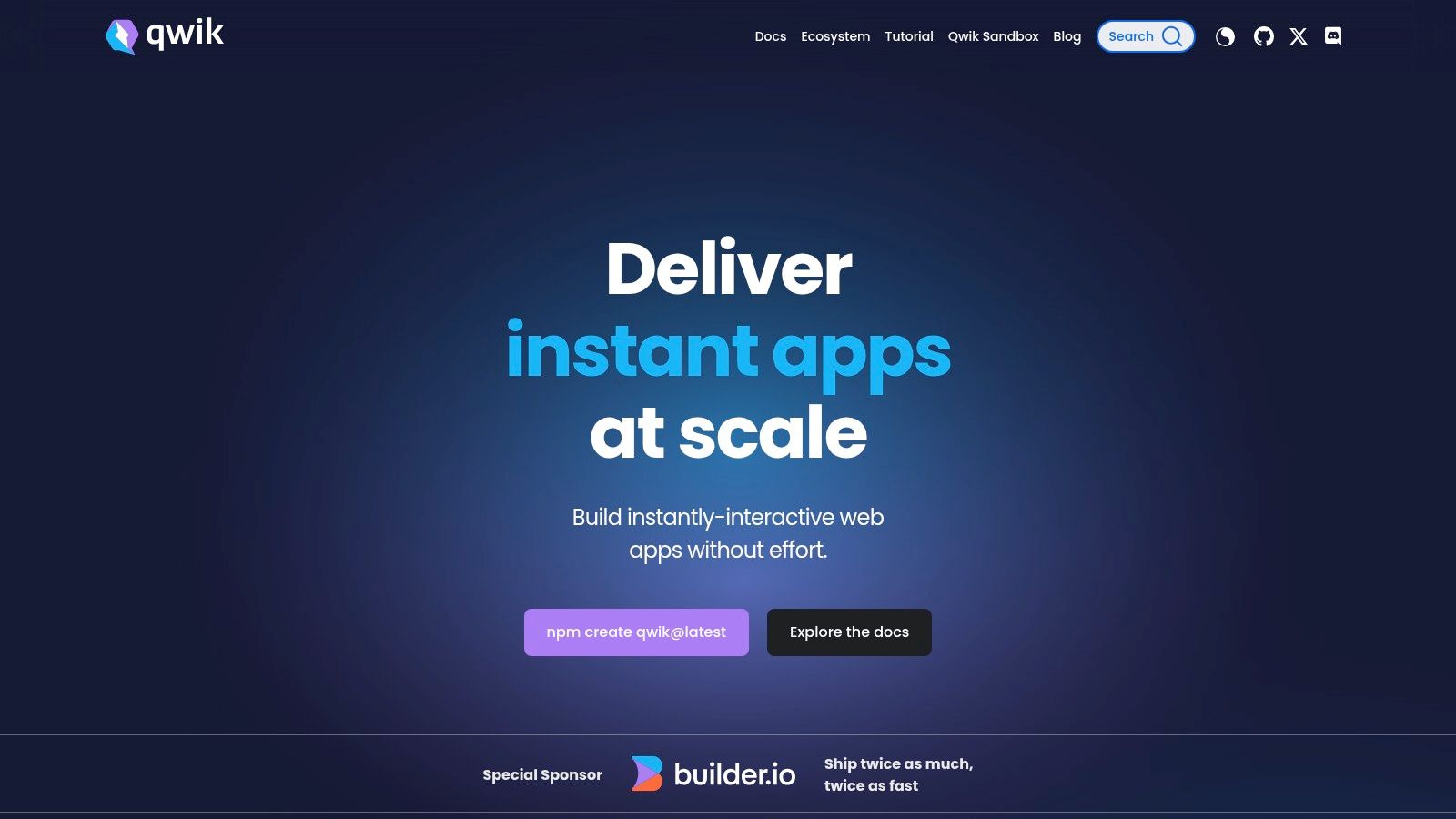
Qwik introduces a novel "resumable" approach, positioning itself as an alternative to React JS focused on achieving instant-on interactivity, regardless of application complexity. By delivering HTML first and delaying JavaScript execution until user interaction, it aims to deliver unparalleled performance and excellent Core Web Vitals scores. The official website, qwik.dev, serves as a comprehensive hub with tutorials, API documentation, and tooling guides.
This framework challenges the traditional model of hydration, where frameworks must re-execute code on the client to make a server-rendered page interactive. Qwik instead "pauses" execution on the server and "resumes" it on the client only when needed, dramatically reducing the amount of JavaScript that needs to be downloaded, parsed, and executed upfront. For businesses whose user experience is tied directly to initial load times, such as e-commerce or content-heavy sites, this performance-first architecture is a significant differentiator.
Key Features and Ecosystem
Qwik’s design philosophy centers on lazy loading everything by default, which is made possible by its innovative toolchain and core features. Its familiar JSX syntax provides a smooth transition for developers coming from React.
- Resumability: Its core innovation, resumability eliminates the need for hydration, leading to near-instant interactive times. The Qwik Optimizer serializes application and component state into the HTML itself.
- Developer Experience (DX): Built on Vite, it offers a fast and modern development environment. The ecosystem includes built-in testing with Vitest and Playwright, plus deployment adapters for platforms like Vercel and Netlify.
- Performance: The framework is explicitly designed to minimize the amount of JavaScript shipped to the client, which directly improves key metrics like Time to Interactive (TTI).
- Growing UI Library: While the ecosystem is younger, the official Qwik UI component library is actively expanding, providing a solid foundation for building new applications.
Pricing and Migration Considerations
Qwik is a free, open-source framework distributed under the MIT License, meaning there are no direct costs to use it. Its value lies in the performance gains it can deliver, which can translate into better user engagement and conversion rates.
For a non-technical founder considering a migration from a platform like Webflow, Qwik offers a path to a high-performance custom application. The mental model of resumability requires a shift in thinking, so the best approach is to start with a single, performance-critical part of the site, like a product landing page or an interactive calculator. By rebuilding this piece in Qwik, a team can validate the performance benefits and learn the framework's unique patterns before committing to a full-scale migration, ensuring the project starts on a technically sound and scalable foundation.
6. Preact
Preact offers a compelling proposition as a fast, lightweight alternative to React JS, boasting a mere 3-4 kB gzipped bundle size. Its primary appeal lies in its near-identical API to React, making it an almost drop-in replacement for performance-critical projects. The official website, preactjs.com, provides comprehensive documentation, examples, and migration guides.
The framework is designed for speed, both in terms of initial load time and runtime performance. For startups looking to optimize their web applications for faster user experiences, especially on mobile or low-bandwidth connections, Preact is an excellent choice. It maintains the familiar component-based architecture and JSX syntax of React, which dramatically reduces the learning curve for developers already proficient in the React ecosystem. This makes it a pragmatic choice for teams wanting to shed kilobytes without a complete conceptual shift.
Key Features and Ecosystem
Preact’s core strength is delivering React-like functionality in a much smaller package. This is achieved through clever optimizations and a focus on core features, supported by a compatibility layer for the wider ecosystem.
- Minimal Bundle Size: Its tiny footprint is a key differentiator, leading to faster page loads and improved Core Web Vitals, which is crucial for SEO and user retention.
- React Compatibility: Using the
preact/compatalias, most existing React applications and libraries can be used with minimal to no code changes. This compatibility layer shims the React API, allowing you to leverage a vast ecosystem. - Performance Focus: Preact uses a highly efficient virtual DOM implementation and supports modern features like server-side rendering (SSR) with seamless hydration, ensuring fast and responsive user interfaces.
- Familiar API: It supports popular React features like Hooks, Context, and Fragments, ensuring that developers can maintain their existing workflows and knowledge base.
Pricing and Migration Considerations
Preact is a free, open-source project distributed under the MIT License, meaning there are no licensing fees. Its development and maintenance are supported by a community of contributors and corporate sponsors.
For a founder whose MVP was built with React, migrating to Preact can be a strategic move to boost performance without a costly rewrite. The process often involves simply aliasing react and react-dom to preact/compat in the build configuration (e.g., webpack or Vite). The main challenge is ensuring compatibility with third-party React libraries that might rely on specific, non-standard React internals. A gradual migration, starting with performance-critical components, allows teams to validate compatibility and realize performance gains incrementally.
7. htmx
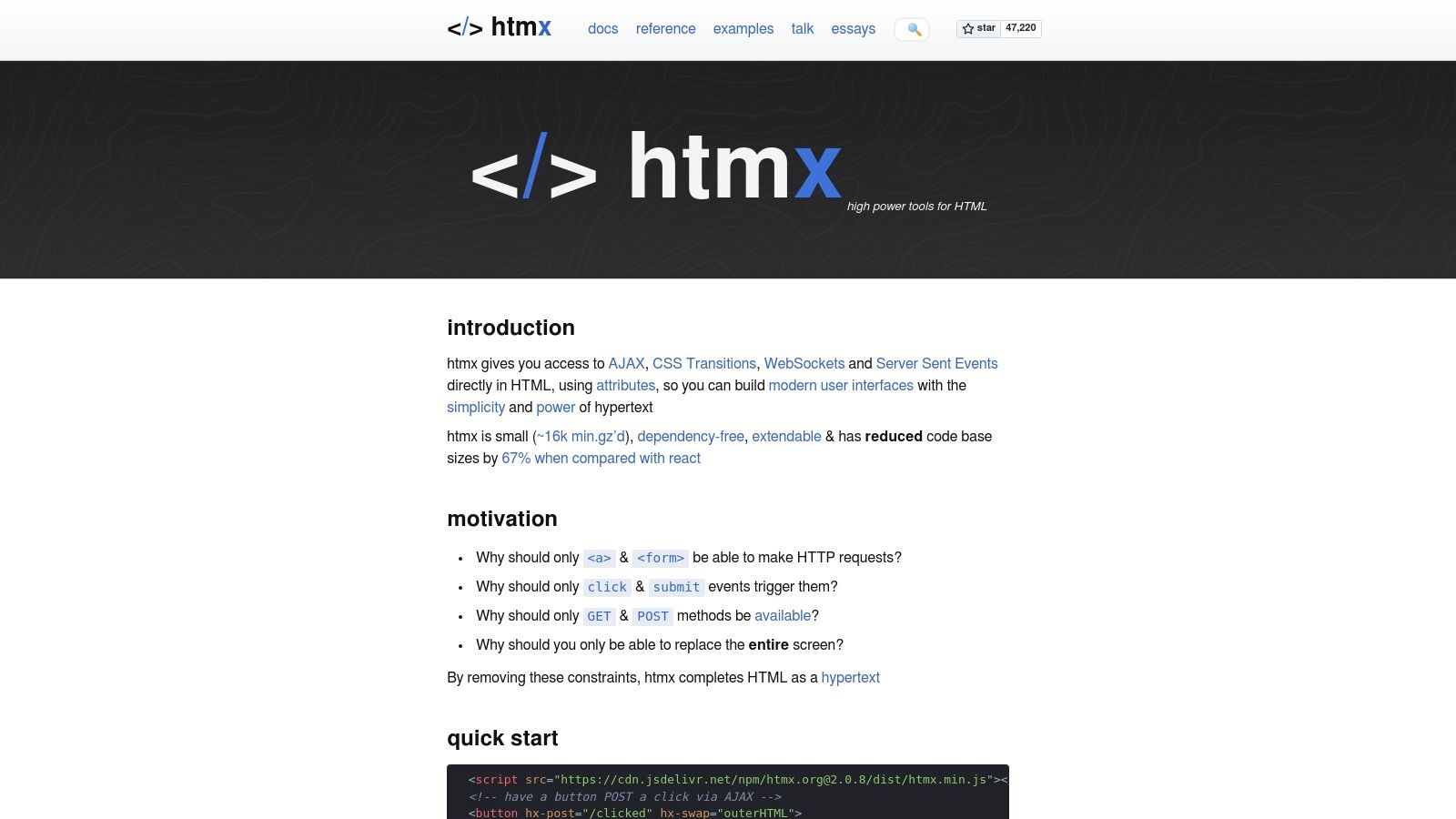
htmx presents a radically different approach as an alternative to React JS, focusing on extending HTML with attributes to achieve modern, interactive user experiences. It enables developers to access AJAX, WebSockets, and Server-Sent Events directly within their HTML, side-stepping the need for complex client-side JavaScript. The official website, htmx.org, provides comprehensive documentation and examples that showcase its hypermedia-driven philosophy.
This approach is particularly powerful for teams looking to enhance server-rendered applications (like those built with Rails, Django, or FastAPI) with dynamic features without adopting a full-blown SPA framework. For founders transitioning from a no-code platform, htmx allows for replacing brittle, client-side automations with robust, server-driven interactivity, often with minimal build tooling and a much simpler development workflow. Its ability to be added via a single script tag significantly lowers the barrier to entry.
Key Features and Ecosystem
htmx's power lies in its simplicity and its ability to keep the "center of gravity" of your application on the server, where many business-critical systems already reside. This contrasts sharply with React's client-centric model.
- Attribute-Driven Interactivity: Instead of writing JavaScript event handlers, you add
hx-*attributes to HTML elements (e.g.,hx-post,hx-trigger,hx-swap) to define how they interact with the server. - Minimal JavaScript: It dramatically reduces the amount of custom client-side JavaScript required for common dynamic behaviors like form submissions, content loading, and real-time updates.
- Backend Agnostic: htmx works with any backend language or framework that can return HTML, making it incredibly versatile for existing technology stacks.
- Lightweight and CDN-Friendly: The library is tiny and can be included with a single script tag, requiring no complex build process or package management for simple use cases.
Pricing and Migration Considerations
htmx is a free, open-source library distributed under the BSD 2-Clause "Simplified" License. There are no costs associated with using it in commercial or personal projects.
For a founder moving away from a tool like Zapier or a no-code backend, htmx offers a pragmatic migration path. You can start by building a robust backend with a framework like FastAPI or Django and then use htmx to "sprinkle" interactivity onto the server-rendered HTML. This avoids the high initial cost and complexity of building a separate API and a full React frontend. A good starting point is to identify a single, high-cost automation (e.g., a multi-step form that triggers several actions) and rebuild it as a server-rendered htmx component, gaining speed, reliability, and control in the process.
Top 7 React Alternatives Comparison
| Technology | Implementation complexity | Resource requirements | Expected outcomes | Ideal use cases | Key advantages |
|---|---|---|---|---|---|
| Vue.js | Low–moderate — incrementally adoptable | Moderate — official libs, devtools, training | Good DX, performant and scalable SPAs | Progressive migration, medium teams, component libraries | Approachable, mature ecosystem, compiler optimizations |
| Angular | High — opinionated architecture, steeper learning curve | High — CLI, DI, SSR/SSG tooling, LTS support | Predictable, enterprise‑grade, maintainable apps | Large teams, enterprise products, long‑term projects | Batteries‑included, strong conventions, robust testing |
| Svelte | Low — compiler handles runtime complexity | Low — small bundles, SvelteKit for routing/SSR | Very small bundles, snappy perceived performance | MVPs, performance‑focused apps, small teams | Compiler‑optimized output, concise components, fast UX |
| SolidJS | Moderate — fine‑grained reactivity with JSX | Low–moderate — Vite/TS integration, smaller ecosystem | Excellent runtime performance, minimal re‑renders | Interactive UIs requiring high throughput, React migrations | Fine‑grained signals, React‑like ergonomics, high perf |
| Qwik | Moderate–high — resumability and lazy execution mindset | Moderate — Vite tooling, optimizer, growing adapters | Instant interactivity, strong Core Web Vitals | Content sites at scale, CWV‑sensitive apps, instant‑interactive pages | Resumability, lazy JS execution, optimized delivery |
| Preact | Low — React‑compatible API, minimal changes | Low — tiny bundle, preact/compat for migration | Small footprint while preserving React ergonomics | Performance‑sensitive frontends, microfrontends, embedding | Very small bundle, easy React migration, fast hydration |
| htmx | Very low — attribute‑driven HTML approach | Minimal — single script, server‑rendered fragments | Reduced client JS and hydration, simpler interactivity | Server‑rendered apps (Rails/Django/FastAPI), legacy migrations | Minimal tooling, CDN‑friendly, fast server‑driven UI updates |
Making Your Choice: From No-Code Fragility to Production-Grade Software
Choosing an alternative to React JS is more than a technical swap; it's a pivotal business decision. It marks the transition from a no-code MVP, constrained by platform limits and integration sprawl, to owning your intellectual property and building a scalable, production-grade application. The right framework choice directly impacts your product's performance, development velocity, and your team's ability to innovate.
As we've explored, the landscape is rich with powerful options. From the raw performance of Svelte and SolidJS to the enterprise-grade structure of Angular, each tool serves a distinct purpose. Vue offers an approachable on-ramp, Preact provides a lightweight migration path, Qwik revolutionizes initial load times with resumability, and htmx empowers backend-focused teams to build modern UIs without heavy JavaScript. Your decision hinges on understanding where your business is today and where you need it to be tomorrow.
Synthesizing Your Decision
The path forward requires a clear-eyed assessment of your specific needs. Are you a non-technical founder preparing a pitch for VCs? A framework that supports rapid development and demonstrates a clear path to scalability is crucial. Have you outgrown the limitations of Airtable and Zapier? Your focus should be on a solution that integrates seamlessly with a robust backend like PostgreSQL and offers custom logic without exorbitant recurring fees.
To crystallize your choice, consider these final factors:
- Team Expertise: The best framework is one your team can master quickly. Assess existing skills and the learning curve associated with each alternative to React JS. A less "performant" framework in the hands of an expert team will always outperform the "best" framework with an inexperienced one.
- Ecosystem & Tooling: Look beyond the core library. Evaluate the maturity of the surrounding ecosystem, including state management libraries, UI component kits, and developer tools. A strong ecosystem accelerates development and simplifies problem-solving.
- Long-Term Vision: Where will your product be in two to five years? An enterprise application demanding stability and long-term support has different needs than a consumer-facing app that must constantly innovate. Choose a technology that aligns with your strategic roadmap, not just your immediate sprint goals.
Ultimately, the goal is to build a robust, secure, and maintainable software asset. This means moving beyond the "no-code trap" where your core business logic is rented, not owned. By selecting the right alternative to React JS and pairing it with a solid backend architecture, you lay the foundation for sustainable growth, secure user data, and a product that can truly scale.
Overwhelmed by the options or need an experienced partner to guide your migration from a no-code platform to a production-ready stack? At First Radicle, we specialize in transforming fragile MVPs into scalable, high-performance applications using modern frameworks like Next.js and SvelteKit. Let us handle the technical complexity so you can focus on growing your business. Learn more about our code migration services at First Radicle.