
A Founder's Guide to App Dev With Python
If your no-code app is starting to feel sluggish, expensive, or just plain restrictive, you’re not alone. What you're experiencing isn't just a technical hiccup; it’s a sign that your business is ready for its next big step. For founders looking to build a scalable, venture-ready product, that next step is often app development with Python. This is about more than just writing code—it's about taking full ownership of your technology to unlock your company’s future.
Why Python Is Your Engine for Scalable Growth
Think of your no-code app as a go-kart. It was perfect for getting you off the ground and proving your idea works, which is a huge win. But now you’re on a bigger track, and a go-kart just won’t cut it in a real race. You need a high-performance engine, a custom-built chassis, and a team that knows how to keep it running at peak performance. That's exactly what a custom Python backend gives you.
Moving to Python isn't about re-creating features you already have. It's a strategic upgrade that turns a fragile prototype into a solid, defensible technology asset—one that directly solves the problems holding back your growth.
Overcoming No-Code Limitations
The "growth ceiling" on no-code tools usually shows up in a few painful ways. Your app gets slower as more users sign up. Your subscription costs start to balloon. And trying to implement your unique business logic becomes a messy patchwork of plugins and third-party tools that are a nightmare to maintain.
Switching to Python gives you back the reins:
- Complete Control: You can build complex, custom logic that truly sets your business apart, without being boxed in by pre-made components.
- True Scalability: Design an architecture that can handle a sudden surge in traffic without crumbling or racking up surprise fees.
- Intellectual Property Ownership: Your code becomes a valuable asset. It’s something you own, which is a big deal to investors.
Migrating from a no-code tool to a Python backend is the moment a founder decides to stop renting their technology and start owning it. It’s a declaration that your business is built to last.
The Power of a Mature Ecosystem
One of Python’s biggest strengths is its massive and mature ecosystem. When you choose Python, you’re not just getting a programming language; you’re tapping into a global community, an incredible number of pre-built libraries, and a huge pool of talent.
The numbers back this up. The TIOBE Index for January 2026 gives Python a 22.61% rating, and it commands 32.43% of programming language interest in the U.S. This isn't just a trend. The Stack Overflow 2025 Developer Survey found a 57.9% adoption rate among developers—the biggest jump in a decade, driven largely by the kind of backend work that founders like you need. You can find more Python market insights that dig into its popularity.
What this means for you is simple: finding skilled developers to build and maintain your app is easier and more affordable than with less common technologies. This robust ecosystem lets you build faster, safer, and with more powerful features, finally allowing your technology to catch up with your vision.
Choosing Your Python Framework: Django vs. FastAPI
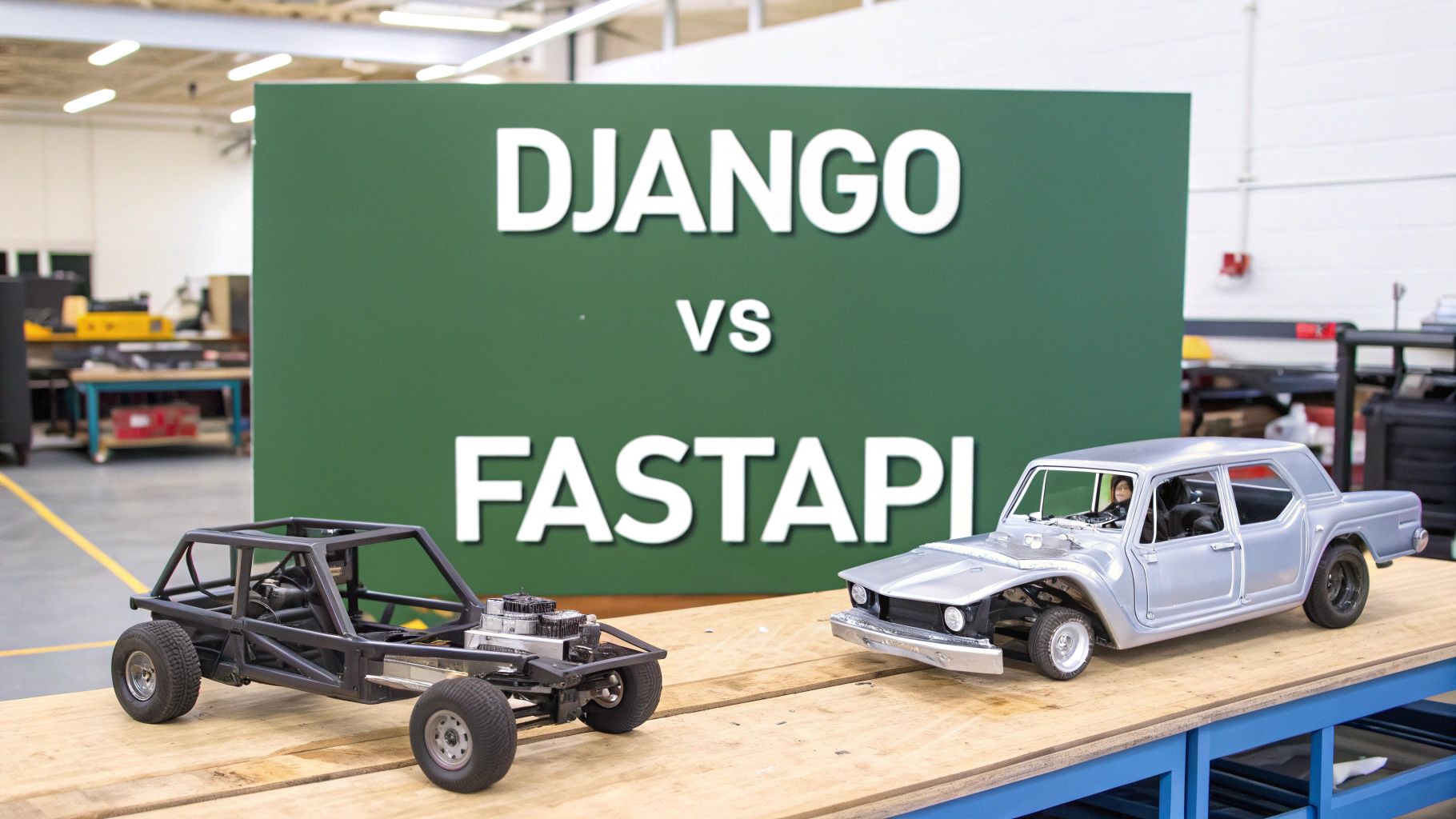
Picking your Python framework is one of the first—and most important—architectural decisions you'll make. Think of it like choosing the chassis for a car. Your choice determines how fast you can build, how you'll handle tight corners, and how easily you can upgrade the engine later on. Get it right, and you’re on the fast track. Get it wrong, and you might be looking at a total rebuild down the line.
Python's ecosystem is a powerhouse, with over 75% global developer adoption for a reason. Its incredible popularity, especially in North America where 86% of users call it their primary language, has fueled a massive community. In fact, its GitHub contributor base is projected to grow by 48.78% year-over-year by August 2025. This means frameworks like Django and FastAPI are battle-tested and constantly improving.
Django: The Batteries-Included Workhorse
Think of Django as the all-in-one toolkit for building serious web applications. It follows a "batteries-included" philosophy, meaning it comes with nearly everything you need right out of the box. This is a huge advantage for founders who need to build complex, feature-rich platforms without getting bogged down in tiny decisions.
Django’s core components are designed to work together perfectly:
- Built-in ORM: Its Object-Relational Mapper is a fantastic tool that lets your developers talk to the database using Python, not raw SQL. This alone speeds up development time immensely.
- Admin Panel: Django automatically generates a secure, production-ready admin interface. For any app that needs content or user management, this is a game-changer, saving you weeks of work.
- Rock-Solid Security: It comes with built-in defenses against common threats like Cross-Site Scripting (XSS) and SQL injection, giving you a secure foundation from day one.
Django is the go-to when your business logic is complex and you need a reliable, all-in-one system. It’s perfect for traditional web apps like SaaS platforms, e-commerce sites, or content management systems.
FastAPI: The Modern, High-Performance Sprinter
On the other hand, you have FastAPI. It's the newer, leaner, and incredibly fast alternative. If Django is a rugged, all-terrain vehicle, FastAPI is the lightweight race car built for pure speed. It’s designed from the ground up for building APIs, making it a perfect match for modern apps where the frontend and backend are separate.
It’s built on modern Python features and standards:
- Asynchronous to the Core: FastAPI is built to handle tons of connections at once. This makes it incredibly efficient at managing high-traffic loads with fewer server resources.
- Automatic Docs: It generates interactive API documentation for you automatically. This is a massive win for collaboration, as your frontend team or third-party developers can instantly see how to use your backend.
- Data Validation: It uses Python type hints to validate incoming data, which helps catch bugs early and ensures your API only accepts the data it expects.
FastAPI shines when your main goal is building a blazing-fast API to power a separate frontend (like a React or mobile app) or a system of microservices.
Making the Right Choice for Your Startup
Choosing between Django and FastAPI isn't about which is "better"—it's about which is better for your product. To help you frame the decision, I’ve put together a quick comparison table tailored for founders. You can also dive deeper with our guide to the best web frameworks available today.
Here’s a head-to-head breakdown to help you decide.
Python Framework Comparison for Founders
| Framework Feature | Django | FastAPI | Flask |
|---|---|---|---|
| Philosophy | "Batteries-included." All-in-one. | "API-first." Modern & fast. | "Micro-framework." Minimalist & flexible. |
| Best For | SaaS platforms, CMS, e-commerce. | High-performance APIs, microservices. | Small projects, simple APIs, prototypes. |
| Development Speed | Very Fast (for full apps) | Very Fast (for APIs) | Slower start; requires adding libraries. |
| Performance | Good | Excellent (async support) | Good (but depends on extensions) |
| Key Strength | Admin panel, ORM, security. | Automatic docs, data validation. | Simplicity and total flexibility. |
| Learning Curve | Steeper; more to learn upfront. | Moderate; async can be tricky. | Easy; great for beginners. |
Ultimately, both Django and FastAPI are fantastic, professional-grade choices. Django gives you a powerful, comprehensive toolkit to build complex applications quickly. FastAPI offers blistering speed and a modern architecture for API-driven products. Your product roadmap and team’s expertise should be the final guide.
Designing a Backend That Powers Your Business
Your backend is the central nervous system of your app. It’s the engine room that handles all the heavy lifting your users never see. While no-code platforms conveniently tuck this away behind a drag-and-drop interface, building your own with Python gives you total control, ownership, and the power to create a truly bulletproof business.
For a non-technical founder, the idea of "backend architecture" can sound pretty intimidating. But you don't need to become a senior engineer overnight. The goal is to grasp the core concepts so you can make smart decisions.
Let's start with an analogy. Imagine you're building a retail business. You could build one giant, all-in-one department store, or you could set up a collection of specialized boutique shops. This is the first big decision you'll face in backend design: choosing between a monolith and a microservices architecture.
Monolithic vs. Microservices Architecture
A monolithic architecture is like that single department store. Every single function—user profiles, inventory, payments, you name it—lives under one roof in a single, unified chunk of code. For most startups coming from a no-code platform, this is hands-down the most practical way to start. It's just simpler and faster to build, test, and deploy when everything is in one place.
A microservices architecture, on the other hand, is like a street lined with those specialized boutiques. The user service is one shop, the payment service is another, and the notification service is a third, each one its own small, independent application. This approach gives you incredible flexibility and resilience when you're operating at a massive scale. If one shop has an issue, the others can keep running. But, and it's a big but, it adds a ton of complexity in getting all those separate services to talk to each other correctly.
For a founder moving from Bubble or Webflow, starting with a well-organized monolith is almost always the right call. It gives you the speed you need to get your new-and-improved product to market, and a smart design will let you break off pieces into microservices later on if you ever need to.
Core Components of a Production-Grade App
Once you've settled on a structure, a professional backend relies on a few key components working in harmony. Think of these as the essential departments in your business headquarters—each has a critical job to do.
A Scalable Database (Your Central Warehouse): Your no-code app probably used something like Airtable, which is fine for getting started. For a real production app, you need an industrial-strength database like PostgreSQL. It’s the professional upgrade—incredibly reliable, powerful, and built to handle millions of records without breaking a sweat. It’s all about making sure your data is stored securely and can be pulled up in an instant.
Secure Authentication (Your Security Desk): Protecting your users' data is non-negotiable. It's your backend's job to verify who a user is (authentication) and what they're allowed to do (authorization). Python frameworks have fantastic libraries for building secure login systems, including social logins (Google, Facebook) and passwordless options.
Reliable Payment Processing (Your Finance Department): If you charge for your product, you need a rock-solid way to handle money. Integrating directly with a payment processor like Stripe using its Python library gives you complete control over subscriptions, one-time payments, and invoicing. Plus, you cut out the middleman fees that are so common with no-code plugins.
Background Task Queues (Your Back Office): Some tasks don't need to happen immediately. Sending a welcome email, generating a big report, or processing a large file shouldn't make a user sit and wait. A task queue, using tools like Celery or Redis Queue (RQ), handles these jobs in the background. This keeps your app feeling snappy and responsive for the user.
Taking this structured approach to app dev with Python helps you build a foundation that isn’t just functional—it’s secure, scalable, and ready for whatever you throw at it. Getting comfortable with these core pieces will help you lead technical discussions with confidence and make sure your technology is always serving your business goals.
How to Test and Deploy Your Python Application
It’s easy to get caught up in the excitement of building new features. But what separates a hobby project from a professional application is reliability. Think of it like a car factory—without a rigorous quality control process, you’re just pushing faulty cars off the assembly line. Automated testing and a solid deployment strategy are that quality control, turning a fragile prototype into an enterprise-ready product.
For any serious app dev with Python, this isn't just a "nice to have" step. It's about protecting your work, making sure the app doesn't fall over as you get more users, and giving you the confidence to ship new features without breaking old ones.
The Non-Negotiable Role of Automated Testing
So, what is automated testing? It’s simply writing code that checks your other code. This acts as a safety net, letting your team move fast without constantly worrying about what might break. For founders, this means fewer late-night emergencies and a product roadmap you can actually stick to. Relying on manual testing is just too slow, error-prone, and impossible to keep up with as you grow.
There are a few different layers to testing, and each has a specific job:
- Unit Tests: These are the simplest and fastest tests. They check tiny, individual pieces of code—like a single function—to make sure the basic building blocks work perfectly on their own.
- Integration Tests: These tests ensure different parts of your application play nicely together. For instance, does your login system actually talk to the database correctly?
- End-to-End (E2E) Tests: This is the big picture. E2E tests mimic a real user's entire journey, from logging in to clicking through a whole workflow, confirming everything hangs together seamlessly.
Automated tests aren't an expense; they're an investment. Every test you write builds a more stable, valuable, and defensible technology asset for your business.
Streamlining Deployment with CI/CD
Once you know your code is solid, you need a dependable way to get it into the hands of your users. This is where CI/CD—Continuous Integration and Continuous Deployment—changes the game by automating the entire release process.
Imagine it's your app's own automated shipping department:
- Continuous Integration (CI): A developer pushes new code. Instantly, a CI server like GitHub Actions wakes up and runs all your automated tests. If a single test fails, the process stops, and the team gets an alert. Bugs are caught before they ever see the light of day.
- Continuous Deployment (CD): If all the tests pass, the CD pipeline takes over. It automatically bundles up your application and sends it to a staging server for a final check. From there, it can be pushed live to your users with a single click.
This kind of automation drastically cuts down the risk of human error and lets you release updates much, much faster.
From Staging to Scalable Cloud Infrastructure
A professional deployment workflow never goes straight from a developer’s laptop to live users. That's a recipe for disaster. You need a buffer zone to catch any last-minute surprises.
That buffer is called a staging environment. It’s an exact mirror of your live production environment where you can do final tests with real (or copied) data before the public sees the update. Think of it as the final dress rehearsal before opening night.
Finally, your app needs a place to live. Cloud platforms like Amazon Web Services (AWS) or Google Cloud Platform (GCP) provide the powerful, scalable infrastructure needed to handle real-world traffic. You can start small and then effortlessly add more server power as your user base grows. This ensures your app stays fast and responsive, no matter how popular it gets.
For a closer look at the steps involved in making your project live, you can explore our guide on how to publish a web page.
Your Roadmap for Moving from No-Code to Python
Thinking about leaving the world of no-code tools for a custom Python app can feel a bit like planning a cross-country move without a map. It’s a huge step up, for sure, but the path can look intimidating. The secret is to break the journey down into clear, manageable phases.
This isn’t about getting lost in technical jargon. This roadmap is built for founders, focusing on the business goals at each stage so you're always in the driver's seat.
Phase 1: Discovery and Schema Mapping
This first step is the most important one. It's all about creating the blueprint. Before anyone writes a single line of code, we need to be crystal clear on what we're building. This goes way beyond a simple feature list; we're translating your no-code app's logic into a professional-grade system.
The heart of this phase is schema mapping. Imagine your no-code database—like Bubble's data types or an Airtable base—is a bunch of notes on scattered index cards. Schema mapping is how we organize those notes into a rock-solid, structured database like PostgreSQL.
This means we'll be:
- Mapping out data relationships: How do users connect to orders? How do products relate to inventory?
- Defining data types: Making sure that text is stored as text, numbers as numbers, and dates as dates. This sounds simple, but getting it right is crucial for performance.
- Planning for growth: We’re not just building for the data you have today, but for where your business will be a year from now.
A successful discovery phase leaves you with a detailed technical spec and a clear project plan. This document is our source of truth, preventing scope creep and making sure the final product is exactly what your business needs. If you're still weighing your options, our guide on choosing a no-code web app builder can provide some useful context.
Phase 2: Sprint-Driven Development and Data Migration
With the blueprint signed off, the build begins. We'll manage this process in sprints—short, focused cycles of development, usually lasting one or two weeks, each with its own set of goals. This agile approach means you get to see progress constantly and provide regular feedback. No disappearing for months on end; you'll see a testable version of your app grow every week.
During this phase, we're working on two tracks at the same time:
- Building the App: The development team gets to work on the Python backend (the engine) and the React/Next.js frontend (what your users see), connecting them with a clean API.
- Migrating the Data: Meanwhile, a separate script is written to carefully pull all your data from the no-code platform and load it into the new PostgreSQL database. We test this script again and again to make sure not a single piece of data gets lost.
The whole point of sprint-driven development is to get rid of surprises. We'll deliver working pieces of the app to a staging server every week so you can test, give feedback, and help steer the project. The final product will be exactly what you envisioned.
Phase 3: Testing, Handover, and Ownership
This final phase is all about making the application yours. Once the core features are built and the data has been safely moved to a staging environment, we kick off a rigorous quality assurance (QA) period. You and your team get to click every button, test every workflow, and make sure everything works perfectly.
This is also when we do the final handover. And I don't just mean sending you a link to a live website. A proper handover means you get complete and total ownership of every single asset.
This includes:
- Your full codebase: The complete source code is transferred to a private GitHub repository that you own.
- Infrastructure control: All cloud accounts (like AWS or Google Cloud) and domain names are set up under your name.
- Documentation and training: You’ll get documentation explaining the architecture and a walkthrough to make sure you know your way around the new tech stack.
This comprehensive handover is the finish line. It marks the moment you go from being a tenant on someone else's platform to the proud owner of a valuable, scalable piece of technology.
Common Questions About App Dev With Python
Deciding to move from a no-code platform to a custom Python backend is a huge step. It’s a real strategic shift. So, it's completely normal for founders to have questions buzzing around about the process, the price tag, and what it all means for the long haul. Let's break down the most common concerns, giving you straight answers to help you make the right call for your company's future.
Is Python Fast Enough for a High-Traffic Application?
Yes, absolutely. This is probably the biggest myth we have to bust, but it's a ghost that haunts conversations for no good reason. People get hung up on the fact that Python is an "interpreted" language, meaning it's not as quick in raw-number crunching as something like Go or Rust. But here's the reality check: for almost every web app out there, the real slowdowns happen somewhere else.
The actual performance bottlenecks are almost always sluggish database queries or network lag—not the programming language itself.
Plus, modern Python frameworks completely flip the script on performance. A tool like FastAPI is built for the world we live in now, handling tons of simultaneous connections without breaking a sweat. It's so efficient that its performance is often right up there with apps built in NodeJS or Go.
The proof is in the pudding, as they say. Some of the biggest names in tech—Instagram, Spotify, and Netflix—all lean heavily on Python. They use it to power massive systems that serve millions of people every single day. If it's good enough for them, it’s more than capable of handling enterprise-level scale.
The trade-off here is a massive strategic win. Python’s development speed is off the charts. You can build, test, and ship features so much faster, letting you get to market and react to user feedback in record time. That kind of agility is usually way more valuable than chasing tiny gains in processing speed.
How Much Does It Cost to Migrate From No-Code to Python?
Thinking about this migration purely as a "cost" is looking at it through the wrong lens. It’s an investment. A serious one, in the future of your company. The upfront price tag will, of course, depend on how complex your app is—how many features, data types, and third-party tools you’ve woven together. But that initial investment is buying you an escape from the hidden, and often escalating, costs of staying put.
Just think about the bills you're already paying:
- Escalating subscription tiers: As you get more users, your monthly bill on platforms like Bubble just keeps climbing.
- Expensive plugin dependencies: Relying on a patchwork of third-party plugins is not only fragile but also adds a bunch of recurring fees.
- Integration sprawl: The more you lean on tools like Zapier to connect everything, the more you pay in both subscription fees and the headache of maintaining it all.
Moving to Python cuts off these financial drains. More importantly, it transforms your app from a monthly line item into a real, defensible asset. When you own your codebase, you're building valuable intellectual property. That's something investors and potential buyers get very excited about. The ROI comes from better reliability, long-term savings, and the freedom to grow without being boxed in by someone else's platform.
What Are the Biggest Risks in a No-Code Migration?
While the upside is huge, let's be real—any migration has risks you need to manage. From our experience guiding companies through this, there are three big ones that founders need to have on their radar to keep things running smoothly.
Data Loss or Corruption: Your user data is everything. The single biggest technical risk is messing that up during the move. A bulletproof data mapping and migration plan isn't a "nice-to-have"; it's non-negotiable. This means mapping out a detailed schema for the new PostgreSQL database and running practice migrations in a staging environment over and over until you're 100% certain everything is perfect.
Scope Creep: "While we're in there, can we just add...?" It's a tempting thought, but it's a trap. The goal of the migration is to perfectly replicate your current app on a new, scalable foundation. Trying to build new features at the same time is the fastest way to blow up your timeline and your budget. You need discipline. Define the core feature set for version one of the new app and put all other shiny ideas on a "post-launch" list.
Choosing the Wrong Development Partner: This is, without a doubt, the biggest risk of all. A lot of generalist dev shops will say they can handle a no-code migration, but they often don't get the unique weirdness involved. Moving off a platform like Bubble has specific challenges. You need a specialist who has a proven, repeatable process, genuinely understands no-code data structures, and can give you a clear timeline with guaranteed results.
Will I Need to Hire a Full-Time Developer After Migrating?
Not right away, and that’s a huge plus for early-stage startups trying to manage their burn rate. A key goal of a professional migration is to hand you a clean, well-documented, and easy-to-maintain Python codebase. Unlike the tangled mess a complex no-code project can become, a well-built Python app is straightforward for any competent developer to pick up.
For many startups, a flexible retainer agreement with the agency that did the migration is the perfect solution for post-launch support. This gives you on-demand access to experts for bug fixes, security updates, or small feature tweaks, all without the cost and commitment of a full-time salary.
This approach acts as a cost-effective bridge, keeping your app stable and secure as you grow. Then, when you hit that next growth milestone and your product roadmap gets more ambitious, you can confidently hire your first full-time engineer. They'll walk into a solid, professional foundation ready for them to build on, instead of being asked to untangle a restrictive no-code black box.
Ready to stop renting your technology and start owning it? At First Radicle, we specialize in turning fragile no-code projects into production-grade software in just six weeks. If you're ready to build a scalable, venture-ready application, book a call with us today.