
7 Surprising Hubs for Finding Apps Developed With Python in 2026
When you hear about apps developed with python, giants like Instagram, Spotify, and Netflix often come to mind. While inspiring, these examples can feel abstract, especially for a founder scaling a business built on no-code tools. You know you need a more robust backend, but where do you find tangible, relatable examples of Python in action? This listicle moves past the usual suspects to reveal seven unexpected hubs and marketplaces brimming with functional Python applications, from AI demos and ERP modules to full-fledged SaaS starters.
We will dissect what makes each platform unique, analyzing the strategic role Python plays and providing actionable takeaways. Each entry includes direct links and screenshots to give you a clear view of the technology at work. This guide is specifically for founders considering a migration from tools like Bubble, Webflow, or Airtable to a custom, scalable backend. It's time to see how production-grade apps developed with python can solve your scaling challenges, provide true IP ownership, and prepare your product for its next stage of growth. Let's explore where to find real-world Python architecture that can directly inform your technical roadmap.
1. PyPI (Python Package Index)
The Python Package Index, or PyPI, is the official third-party software repository for Python. It's the central hub where developers publish and share their work, making it a foundational resource for anyone building apps developed with python. Think of it as the App Store for Python's building blocks; it hosts hundreds of thousands of projects, from tiny utility libraries to full-fledged applications.
While PyPI is primarily known for housing libraries (reusable code packages), it also serves as a distribution platform for installable command-line tools and server applications. For a founder transitioning from a no-code platform, PyPI is where your development team will source the components to build your custom backend, from web frameworks like Django and FastAPI to data analysis tools like Pandas.
Strategic Analysis: The "Lego Box" for Your Custom App
PyPI itself is an application built using Python, specifically with the Pyramid framework and Elasticsearch for search. Its existence and function demonstrate a core strength of the Python ecosystem: a community-driven, open-source philosophy that accelerates development.
- How Python is Used: PyPI's backend (Warehouse) is a Python web application. It handles user authentication, package uploads, version management, and serves a massive API that tools like
pipanduvuse to download packages. - Key Architecture: Built on the Pyramid web framework, it uses PostgreSQL for its primary database and Elasticsearch to power its fast and reliable search functionality. This stack is a testament to Python's ability to power robust, high-traffic web services.
- Scalability: PyPI serves petabytes of data and handles millions of requests daily, proving that a well-architected Python application can scale to enterprise-level demand.
Key Insight for Founders: Your migration from a no-code tool like Bubble or Webflow doesn't mean starting from zero. PyPI gives your team access to a vast, pre-built "Lego box" of functionalities (authentication, data processing, API integrations) that significantly cuts down development time and cost.
Actionable Takeaways
For non-technical founders, understanding PyPI's role is crucial for managing a technical team.
- Vet Your Dependencies: While PyPI is an incredible resource, not all packages are created equal. Instruct your team to vet dependencies for security vulnerabilities, maintenance status, and community support. Tools like
pip-auditcan automate security checks. - Understand Licensing: Every package on PyPI has a license (MIT, Apache, etc.). Ensure your team only uses packages with licenses compatible with your business model to avoid future legal complications over your intellectual property.
- Leverage It for Scoping: Before committing to building a feature from scratch, ask your developers to search PyPI first. Often, a well-maintained library can provide 80% of the required functionality, turning a multi-week project into a few days of integration work.
Website: https://pypi.org
2. Hugging Face Spaces
Hugging Face Spaces is a collaborative platform for building, hosting, and sharing machine learning applications. It serves as an interactive showcase of apps developed with python, allowing users to run AI models directly in their browser. Think of it as a GitHub for ML demos; it's the go-to place for developers to deploy prototypes and for users to experience the latest AI capabilities without any setup.
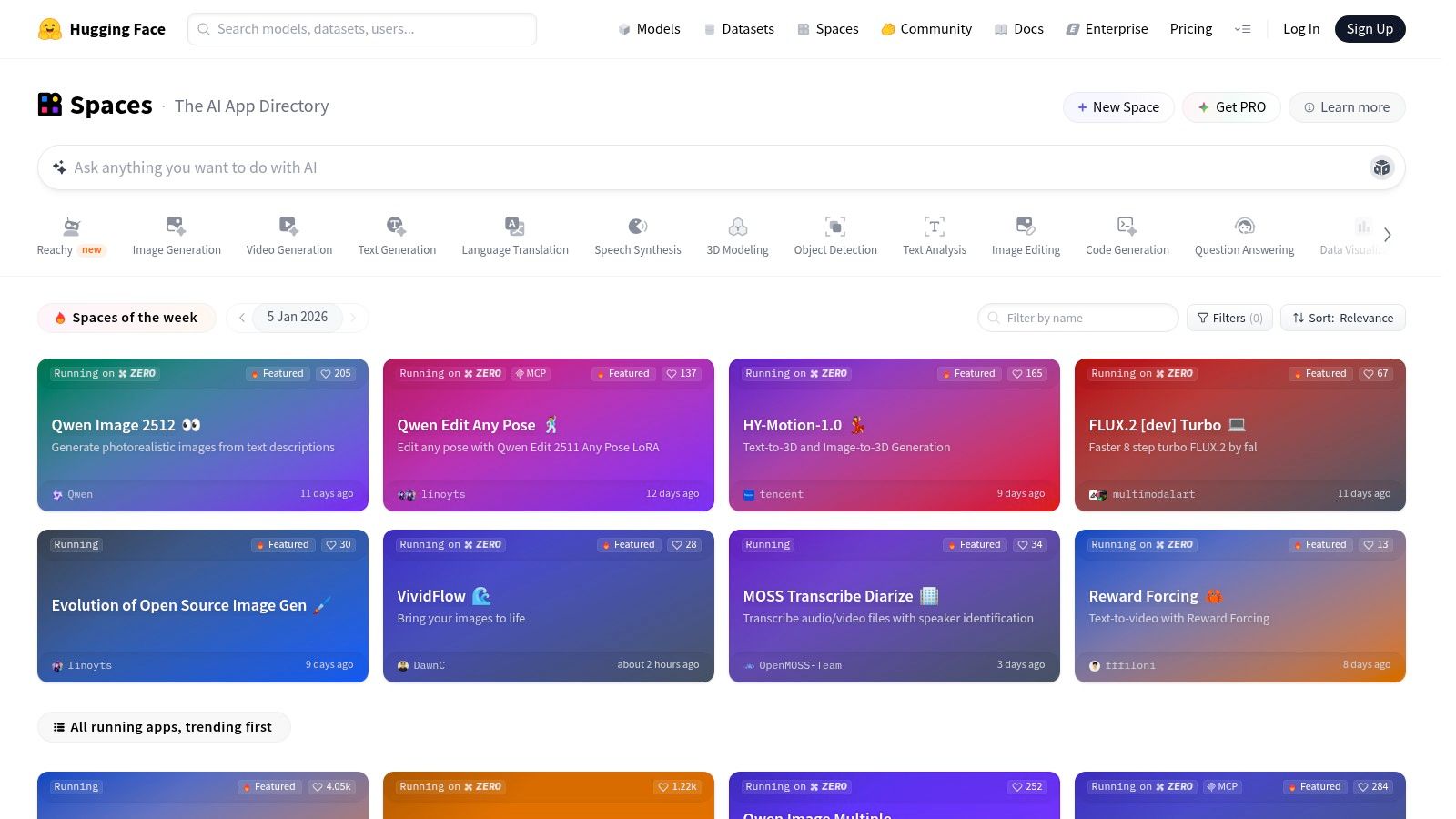
For a founder exploring an AI-powered feature, Hugging Face Spaces is an invaluable discovery tool. You can interact with thousands of open-source models, from text generation to image analysis, often built with simple Python libraries like Gradio or Streamlit. This allows for rapid validation of ideas before committing to complex development cycles.
Strategic Analysis: The Interactive AI Prototyping Ground
Hugging Face Spaces demonstrates Python's dominance in the AI and machine learning landscape. The platform itself leverages Python extensively, but its true power lies in how it enables the Python community to quickly turn complex models into accessible web applications.
- How Python is Used: The vast majority of apps ("Spaces") are built with Python. They typically use a machine learning framework like PyTorch or TensorFlow, combined with a UI library like Gradio or Streamlit to create the interactive front-end.
- Key Architecture: A Space is essentially a Git repository containing code and a specification file (like
requirements.txt) that runs inside a Docker container. Hugging Face manages the orchestration, providing free CPU tiers and optional paid GPU upgrades for more demanding applications. - Scalability: While the free tier is designed for demos and may sleep due to inactivity, the platform offers paid hardware options. This allows a popular demo to scale its compute resources on demand, handling increased user traffic without requiring a full infrastructure migration.
Key Insight for Founders: Instead of building an AI feature from a theoretical concept, you can use Spaces to find an existing, functional model. Your team can then "duplicate" the Space, analyze its Python code, and adapt the underlying model for your specific use case, drastically de-risking your AI development roadmap.
Actionable Takeaways
Founders can leverage Hugging Face Spaces for more than just inspiration; it's a practical tool for product strategy.
- Validate Features Instantly: Before scoping a new AI feature, search Spaces for existing implementations. Interacting with a live demo provides immediate feedback on user experience and technical feasibility, saving countless hours of internal R&D.
- Scout for Talent and Tech: The creators of popular Spaces are often experts in their niche. The platform can be a recruiting ground or a place to identify the exact open-source models and libraries that will power your product.
- Prototype with Low-Code Python: Empower your technical team to use Gradio or Streamlit to build an interactive prototype on Spaces in just a few hours. This is faster than wireframing and provides a functional tool for gathering early user feedback.
Website: https://huggingface.co/spaces
3. Streamlit Community Cloud – Explore Gallery
The Streamlit Community Cloud is a platform where developers can deploy and share interactive web applications built entirely in Python. Its Explore Gallery is a curated showcase of these community-built apps developed with python, ranging from sophisticated AI-powered resume analyzers to complex data dashboards. For founders, it's a live, interactive portfolio of what Python can achieve in a web browser with minimal code.
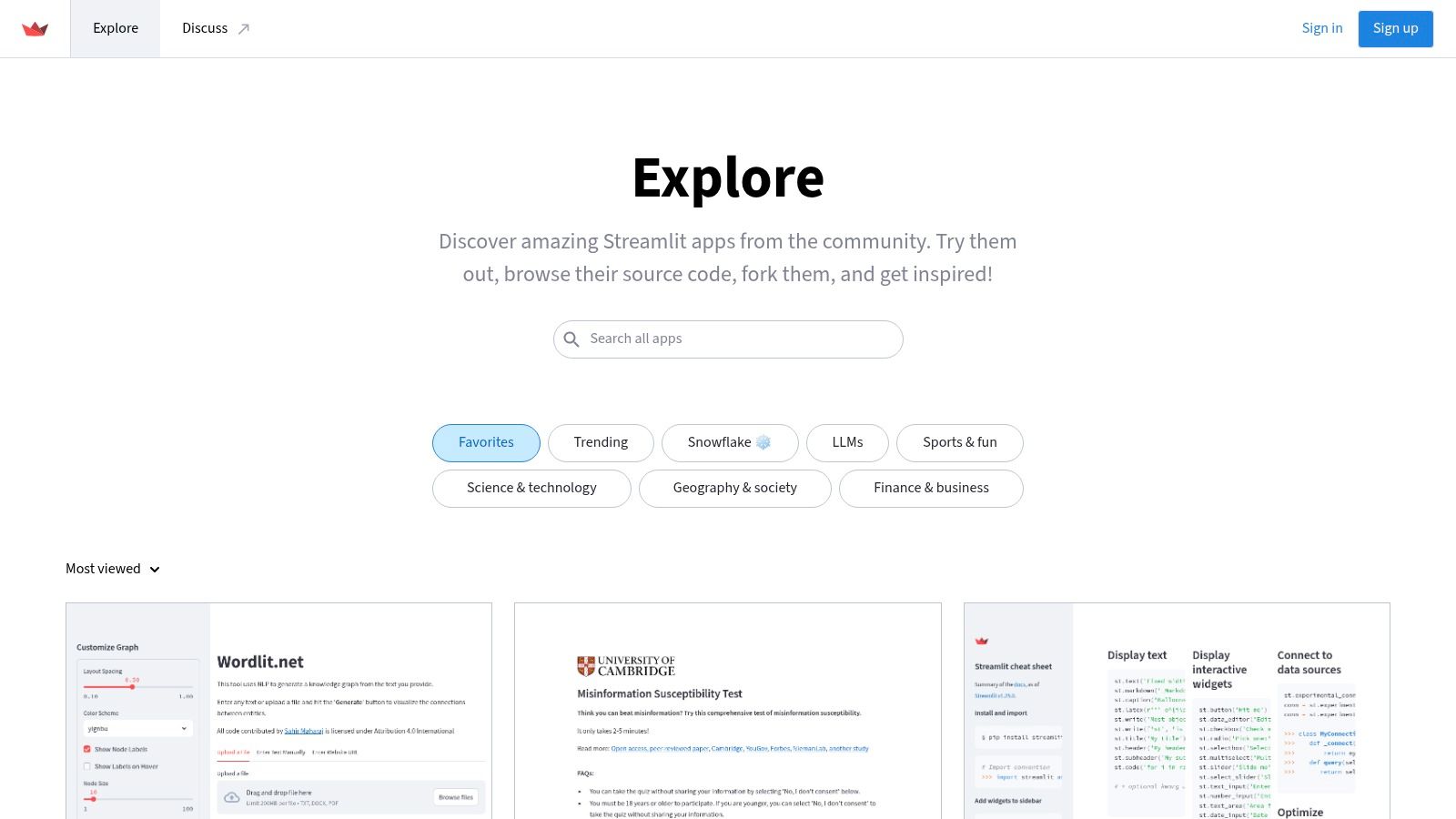
Unlike traditional web applications that require separate frontend and backend development, Streamlit allows a single Python script to generate a full-featured user interface. The gallery lets you test these apps directly in your browser with no setup, and most link directly to their source code on GitHub, offering a transparent look into how they were built.
Strategic Analysis: The Rapid Prototyping Engine
Streamlit itself exemplifies Python's power for rapid application development. It turns data scripts into shareable web apps, making it an invaluable tool for building internal tools, data visualizations, and minimum viable products (MVPs) for AI-driven features.
- How Python is Used: Streamlit apps are pure Python. The framework handles all the complexity of rendering web components (sliders, buttons, charts) and managing state, allowing developers to focus solely on the application's logic.
- Key Architecture: A Streamlit app runs a Python script on a server. When a user interacts with the app, the entire script re-runs, and Streamlit cleverly calculates the minimal changes needed to update the frontend. This simple execution model makes development incredibly fast.
- Scalability: While a single Streamlit app is not designed for massive concurrent user loads like a Django or FastAPI application, its purpose is different. It excels at quickly creating and deploying tools for smaller teams or for public-facing demos that prove a concept.
Key Insight for Founders: Before investing heavily in a custom React frontend for a new data-driven feature, your team can build a fully functional prototype with Streamlit in days, not weeks. This allows you to validate ideas with real users and gather feedback much earlier in the development cycle.
Actionable Takeaways
For non-technical founders, the Streamlit Gallery is a powerful resource for ideation and scoping.
- Explore for Inspiration: Browse the gallery to see how other companies are solving problems with Python. You can find everything from financial modeling tools to machine learning demos, providing concrete examples to discuss with your development team.
- Prototype Internal Tools: If your team is hitting the limits of spreadsheets or Airtable, task a developer with building a simple Streamlit app. This can centralize a data-heavy workflow, providing a custom solution without the overhead of a large-scale project. For a better understanding of how these pieces fit together, explore these software architecture best practices.
- Use it for Technical Vetting: Ask potential technical hires to build and deploy a simple Streamlit app as part of the interview process. It’s a fast and effective way to assess their Python skills and ability to deliver a functional product.
Website: https://share.streamlit.io/explore
4. Odoo Apps Store
The Odoo Apps Store is the official marketplace for modules and extensions for Odoo, a powerful open-source suite of business management software written in Python. It's a prime example of a platform enabling other apps developed with python to thrive within a specific ecosystem. For businesses running on Odoo, this store is the go-to resource for adding functionality like advanced accounting, CRM, e-commerce, and inventory management.
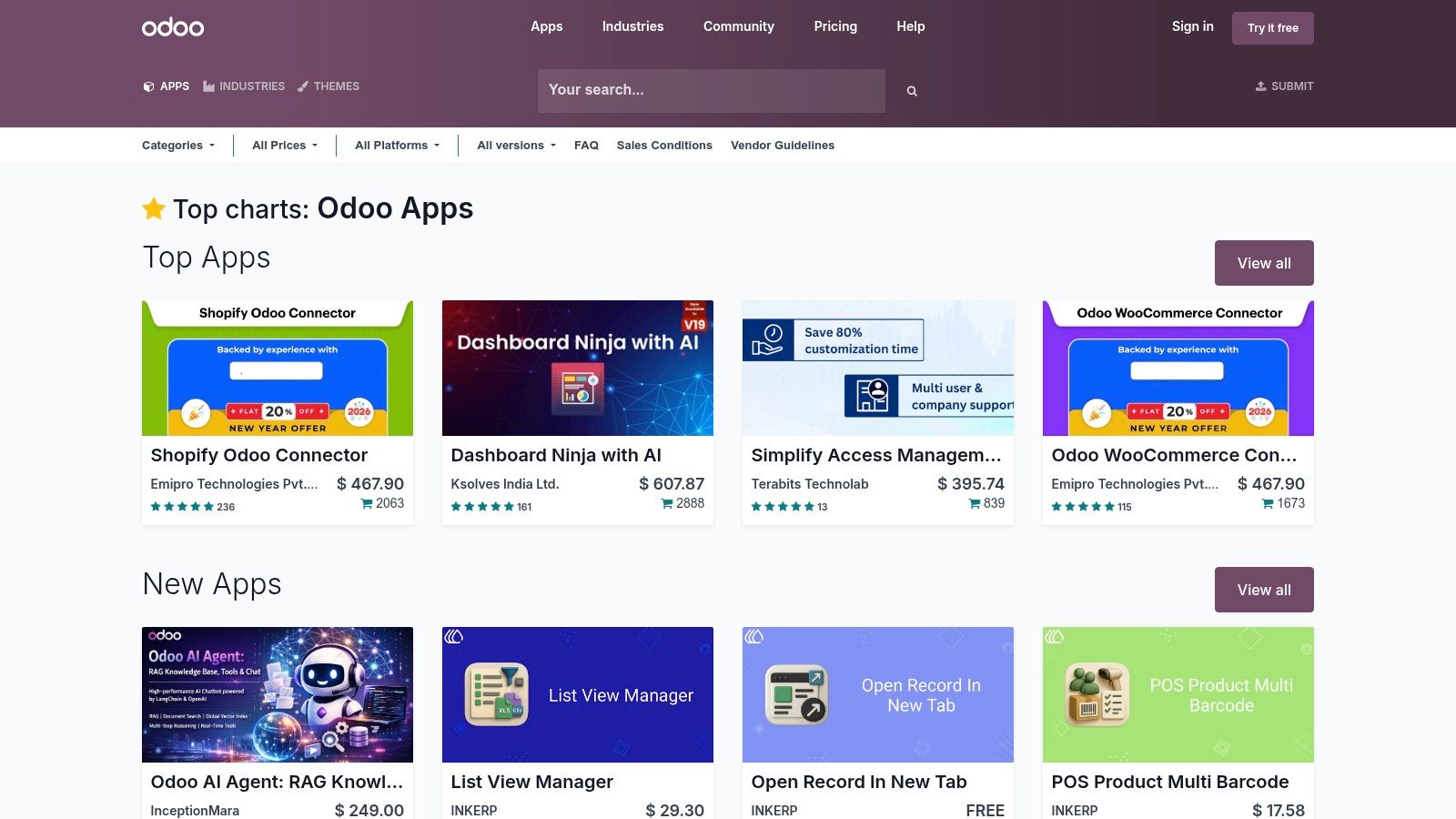
Unlike PyPI which houses general-purpose libraries, the Odoo Apps Store provides production-ready business applications. Founders migrating from a patchwork of tools like Airtable and Zapier can see Odoo as a unified, Python-based alternative. The app store allows them to extend a solid foundation rather than building every business process from the ground up.
Strategic Analysis: The "Business OS" Extension Hub
Odoo itself is a comprehensive ERP built with Python, using a PostgreSQL database and its own ORM (Object-Relational Mapping) framework. The App Store is a critical component of this ecosystem, showcasing Python's strength in building modular, extensible, and data-intensive business applications.
- How Python is Used: Every app on the store is essentially a Python package designed to integrate seamlessly with the core Odoo system. They extend existing models, create new user interfaces, and add business logic for specific operational needs.
- Key Architecture: Odoo's modular architecture is its defining feature. An "app" is a directory containing Python files, XML views, and static assets. This design allows developers to cleanly add or modify features without altering the core codebase, ensuring stability and easier upgrades.
- Scalability: Odoo is built to scale from a small business to a large enterprise. The app ecosystem supports this by allowing companies to add complexity and features incrementally as they grow, avoiding the need for a complete system overhaul.
Key Insight for Founders: Instead of duct-taping multiple SaaS tools together, you can adopt a single Python-based platform (Odoo) and use its app store to customize it precisely to your workflow. This creates a unified data source and a more cohesive, scalable operational backbone.
Actionable Takeaways
Using a third-party marketplace requires careful planning to maintain system integrity and security.
- Perform Due Diligence: The quality of apps can vary significantly by vendor. Before purchasing, check reviews, the developer's history, and compatibility with your Odoo version. Always test new modules in a staging environment first.
- Prioritize Supported Apps: Opt for apps that offer professional support and regular updates. An abandoned module can become a security risk or break during an Odoo upgrade, creating costly technical debt.
- Audit for Security: Just like with PyPI packages, third-party Odoo modules can introduce vulnerabilities. It's crucial to follow security best practices for your web applications and have your development team review the source code of critical apps for potential issues.
Website: https://apps.odoo.com
5. CodeCanyon (Envato) – Python Scripts and Apps
CodeCanyon is a commercial marketplace where developers sell pre-built scripts, plugins, and web applications. It serves as a valuable resource for finding turnkey apps developed with python, ranging from Django-based SaaS starters and automation tools to specialized data processing utilities. Unlike PyPI's open-source libraries, CodeCanyon offers ready-to-deploy products for a one-time fee.
For a founder looking to accelerate development, this platform provides a middle ground between a no-code tool and a fully custom build. You can purchase a script that handles 90% of a required feature set, such as a customer support portal or a content management system, and then have your development team customize the remaining 10% to fit your unique business logic.
Strategic Analysis: A Marketplace for "App Blueprints"
CodeCanyon is less about foundational components and more about providing functional "app blueprints." You are essentially buying source code that you can host and modify, offering a significant head start on development.
- How Python is Used: The platform hosts a wide variety of Python-based applications, most commonly built with popular frameworks like Django and Flask. These range from e-commerce backends and REST API servers to specialized scrapers and desktop GUI tools.
- Key Architecture: The architecture varies by product, but most listings are complete web applications with a database schema (often PostgreSQL or MySQL), backend logic, and a user interface. Many come with deployment instructions for popular cloud hosts.
- Scalability: The scalability of a purchased script depends entirely on its author's implementation. A well-written Django application from CodeCanyon can scale effectively, but founders must perform due diligence on the code quality before buying.
Key Insight for Founders: Instead of building a common feature from scratch (like a user management dashboard), you can buy a pre-built, documented solution for a fraction of the cost. This frees up your development budget to focus on your core, proprietary features that create real business value.
Actionable Takeaways
Using CodeCanyon effectively requires a strategic approach to vetting and integration.
- Prioritize Vetting: Before purchasing, carefully examine an item's reviews, comment history, and last-updated date. A script that hasn't been updated in years may have security vulnerabilities or rely on outdated dependencies.
- Clarify the License: Most CodeCanyon items use a license that permits use in a single end product. If you plan to use a script across multiple projects or resell it, you will likely need an extended license. Confirm this before you buy.
- Use as a Base, Not a Final Product: Treat purchased scripts as a foundation. Plan for your team to spend time reviewing the code, adapting it to your infrastructure, and customizing it to meet your specific security and feature requirements.
Website: https://codecanyon.net/search/python
6. Superhive (formerly Blender Market)
Superhive, known formerly as Blender Market, is a curated digital marketplace specifically for add-ons, scripts, and tools for the open-source 3D software, Blender. Since Blender’s scripting and add-on API is built entirely in Python, Superhive serves as a critical ecosystem hub, making it a prime example of a platform facilitating the distribution of specialized apps developed with python. It provides 3D artists and content creators with production-ready tools that extend Blender's core functionality.
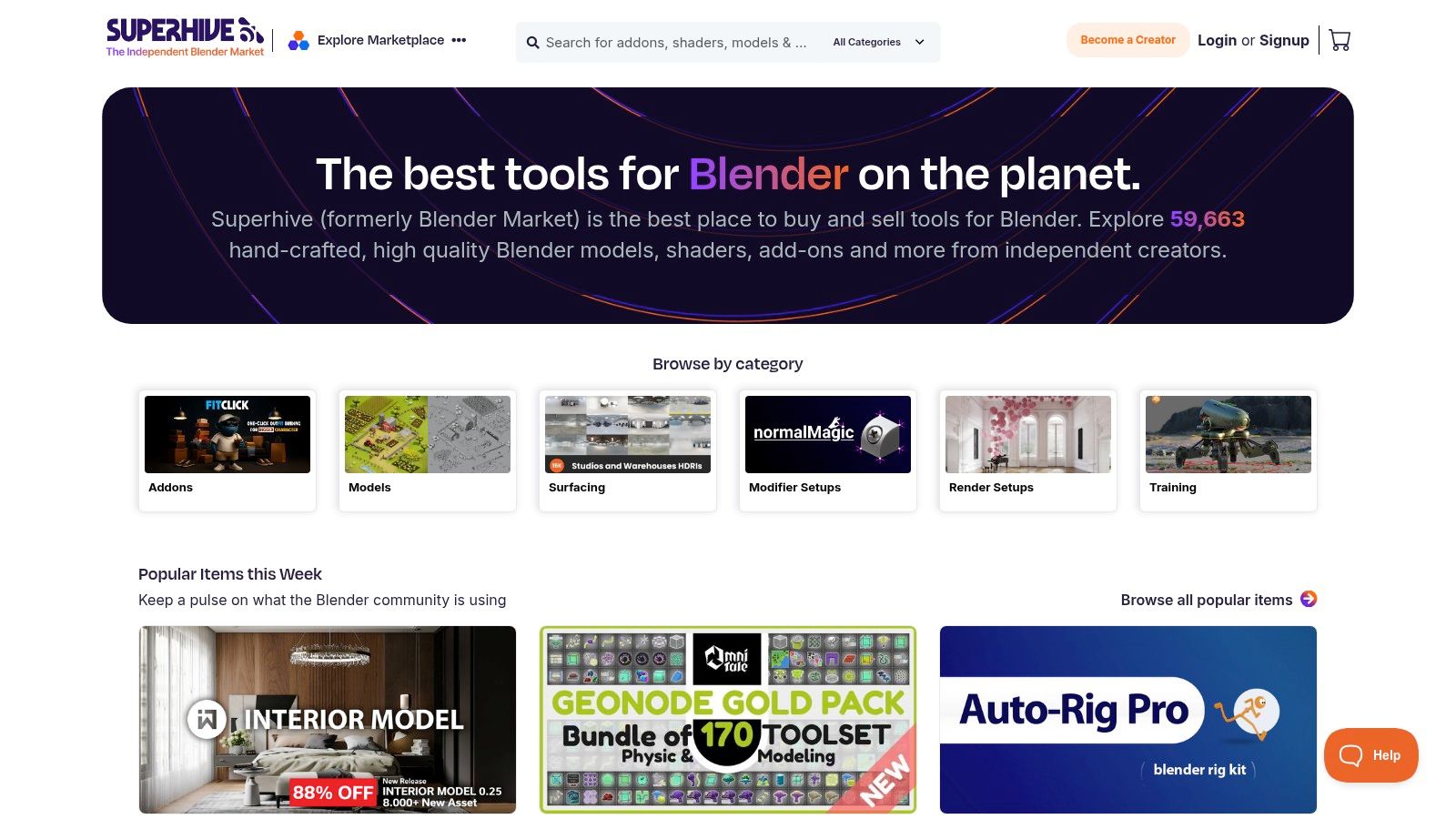
For a founder whose product involves 3D visualization, procedural content generation, or VFX workflows, Superhive demonstrates a niche but powerful application of Python. It's a marketplace where Python isn't just a backend language but the product itself, packaged into tools that solve highly specific, creative problems.
Strategic Analysis: The Specialized Toolkit for a Creative Niche
Superhive is not just a store; it’s a platform built on the extensibility of a major creative application. The add-ons sold are self-contained Python applications that hook into Blender's API, showcasing Python’s strength as a "glue language" that can augment and automate complex software. The marketplace itself is a Django application, proving Python's capability from the backend to the end-user product.
- How Python is Used: Python is the core technology of the products sold on the platform. Add-ons handle tasks like complex modeling, procedural texturing, and animation rigging. The Superhive website itself runs on Django, managing seller portals, product listings, and customer transactions.
- Key Architecture: The platform leverages the Django web framework for its robust backend, handling everything from user authentication to order processing. This choice allows for rapid development of complex marketplace features, ideal for a content-heavy, community-driven site.
- Scalability: While its user base is more niche than a general-purpose app store, the platform supports a vibrant community of thousands of creators and customers, processing transactions and delivering digital goods reliably.
Key Insight for Founders: If your business serves a highly specialized vertical that uses extensible software (like Blender, CAD programs, or scientific tools), a Python-driven marketplace can create a powerful ecosystem and a defensible business model around a core product.
Actionable Takeaways
Understanding Superhive's model can inspire new business strategies, especially for those serving niche, technical, or creative markets.
- Build an Ecosystem, Not Just a Product: If your app can be extended, create a marketplace. Using a Python framework like Django or FastAPI can accelerate the development of a platform where your community can buy and sell add-ons, creating a new revenue stream and increasing your product's stickiness.
- Leverage Python for Automation: Many products on Superhive automate repetitive, time-consuming tasks for artists. Identify similar workflow bottlenecks for your own customers. A custom Python script or tool could become a valuable, high-margin product or feature.
- Validate Niche Markets: Superhive proves that a highly focused marketplace can thrive. Before building a broad, general-purpose platform, consider if a niche-specific solution built with Python could capture a dedicated and underserved audience more effectively.
Website: https://superhivemarket.com
7. AppSeed (Django/Flask Starters and SaaS Kits)
AppSeed provides a specialized catalog of open-source and commercial app starters built with Python frameworks like Django and Flask. It serves as a launchpad for founders who need to move beyond no-code limitations by offering production-grade codebases. These starters come pre-configured with essential features like authentication, database integration, Stripe payments, and API scaffolding, making them powerful apps developed with python in their own right.
Unlike building from scratch, AppSeed allows a development team to start with a functional, deployable application. Many kits include Docker files and CI/CD pipelines, significantly reducing the initial setup time. For a founder, this means your team can immediately focus on building your unique business logic instead of reinventing common components like user sign-ups or subscription management.
Strategic Analysis: The SaaS "Boilerplate" for Your Custom App
AppSeed's value proposition is pure acceleration. By providing a pre-built yet fully customizable foundation, it bridges the gap between a no-code MVP and a fully-fledged, scalable web application. The platform itself demonstrates how to package and productize Python code effectively.
- How Python is Used: The core products are Python web applications. AppSeed offers starters built with both Django (for robust, all-in-one solutions) and Flask (for lightweight, modular microservices), showcasing Python's flexibility for different architectural needs.
- Key Architecture: A typical AppSeed starter includes a Python backend (Django/Flask), a modern frontend (React/Vue), user authentication, ORM for database interaction (e.g., SQLAlchemy), and deployment scripts (Docker, Gunicorn). This architecture mirrors what a professional team would build for a new project.
- Scalability: The starters are designed with best practices in mind, making them ready for production environments. By including Docker and CI/CD configurations, they provide a clear path for building scalable web applications from day one.
Key Insight for Founders: AppSeed isn't just a code template; it's a strategic asset. It allows you to gain full code ownership and intellectual property while slashing the time-to-market for your custom application, directly addressing the key risks of migrating from a no-code platform.
Actionable Takeaways
For founders managing the transition to a custom build, AppSeed offers a tangible starting point for your development team.
- Use Starters for Accurate Scoping: Provide your development team or agency with an AppSeed starter as a baseline. This turns abstract feature requests into concrete modification tasks, leading to more accurate project timelines and cost estimates.
- Evaluate the Tech Stack: AppSeed offers various stacks (e.g., Django with React, Flask with Vue). Discuss with your technical lead which starter best aligns with your long-term product vision and team expertise before purchasing a commercial license.
- Prioritize a "Vanilla" Starter: For your first custom build, instruct your team to select a starter with minimal UI customization. Focus first on migrating and building your core business logic on the new backend before investing heavily in frontend design.
Website: https://appseed.us
Comparison of 7 Python App Platforms
| Platform | Implementation complexity | Resource requirements | Expected outcomes | Ideal use cases | Key advantages |
|---|---|---|---|---|---|
| PyPI (Python Package Index) | Low for installing libraries (pip); variable for full apps | Minimal (local Python environment); depends on package runtime | Access to libraries, tools and versioned distributions; not always turnkey apps | Developers needing libraries, dependencies or packaging | Largest Python catalog; standard distribution and automation APIs |
| Hugging Face Spaces | Low for users; moderate for creators (Gradio/Streamlit or Docker) | Hosted browser runtime; optional paid CPU/GPU tiers for scale | Interactive, runnable web demos and ML prototypes | ML demos, interactive AI utilities, shareable prototypes | Instant browser access, strong community, scalable hardware options |
| Streamlit Community Cloud – Explore Gallery | Very low for users; moderate for creators with GitHub | Hosted Streamlit runtime with GitHub integration; limited resources | Quickly runnable dashboards and demos with source links | Dashboards, data tools, quick evaluations and demos | Very low friction, transparent source code, easy forking |
| Odoo Apps Store | Medium — requires Odoo admin/installation knowledge | Odoo server (self‑hosted or Odoo.sh); some paid modules | Production‑grade ERP modules that extend Odoo functionality | Businesses extending Odoo (accounting, CRM, e‑commerce) | ERP‑focused marketplace; vendor ecosystem; production extensions |
| CodeCanyon (Envato) – Python Scripts and Apps | Low to medium — purchase then deploy/customize | Local/server hosting; license management via Envato | Commercial scripts and apps ready to customize or deploy | One‑off utilities, web starters, niche automation tools | Verified checkout, demos, author support and licensing |
| Superhive (Blender Market) | Low for users installing add‑ons; creators follow Blender API | Blender desktop environment; typically local workstation | Curated Blender add‑ons and Python scripts for 3D workflows | 3D artists, VFX, content‑creation pipelines needing plugins | Curated, quality‑checked Blender‑specific marketplace |
| AppSeed (Django/Flask Starters and SaaS Kits) | Moderate — starterkits provide scaffolding but need adaptation | Developer resources to customize and deploy; often include Docker/CI | Production‑grade starters (auth, payments, CI) to accelerate app delivery | Teams building Django/Flask apps, SaaS MVPs and dashboards | Speeds development with complete starters; full source and deployment scaffolding |
From No-Code Limits to Scalable Assets: Your Next Move
Our journey through diverse marketplaces and platforms like PyPI, Hugging Face Spaces, and the Odoo Apps Store reveals a powerful, unifying thread: Python is the ultimate enabler for founders ready to scale beyond their initial no-code MVP. The examples we’ve explored are not just showcases of technical prowess; they are strategic roadmaps for transforming a constrained no-code project into a valuable, proprietary technology asset.
From the rapid prototyping power of Streamlit to the full-stack SaaS kits from AppSeed, the evidence is clear. The limitations you’re facing with platform lock-in, escalating Zapier costs, or an Airtable database struggling under load are not permanent roadblocks. They are signals that it's time to transition to a custom backend. Building with Python means you're not just fixing a problem; you're investing in a foundation that is secure, scalable, and entirely your own.
Key Strategic Takeaways
The most successful apps developed with python share a common DNA. They leverage the language's strengths to solve specific business problems, creating moats that are difficult for competitors to cross.
- Own Your IP: Moving from a no-code platform to a custom Python backend converts your operational processes into tangible intellectual property. This is a critical factor for attracting venture capital and increasing your company's valuation.
- Embrace Modularity: Python’s ecosystem, exemplified by PyPI and the Django framework, thrives on reusable components. This allows you to build complex features like user authentication, payment processing, and data dashboards faster and more reliably than stitching together third-party no-code services.
- Prepare for Scale: Platforms like Hugging Face and Superhive demonstrate how Python handles massive user loads and complex computations. A Python backend built on a robust database like PostgreSQL ensures your application won't falter during a viral traffic spike, unlike many no-code solutions.
- Reduce Operational Fragility: A custom backend replaces a complex web of brittle automations with a single, coherent system. This dramatically reduces maintenance overhead, eliminates points of failure, and cuts down on exorbitant subscription fees for multiple SaaS tools.
Your Action Plan for Migration
Transitioning from no-code to code doesn't have to be an intimidating leap. It’s a calculated step toward building a more powerful and defensible business.
- Audit Your Bottlenecks: Identify the exact points where your current no-code stack is failing. Is it the database performance, the cost of integrations, the lack of custom features, or security concerns?
- Define Your Core Logic: Map out the essential business logic that makes your product unique. This is what needs to be translated from brittle automations into a clean, efficient Python backend.
- Choose the Right Stack: Based on your needs, select the appropriate framework. Django is excellent for complex, database-driven applications requiring robust security, while Flask or FastAPI are ideal for lighter, API-focused services.
- Find a Technical Partner: For non-technical founders, partnering with a development team that specializes in this migration is crucial. Look for a partner who understands both the limitations of no-code and the strategic advantages of building apps developed with python.
Ultimately, making the move to Python is about taking control of your company's destiny. It's about building a future-proof asset that can grow with your vision, not a temporary solution that constrains it. The flexibility, power, and scalability of Python provide the bedrock you need to build a truly significant and lasting enterprise.
If you’re ready to transition from a fragile no-code project to a production-grade application, consider a partner who specializes in this exact migration. First Radicle turns Bubble, Webflow, and Airtable projects into scalable, investor-ready Python apps in just six weeks, giving you the robust foundation needed to scale your vision. Learn more about our process at First Radicle.