
What Is the Best Framework for React? 7 Top Picks for 2026
The React ecosystem has evolved far beyond a simple client-side library. For founders and engineering teams, the initial decision of selecting the best framework for React is a critical inflection point that dictates scalability, performance, and long-term maintainability. This choice is especially crucial for startups graduating from no-code MVPs on platforms like Bubble or Webflow, or for teams hitting the operational limits of tools like Airtable and Zapier. Moving to a production-grade stack means building defensible IP, and your framework choice is the foundation.
This guide provides a direct, opinionated comparison of leading React frameworks to help you make the right architectural bet. We move past the basics to analyze the practical implications of adopting Next.js versus Remix, or when a full-stack solution like RedwoodJS might be a better fit than a more traditional setup. You will learn how each framework handles core production challenges like data fetching, server-side rendering, code splitting, and deployment.
We will dive deep into the specific pros and cons relevant to a growing business, from securing user authentication and payment processing to optimizing for SEO and core web vitals. We'll explore which framework offers the best developer experience for a small team and which one is built to handle viral user growth without collapsing. Each section provides actionable insights and clear recommendations tailored to specific use cases, helping you choose a stack that supports your company's immediate needs and future ambitions.
1. Next.js
Next.js, maintained by Vercel, stands as the most established and widely adopted production framework for React. It provides a robust, opinionated structure for building everything from static marketing sites to complex, dynamic web applications. For startups migrating from no-code platforms or needing a production-grade stack, Next.js offers a battle-tested foundation with an unparalleled ecosystem, solidifying its place as a top contender for the best framework for React.
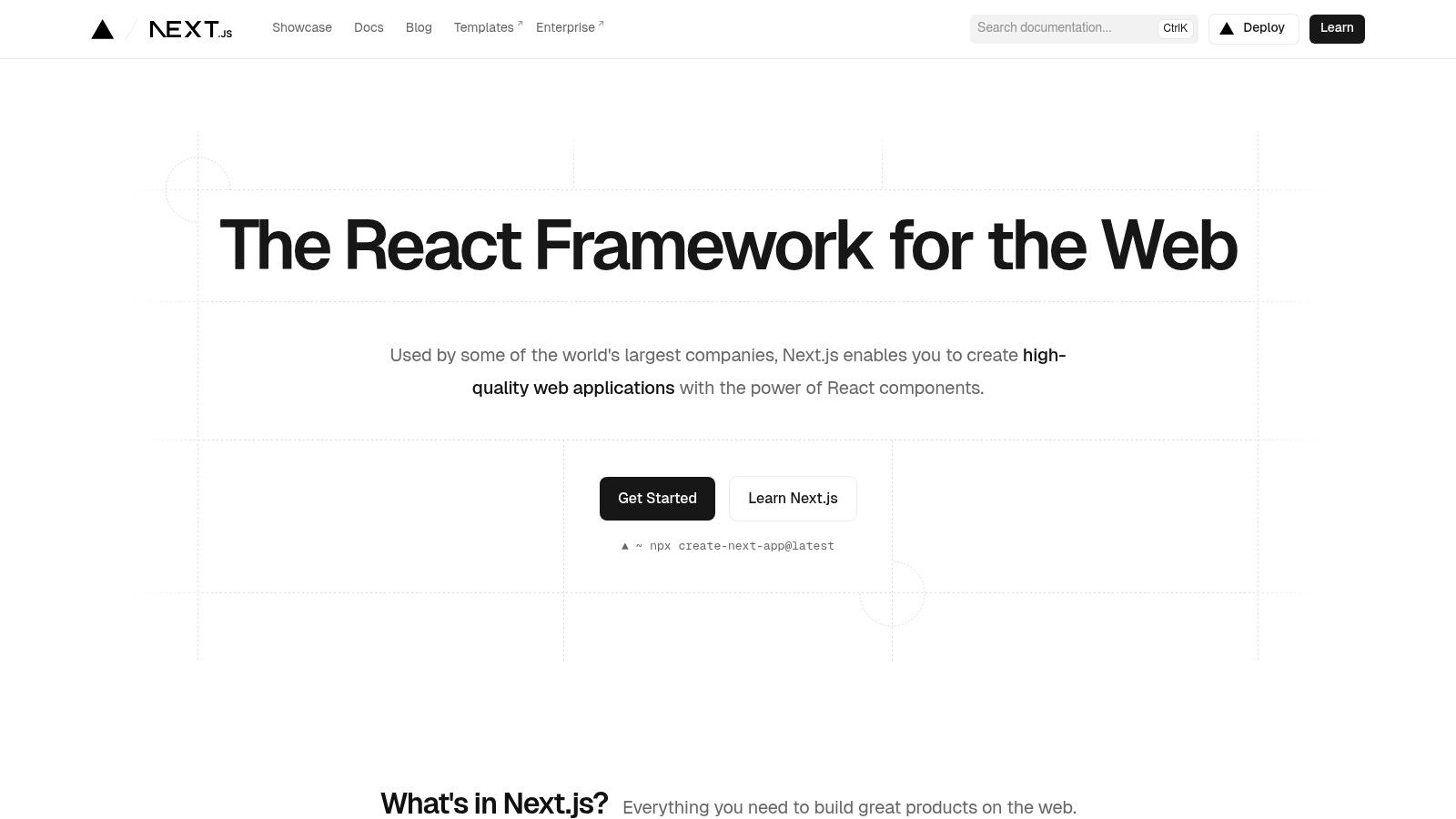
The framework's core strength lies in its hybrid rendering capabilities, allowing developers to choose the optimal rendering strategy on a per-page basis: Server-Side Rendering (SSR) for dynamic content, Static Site Generation (SSG) for fast, cacheable pages, and Incremental Static Regeneration (ISR) to update static content without a full rebuild. This flexibility is crucial for building performant applications that scale effectively.
Key Features and Strengths
The introduction of the App Router marked a significant evolution, bringing React Server Components (RSC) to the forefront. This modern approach allows components to render exclusively on the server, reducing the client-side JavaScript bundle size and improving initial load times.
- App Router: Enables advanced features like nested layouts, server-side data fetching directly within components, and streaming UI for a better user experience.
- File-System Routing: Simplifies page creation. Creating a file within the
apporpagesdirectory automatically generates a corresponding route, accelerating development. - Built-in Optimizations: Next.js includes automatic code splitting, image optimization with the
<Image>component, and font optimization to ensure high performance out of the box.
Ideal Use Cases and Considerations
Next.js excels in scenarios requiring both SEO performance and dynamic user interactivity, making it ideal for e-commerce platforms, content-heavy marketing sites, and full-stack applications. The seamless deployment experience on Vercel is a major draw, offering a zero-configuration CI/CD pipeline, preview deployments for every Git push, and global edge network delivery.
However, the power of the App Router and its associated concepts like RSC and Server Actions introduces a steeper learning curve compared to simpler client-side React setups. For small, simple applications or teams unfamiliar with server-side concepts, the framework's complexity can feel like overkill.
Expert Insight: For founders building a scalable product, Next.js provides the architectural integrity needed for long-term growth. Its server-centric patterns are fundamental to building scalable web applications that can handle complex business logic and growing user bases.
Website: https://nextjs.org
2. Remix
Remix, now maintained by Shopify, presents a compelling alternative to Next.js by focusing on web standards and fundamentals. It is a full-stack, server-rendered React framework designed to deliver resilient, fast user experiences by leveraging the power of the server and native browser features. For teams that value progressive enhancement and want a framework that feels closer to the web platform itself, Remix offers a refreshing and powerful approach, making it a strong candidate for the best framework for React.
The framework's philosophy centers on embracing the client-server model. Data mutations are handled through standard HTML forms and HTTP methods, which means applications can work even before JavaScript loads. This architecture simplifies data management, eliminates complex client-side state, and ensures that core functionality is robust and accessible by default.
Key Features and Strengths
Remix’s standout feature is its routing system, which deeply integrates data loading, mutations, and error handling. Each route can define a loader function to fetch data on the server and an action function to handle submissions, creating a clear and co-located data flow that is easy to reason about.
- Nested Routes: Allows parent routes to provide a layout for child routes, which can load their data in parallel. This prevents "waterfall" network requests and enables faster, more granular UI updates.
- Data Loaders & Actions: Simplifies data fetching and mutations.
loaderfunctions run on the server before a component renders, whileactionfunctions handle form submissions, seamlessly revalidating data and updating the UI. - Built-in Error Handling: Each route can export an
ErrorBoundarycomponent, creating resilient UIs where an error in one part of the page doesn't crash the entire application.
Ideal Use Cases and Considerations
Remix is an excellent choice for content-driven sites and complex web applications where data workflows and form submissions are central, such as dashboards, e-commerce checkouts, and internal tools. Its emphasis on web standards makes it highly durable, and its deployment-agnostic nature provides flexibility, with first-party starters for Vercel, Netlify, Fly.io, and more, preventing vendor lock-in.
However, its ecosystem is smaller and less mature than that of Next.js. While the community is growing rapidly, finding third-party libraries, tutorials, and "recipes" for specific problems can be more challenging. Teams accustomed to the vast resources available for Next.js might find the transition requires a greater reliance on official documentation and first-principles thinking.
Expert Insight: Remix's focus on server-centric data mutations and web fundamentals aligns well with building robust, long-lasting applications. Its architecture is a great example of the principles discussed in guides to the best web frameworks, where durability and maintainability are key.
Website: https://remix.run
3. Gatsby
Gatsby has carved out a powerful niche as a React-based framework optimized for content-rich, high-performance websites. Acquired by Netlify, it remains a premier open-source choice for developers building marketing sites, documentation portals, and blogs that demand speed and reliability. For startups whose core product relies on delivering content efficiently, Gatsby provides a mature ecosystem and a streamlined developer experience, making it a strong candidate for the best framework for React in content-centric scenarios.
The framework's primary strength is its powerful data layer, which uses GraphQL to pull data from any source-headless CMSs, APIs, Markdown files-during the build process. This data is then used to generate a full suite of static HTML, CSS, and JavaScript files. The result is a pre-built site that can be served from a global CDN, offering exceptional load times, improved SEO, and a resilient architecture with minimal server-side dependencies.
Key Features and Strengths
Gatsby's ecosystem is designed to accelerate the development of content-driven websites. Its extensive plugin library handles common needs like image optimization, sourcing from different CMS platforms, and integrating analytics, often with just a few lines of configuration.
- Powerful Data Layer: Leverages GraphQL to unify data from multiple sources, providing a consistent and predictable way to manage content across your application.
- Rich Plugin and Theme Ecosystem: Offers thousands of plugins for sourcing data, transforming content, and adding features. Themes provide reusable, composable site patterns to jumpstart development.
- Performance by Default: Gatsby automatically implements performance best practices, including code splitting, inlining critical CSS, and pre-loading resources for subsequent pages, ensuring a fast user experience.
Ideal Use Cases and Considerations
Gatsby is the go-to framework for projects where content is the star. It is perfectly suited for company blogs, marketing websites, e-commerce storefronts (especially those using a headless CMS like Shopify), and documentation sites. The deep integration with Netlify offers a seamless CI/CD and hosting experience, simplifying the deployment pipeline from development to production.
However, Gatsby's build-time data-sourcing model makes it less ideal for highly dynamic applications that require real-time data fetching on the client side. While it supports client-side rendering for such use cases, newer frameworks built around React Server Components may offer more ergonomic patterns for complex, full-stack applications. For teams primarily focused on static content, Gatsby's focused approach remains a significant advantage.
Expert Insight: When building content-heavy platforms, data integrity is paramount. Gatsby's build-time data sourcing provides a secure snapshot of your content, which complements robust security best practices for web applications by reducing the attack surface area of a live database connection.
Website: https://www.gatsbyjs.com
4. RedwoodJS
RedwoodJS positions itself as an opinionated, full-stack framework designed to take you from idea to MVP and beyond with unprecedented speed. Combining React with GraphQL, Prisma, and TypeScript, it offers a "batteries-included" experience that is particularly appealing for startups and teams building greenfield applications. For founders needing to quickly build a robust, production-ready product, RedwoodJS provides a guided path, making it a strong candidate for the best framework for React.
The framework's core philosophy is to simplify the developer experience by making key architectural decisions for you. It seamlessly integrates a React frontend with a GraphQL API layer powered by a Prisma-connected database, typically PostgreSQL. This integrated setup eliminates the significant overhead of wiring together disparate technologies, allowing teams to focus on building features rather than configuring infrastructure.
Key Features and Strengths
RedwoodJS shines with its powerful command-line interface (CLI) and code generators, which automate common development tasks. From scaffolding entire pages to generating database schemas and API services, these tools dramatically accelerate the development workflow and enforce consistent conventions across the codebase.
- End-to-End Scaffolding: Use simple CLI commands to generate pages, layouts, GraphQL schemas, and database migrations. This feature drastically reduces boilerplate and ensures best practices from the start.
- Opinionated Full-Stack Conventions: RedwoodJS provides a clear, conventional structure for your entire application, including built-in testing with Jest, Storybook for component development, and streamlined deployment guides.
- Tutorial-Driven Documentation: The framework is famous for its comprehensive, tutorial-led onboarding process, which guides developers through building a complete application, making the learning curve much more manageable.
Ideal Use Cases and Considerations
RedwoodJS is an excellent choice for startups and small teams that need to ship a full-stack product quickly without getting bogged down in architectural debates. Its guided, convention-over-configuration approach is perfect for building MVPs, internal tools, and SaaS applications where development velocity is a top priority. The integrated nature of the stack simplifies everything from authentication to data fetching.
However, this opinionated nature can also be a limitation. Teams that require a more flexible or bespoke architecture may find Redwood's conventions restrictive. Its ecosystem, while growing, is smaller than that of Next.js, meaning fewer third-party integrations and community resources are available. The framework is also actively exploring React Server Components, indicating its commitment to modern React patterns.
Expert Insight: Redwood's "Cells" concept is a game-changer for data fetching. A Cell is a declarative component that handles the entire lifecycle of fetching data, including loading, empty, error, and success states, which significantly simplifies managing asynchronous UI.
Website: https://redwoodjs.com
5. Blitz.js
Blitz.js positions itself as "The Missing Fullstack Toolkit for Next.js," aiming to bring the productivity and conventions of frameworks like Ruby on Rails to the React ecosystem. It's not a standalone framework but an opinionated layer built directly on top of Next.js, designed to streamline the development of full-stack applications by eliminating the need for a separate API layer. For teams who love the power of Next.js but want to accelerate development, Blitz offers a compelling set of tools, making it a unique contender for the best framework for React when speed is paramount.
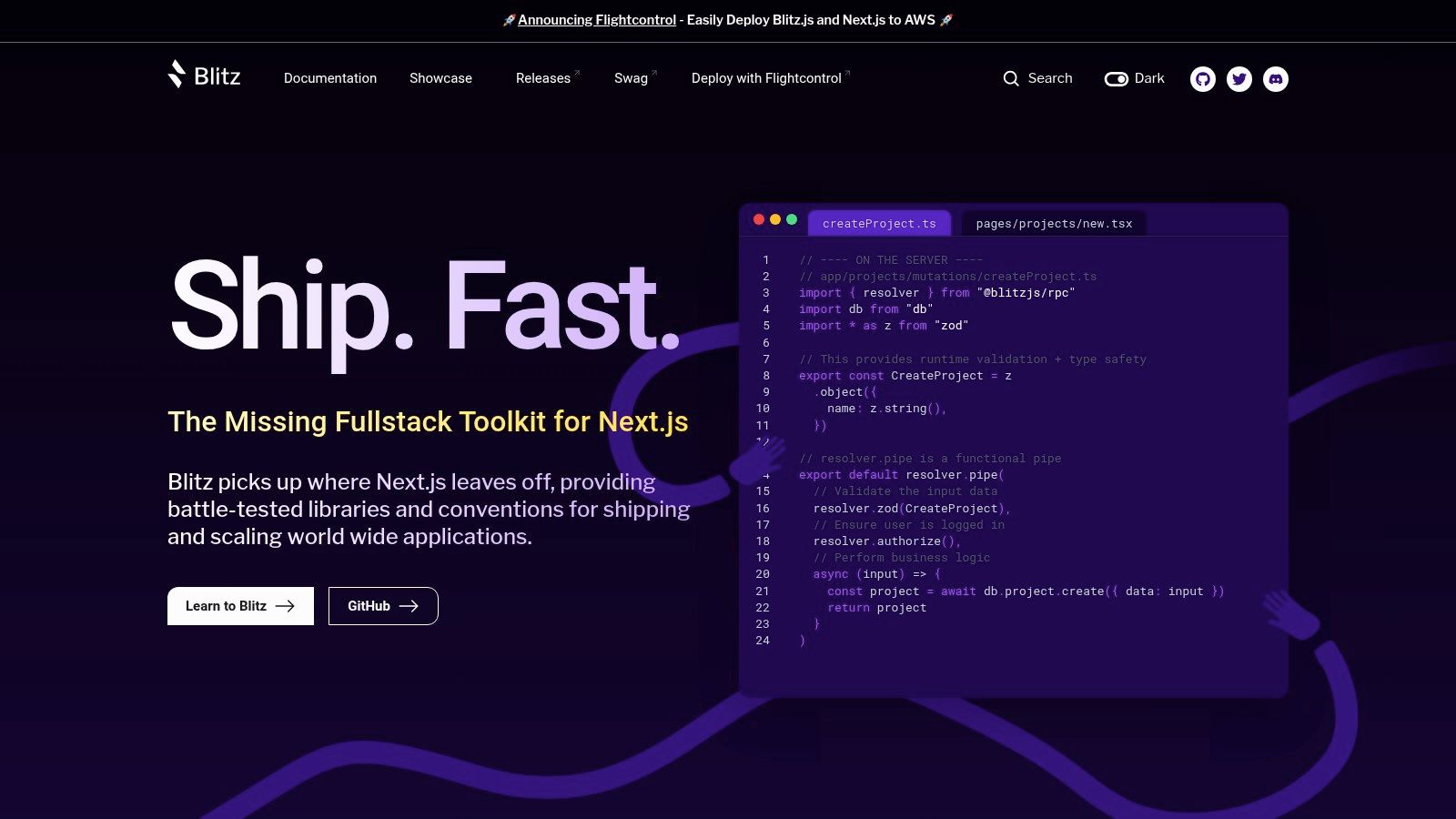
The core innovation of Blitz.js is its "Zero-API" data layer. This allows you to import server code directly into your React components as if it were running in the browser. Blitz handles the behind-the-scenes work of creating an API endpoint, managing serialization, and fetching the data, providing a seamless, fully typesafe data-fetching experience without writing any API code. This approach drastically reduces boilerplate and simplifies the mental model for building features.
Key Features and Strengths
Blitz enhances the Next.js foundation with powerful code generation and conventions that enforce a consistent project structure, which is invaluable for growing teams. Its command-line interface (CLI) and "Recipes" feature automate the integration of common tools and libraries, saving significant setup time.
- Zero-API Data Layer: Import server code directly into components, enabling full-stack, end-to-end type safety with zero manual API setup.
- Code Scaffolding: Use the
blitz generatecommand to rapidly create everything needed for a data model, including Prisma schemas, queries, and mutations. - Built-in Authentication: Comes with a robust, session-based authentication system out of the box, covering sign-up, login, and password reset functionalities.
- Recipes: A single command like
blitz install tailwindcan automate the entire process of adding and configuring a new library, including package installation and code modifications.
Ideal Use Cases and Considerations
Blitz.js is an excellent choice for startups and teams that want to build monolithic, full-stack Next.js applications with maximum velocity. It is particularly well-suited for projects that would traditionally require a separate Node.js backend, as it unifies the frontend and backend logic into a single, cohesive codebase. This is ideal for internal tools, SaaS products, and any application where rapid feature development is a top priority.
However, because Blitz is tightly coupled with Next.js, its value is confined to that ecosystem. For teams building microservices or preferring to maintain a strict separation between their frontend and backend APIs, the "Zero-API" approach might feel too monolithic. It adds another layer of abstraction, which could be a hurdle for developers who are not yet comfortable with Next.js itself.
Expert Insight: For founders who need to move incredibly fast without sacrificing the power of a production-grade stack, Blitz provides a Rails-like development experience. This is especially valuable when transitioning from a no-code MVP, as it provides the structure and automation needed to build a complex, data-driven application quickly.
Website: https://blitzjs.com
6. Frontend Masters
While not a framework itself, Frontend Masters is an indispensable resource for teams deciding which production-grade stack to adopt. It’s a premium learning platform offering in-depth workshops on React and its ecosystem, taught by practicing industry experts. For founders and engineering leads, it provides the structured, high-quality knowledge needed to evaluate options like Next.js or Remix and determine the best framework for React for their specific business needs.
The platform's value lies in its curated, up-to-date content that cuts through the noise of scattered tutorials and blog posts. Instead of just learning syntax, the courses dive deep into the architectural patterns, performance trade-offs, and practical implementation details of modern frameworks. This expert-led guidance is crucial for teams migrating from no-code tools, helping them understand the underlying principles before committing to a technical direction.
Key Features and Strengths
Frontend Masters organizes content into clear learning paths, allowing teams to systematically build expertise. You can go from foundational React concepts to advanced server-side rendering patterns in Next.js, all within a single, cohesive platform. The frequent content updates ensure that the material stays relevant as frameworks evolve.
- Expert-Led Workshops: Courses are taught by renowned professionals who work with these technologies daily, including core contributors and senior engineers from top tech companies.
- Structured Learning Paths: Guided paths help individuals and teams master a subject from the ground up, providing certificates of completion.
- High-Signal Content: The platform focuses on depth over breadth, ensuring every course delivers vetted, practical insights without filler.
- Offline Access: iOS and Android apps allow for offline playback, making it convenient for learning on the go.
Ideal Use Cases and Considerations
This platform is ideal for engineering teams that need to upskill quickly and make an informed framework decision. It’s also invaluable for non-technical founders who want to grasp the technical landscape and participate meaningfully in architectural discussions. By investing in this education upfront, teams can avoid costly rewrites and architectural mistakes down the line.
The primary consideration is the subscription-only model; courses cannot be purchased individually, and there is no free trial for the paid tiers. However, for a team serious about building a scalable product, the cost is a small investment compared to the price of choosing the wrong technical stack. The platform is also available to students via the GitHub Student Developer Pack.
Expert Insight: Before locking in your tech stack, have your team complete the relevant learning path on Frontend Masters. The clarity gained on complex topics like Server Components versus traditional SSR will directly inform your architectural choices and de-risk your migration from a no-code MVP.
Website: https://frontendmasters.com
7. Udemy
While not a framework itself, Udemy is an indispensable resource for teams deciding on the best framework for React. This massive online course marketplace provides extensive, on-demand video content covering Next.js, Remix, Gatsby, and the entire React ecosystem. For founders and teams transitioning from no-code platforms, Udemy offers a budget-friendly, self-paced way to gain practical skills before committing to a specific technology stack.
The platform's primary advantage is its sheer volume and variety. You can find multiple courses on the same topic from different instructors, each with a unique teaching style and project focus. This allows learners to compare methodologies and find an approach that resonates with their team's learning preferences, from deep-dive theoretical courses to hands-on, project-based tutorials where you build a full-stack application from scratch.
Key Features and Strengths
Udemy's model is built around accessibility and practical application. Many of its most popular React framework courses guide students through building real-world projects, such as e-commerce storefronts or SaaS dashboards, providing invaluable hands-on experience that is crucial for building production-ready applications.
- Broad and Current Catalog: The platform features thousands of courses, with many instructors consistently updating their content to cover the latest features, like the Next.js App Router or Remix's evolving data-loading strategies.
- Project-Based Learning: A significant number of courses focus on learning by doing. This practical approach is ideal for teams that need to get up to speed quickly and apply new concepts directly to their product development.
- Lifetime Access Model: Most courses are sold as a one-time purchase with lifetime access, allowing team members to revisit complex topics as needed without recurring subscription fees.
Ideal Use Cases and Considerations
Udemy is perfect for startups needing to upskill their teams without a large training budget. It allows individual developers to learn a new framework or for a non-technical founder to gain a foundational understanding of the stack their team is building. The frequent and deep discounts make it an extremely cost-effective educational tool.
However, the quality of courses on Udemy can be inconsistent, as anyone can become an instructor. It is essential to vet courses by carefully reading reviews, checking the instructor's credentials, and previewing course content. The fluctuating pricing model, while often beneficial, can also be confusing, with prices for the same course varying significantly based on active promotions.
Expert Insight: For teams evaluating a migration to a new framework, purchasing a few highly-rated, project-based courses on Udemy for each contending framework can be a low-cost, high-impact way to prototype and understand the developer experience before making a final commitment.
Website: https://www.udemy.com
Top 7 React Frameworks & Resources — Comparison
| Item | Implementation complexity | Resource requirements | Expected outcomes | Ideal use cases | Key advantages |
|---|---|---|---|---|---|
| Next.js | Moderate–high (App Router concepts add complexity) | Node runtime, optional Vercel for zero‑config deploy, ecosystem libraries | Scalable production apps with SSR/RSC, hybrid SSG/SSR patterns | Enterprise apps, large teams, hybrid dynamic/static sites | Mature ecosystem, first‑class Vercel optimizations, extensive docs |
| Remix | Moderate (server‑rendered patterns, loaders/actions) | Server runtime (many hosts supported), fewer third‑party recipes | Robust server‑rendered apps with progressive enhancement and strong error handling | Apps needing nuanced routing/data flows and web‑standards focus | Web fundamentals focus, multiple deployment paths, built‑in error boundaries |
| Gatsby | Low–moderate (simple for static sites; more work for dynamic) | Build infrastructure, plugin/theme ecosystem, CMS integrations | Fast, SEO‑friendly static/content sites with rich media support | Blogs, docs, marketing and content‑heavy sites | Large starter/plugin marketplace, strong content workflow support |
| RedwoodJS | Moderate (opinionated full‑stack conventions) | GraphQL, Prisma, TypeScript, generators, opinionated stack | End‑to‑end apps and rapid MVPs with guided defaults | Startups and greenfield projects needing full‑stack scaffolding | Batteries‑included stack, code generators, tutorial‑driven onboarding |
| Blitz.js | Low–moderate (layers on Next.js with conventions) | Next.js base, Blitz recipes, TypeScript support | Rapid full‑stack apps with Rails‑like developer productivity | Teams wanting conventions within the Next ecosystem | Built‑in auth, code generators/recipes, reduces boilerplate |
| Frontend Masters | N/A (learning platform) | Subscription cost, time for courses, team training budget | Deep, up‑to‑date expertise and informed framework choices | Teams/individuals evaluating frameworks or upskilling | Expert‑led workshops, live Q&A, structured learning paths |
| Udemy | N/A (course marketplace) | Per‑course purchase or optional subscription, learner time | Practical, project‑based skills depending on course quality | Budget learning, sampling multiple instructors/approaches | Large catalog, frequent sales, lifetime access to purchased courses |
From No-Code Fragility to Production-Grade React
Navigating the landscape of modern web development can feel like choosing a path through a dense, ever-changing forest. For founders and product leaders graduating from the world of no-code platforms like Bubble and Webflow, this journey is particularly critical. You've validated your MVP, found product-market fit, and now face the daunting task of replacing a fragile, often expensive, collection of third-party tools with a scalable, defensible technology stack. The core decision in this transition is selecting the best framework for React, a choice that will fundamentally shape your application's performance, developer experience, and long-term potential.
Throughout this guide, we've dissected the industry's top contenders. We saw how Next.js has become the de facto standard for building comprehensive, full-stack applications with its powerful hybrid rendering strategies and server-side capabilities. We explored how Remix offers a compelling, web-standards-focused alternative that excels in data loading and mutation, simplifying complex user interactions. For content-heavy sites, Gatsby remains a powerhouse, pre-rendering pages into static HTML for unparalleled speed and security. Meanwhile, opinionated, full-stack frameworks like RedwoodJS and Blitz.js provide an integrated, "zero-API" experience that can dramatically accelerate development for teams that buy into their conventions.
Your Framework Decision Matrix
Choosing the right tool isn't about finding a single "best" option; it's about aligning a framework's strengths with your specific business goals and technical constraints. Your final decision should be a calculated one, balancing immediate needs with your long-term vision.
Here are the critical factors to weigh before you commit:
- Project Scope and Complexity: Are you building a content-driven marketing site, a dynamic e-commerce platform, or a complex SaaS application with real-time data needs? A static site generator like Gatsby is perfect for the first, while a feature-rich framework like Next.js or Remix is better suited for the others.
- Team Skillset: Evaluate your team's existing knowledge. A framework with a steeper learning curve or a more opinionated structure might slow down a team new to its concepts. Conversely, a highly structured framework like RedwoodJS could be a force multiplier for a small, agile team.
- Performance Requirements: Consider your performance budget. Do you need the instant-load experience of a static site, or is the dynamic, on-demand rendering of server components more critical for your application's user experience? Your rendering strategy is a direct outcome of your framework choice.
- Scalability and Long-Term Vision: Think five years ahead. Will your chosen framework and its ecosystem support the features you plan to build? Migrating frameworks is a costly and disruptive process, so choosing one with a strong community, excellent documentation, and a clear roadmap is paramount for future-proofing your investment.
Actionable Next Steps: From Theory to Implementation
You've absorbed the theory; now it's time for action. Don't let analysis paralysis stall your progress. The most effective way to validate your choice is to get your hands dirty.
- Build a Small Prototype: Take a core feature of your application-perhaps a complex form or a data-heavy dashboard-and build a proof-of-concept in your top two framework choices. This small investment of time will reveal invaluable insights into the developer experience and true capabilities of each tool.
- Evaluate the Ecosystem: Look beyond the framework itself. Investigate the libraries, authentication solutions (like Auth.js or Clerk), and deployment platforms (like Vercel or Netlify) that integrate seamlessly with your chosen stack. A strong ecosystem can save you hundreds of development hours.
- Invest in Learning: Whether you're upskilling your existing team or preparing to hire, dedicated learning is non-negotiable. Platforms like Frontend Masters and Udemy, as we've covered, offer structured paths to mastering these powerful tools, ensuring your team can leverage them to their full potential.
Ultimately, the transition from a no-code MVP to a production-grade React application is a sign of success. It means you've built something people want and are ready to invest in a foundation that can support your growth for years to come. The right framework is more than just code; it's a strategic asset that enables you to build faster, perform better, and deliver a superior experience to your users.
Making the leap from a no-code MVP to a fully-owned, scalable codebase is where most startups face their biggest technical challenge. At First Radicle, we specialize in this exact transition, migrating fragile applications to production-grade Next.js stacks in just six weeks. If you're ready to build defensible IP and a platform that can scale with your ambition, visit us at First Radicle to see how we can help you build for the future.