
Top 12 Best Frameworks for React for No-Code Founders in 2026

You've built a successful MVP on Bubble, Airtable, or Webflow, but now you’re hitting a wall. Your Zapier bills are spiraling, you're concerned about data ownership for your upcoming VC pitch, and the performance limitations of your no-code stack are becoming a serious bottleneck. It's time to transition to a production-grade, scalable solution built on React, but the ecosystem is vast and confusing. This guide is your direct path through the noise.
We’ve created a comprehensive resource list specifically for founders and product leaders in your exact position. Forget generic feature lists; this article dives deep into the best frameworks for React, evaluating each one through the lens of a no-code to full-stack migration. We analyze the practical trade-offs you'll face when moving from a platform like Airtable to a real PostgreSQL database or replacing complex integration workflows with a custom backend.
Each entry provides a clear, opinionated analysis covering:
- Best-Use Cases: Understand precisely which business problems each framework solves best.
- Migration Considerations: Get actionable insights on moving auth, payments, and core data.
- Developer Experience: Learn how each framework impacts your team's productivity and hiring potential.
- Performance & Scalability: Discover the real-world trade-offs for hosting, performance, and long-term growth.
This listicle is designed to be scannable and practical. You'll find direct links and concise breakdowns for top-tier options like Next.js, Remix, RedwoodJS, and Wasp, helping you make an informed decision on the right technical foundation for your company's next phase. Let's find the framework that will secure your intellectual property, scale your operations, and prepare your product for its next million users.
1. Next.js
Next.js is the dominant, production-grade React meta-framework, making it one of the best frameworks for React available today. Maintained by Vercel, it provides a comprehensive, opinionated structure for building full-stack applications, handling everything from routing and data fetching to server-side rendering and static site generation. For founders migrating from platforms like Bubble or Webflow, Next.js offers a direct path to an ownable, scalable, and high-performance tech stack.
Its core strength lies in its hybrid rendering capabilities. You can pre-render pages at build time for maximum speed (SSG), render them on-demand per request (SSR), or even update static content after deployment with Incremental Static Regeneration (ISR). This flexibility allows for fine-tuned performance optimization, crucial for SEO and user experience. The introduction of the App Router, React Server Components, and Server Actions has further blurred the lines between frontend and backend, enabling developers to write server-side logic directly within their components. This simplifies data mutations and reduces the need for separate API endpoints, a common pain point for teams managing integration-heavy no-code stacks.
Key Considerations for Founders
- Developer Experience & Hosting: Next.js is open-source and free to use. The developer experience is world-class, especially when paired with Vercel for hosting. Vercel’s seamless Git integration provides instant deployments, preview environments for every pull request, and a generous free tier for personal projects and small teams.
- Ecosystem & Hiring: Its immense popularity means a vast ecosystem of libraries, tutorials, and a large talent pool. Finding developers experienced with Next.js is significantly easier than for niche frameworks.
- Migration Path: For those moving from an Airtable backend, Next.js pairs natively with databases like PostgreSQL (via an ORM like Prisma). This provides the robust data querying and relational integrity that growing applications require. This framework is a top choice if you want to understand more about how the best React framework can serve your startup's needs.
| Pros | Cons |
|---|---|
| Huge ecosystem and strong community support. | App Router & RSCs have a steep learning curve. |
| First-class hosting and DX on Vercel. | Tight coupling with Vercel can influence architecture. |
| Flexible rendering strategies (SSR, SSG, ISR). | Can be overkill for simple static websites. |
Website: https://nextjs.org
2. React Router (v7)
React Router has evolved from a simple client-side routing library into a powerful tool that can function as a full-stack framework. For teams that value flexibility, React Router (v7) offers a unique proposition: start with a simple single-page application (SPA) and incrementally adopt advanced features like data loading, server-side rendering, and streaming without a complete architectural overhaul. This makes it one of the best frameworks for React if you prefer a more gradual, less opinionated approach to building your application.
Its core innovation lies in bringing data-loading primitives (loaders and actions) directly into the routing layer, a concept inspired by web standards like HTML forms. This colocation of data fetching with route definitions simplifies component logic and helps eliminate common race conditions. While it doesn't enforce a rigid project structure like Next.js, it provides the necessary building blocks for SSR and pre-rendering, allowing founders to piece together a stack that precisely fits their needs. This approach is ideal for projects where you want to maintain fine-grained control over your server setup and build process.
Key Considerations for Founders
- Developer Experience & Hosting: React Router is framework-agnostic, meaning you can integrate it into any build setup, from Vite to a custom Express server. This freedom requires more initial configuration but offers unparalleled flexibility in hosting choices. The developer experience is centered on strong documentation and adherence to standard web APIs, which can ease the learning curve for those familiar with traditional web development.
- Ecosystem & Hiring: As a foundational library in the React ecosystem for years, the talent pool is vast. However, finding developers specifically experienced with its newer full-stack capabilities might be more challenging than finding a Next.js developer. Understanding the nuances of these React.js alternatives is crucial when planning your tech stack.
- Migration Path: For founders moving from a tool like Bubble, React Router provides a path to build a custom backend with Node.js and connect to any database. You control the entire stack, which is powerful but also means you are responsible for integrating services for authentication, payments, and data management yourself.
| Pros | Cons |
|---|---|
| Flexible: start as an SPA and adopt SSR later. | Fewer batteries-included conventions than Next.js. |
| Strong documentation and focus on standard web APIs. | Requires more assembly for a full-stack experience. |
| Can be integrated into any build environment. | Smaller ecosystem for full-stack patterns. |
Website: https://reactrouter.com
3. Remix
Remix is a full-stack web framework that leverages web standards to deliver a fast, smooth, and resilient user experience. Created by the team behind React Router, it focuses on server/client code colocation and progressive enhancement. For founders, Remix represents a powerful paradigm for building web applications where the frontend and backend are deeply intertwined, simplifying data loading, mutations, and error handling through standard HTML form submissions and server-side logic.
Its core philosophy centers on route-based data fetching and actions. Each route can export a loader function to fetch data on the server and an action function to handle data mutations, making components cleaner and more focused on presentation. This approach minimizes client-side state management for data and eliminates complex API route handling, a common challenge when scaling beyond no-code platforms. As of version 2.9, many of Remix's core features have been integrated directly into React Router, solidifying its patterns as a foundational part of the React ecosystem and one of the best frameworks for React to consider.
Key Considerations for Founders
- Developer Experience & Hosting: Remix is open-source and platform-agnostic, capable of deploying to any JavaScript environment, including Node.js servers, serverless functions, or edge runtimes like Cloudflare Workers. This flexibility gives founders complete control over their infrastructure choices without vendor lock-in.
- Data Integrity & Mutations: Its use of standard HTML forms for data submission ensures that applications work even with JavaScript disabled. This "progressive enhancement" model provides a robust baseline and simplifies building resilient forms for tasks like payment processing or user sign-ups.
- Migration Path: For teams moving from Airtable or Bubble, Remix's
loaderandactionfunctions offer a clear and structured way to interact with a new backend database (like PostgreSQL with Prisma). This pattern simplifies the transition by colocating data logic with the UI components that depend on it.
| Pros | Cons |
|---|---|
| Focus on web standards ensures resilience. | Core features are now merging into React Router, causing some confusion. |
| Simplified data loading and mutation patterns. | Smaller ecosystem compared to Next.js. |
| Deployment flexibility across various platforms. | Less opinionated, requiring more initial setup decisions. |
Website: https://remix.run
4. Gatsby
Gatsby is a specialized React framework that excels at building high-performance, content-rich websites. It leverages a powerful data layer powered by GraphQL to source content from anywhere: CMSs, markdown files (MDX), or external APIs, making it a strong choice for static sites like blogs, marketing pages, and documentation. For founders whose businesses revolve around content, Gatsby offers an incredibly streamlined workflow for creating fast, SEO-friendly web experiences.
Its primary strength is its plugin ecosystem and data layer. You can pull data from an Airtable base, a headless CMS like Contentful, and local files simultaneously, and then query it all with a unified GraphQL API. Gatsby then uses this data to generate static pages at build time (SSG), ensuring lightning-fast load speeds. It also supports modern rendering techniques like Deferred Static Generation (DSG) and Server-Side Rendering (SSR) for more dynamic needs, offering a flexible approach to performance. This framework is a key player when considering the best frameworks for React for content-centric projects.
Key Considerations for Founders
- Developer Experience & Hosting: Gatsby is open-source and free, with a helpful CLI and excellent tutorials. It is platform-agnostic but pairs exceptionally well with hosting providers like Netlify, which acquired Gatsby, and offers features like Gatsby Cloud for optimized builds and preview environments.
- Ecosystem & Hiring: While its community momentum has been challenged by frameworks like Next.js, Gatsby still boasts a mature and extensive plugin ecosystem. These plugins can handle everything from image optimization to CMS integration, significantly accelerating development for common use cases.
- Migration Path: For teams moving from a platform like Webflow or a headless CMS, Gatsby provides a direct migration path. Its GraphQL data layer can connect to your existing content sources, allowing you to rebuild the frontend with React while preserving your content workflows.
| Pros | Cons |
|---|---|
| Mature plugin ecosystem accelerates integrations. | Community momentum has shifted toward other frameworks. |
| Strong documentation for content-heavy & MDX sites. | Can be complex for simple sites without a data source. |
| Excellent performance for static content (SSG). | Build times can become slow on very large sites. |
Website: https://www.gatsbyjs.com
5. Astro
Astro is a modern, content-focused web framework that excels at building fast websites by shipping minimal to zero JavaScript by default. While not exclusively a React framework, its official integration allows developers to use React components seamlessly. This makes Astro an excellent choice for founders whose primary need is a high-performance marketing site, blog, or e-commerce storefront, but who still want the power of React for interactive user interface elements.
Its core innovation is the "Islands Architecture." This approach treats UI components as isolated "islands" on a static, server-rendered HTML page. These islands can then be hydrated with client-side JavaScript on demand, ensuring that users only download the code necessary for the interactive parts of a page. For a startup migrating a Webflow marketing site, this means you can achieve superior performance and SEO scores while still using React for complex components like a contact form or a pricing calculator, making it one of the best frameworks for React when performance is paramount.
Key Considerations for Founders
- Performance & Use Case: Astro is built for speed, especially for content-heavy sites. It's an ideal choice for your company blog, documentation, or marketing landing pages. It allows you to build a lightning-fast static frontend that can consume data from any backend, including a headless CMS or a custom API built alongside it.
- Developer Experience & Flexibility: Astro is open-source and free to use. Its major advantage is UI framework-agnosticism. You can use React for one component, Vue for another, and Svelte for a third, all on the same page. This provides flexibility if your team has diverse skill sets or if you want to experiment with different technologies.
- Migration Path: Astro is not an all-in-one full-stack solution like Next.js. You'll need to bring your own backend and database. This makes it a great choice for teams that already have a separate backend or plan to build one, as Astro focuses purely on optimizing the frontend delivery.
| Pros | Cons |
|---|---|
| Exceptional performance with minimal JavaScript. | Not a full-stack, opinionated framework by default. |
| Allows use of multiple UI frameworks (React, Vue, etc.). | Less suited for highly dynamic, single-page apps (SPAs). |
| Excellent for content-rich websites like blogs and docs. | Requires bringing your own backend for dynamic data. |
Website: https://astro.build
6. Expo
Expo is a powerful React framework focused on building universal Android, iOS, and web applications from a single codebase using React Native. While not a traditional web-first framework, it earns its spot as one of the best frameworks for React when a startup's primary goal is a cross-platform mobile app that also needs a web presence. For founders whose product is inherently mobile, Expo abstracts away the complexities of native development, offering a streamlined path from prototype to production.
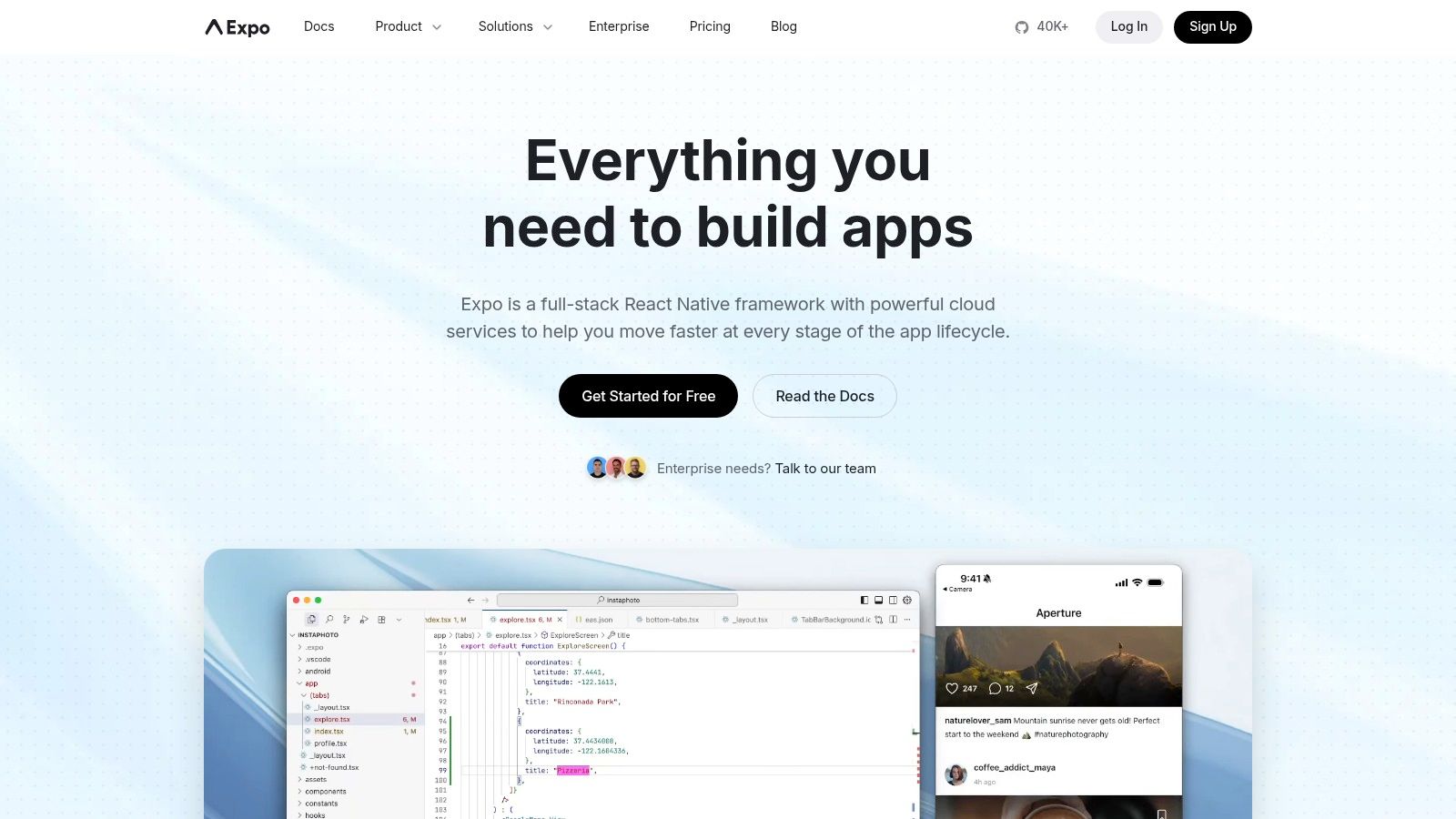
Its core value proposition is its managed workflow and comprehensive SDK. Expo provides pre-built modules for accessing native device features like the camera, GPS, and push notifications, which dramatically speeds up development. Combined with its file-based router and the "Snack" in-browser editor for rapid prototyping, it creates an unparalleled developer experience for mobile-centric projects. The Expo Application Services (EAS) further simplify the entire lifecycle, handling complex build processes, app store submissions, and over-the-air updates directly from the cloud.
Key Considerations for Founders
- Developer Experience & Hosting: Expo is open-source and free to use. The developer experience is a major draw, enabling rapid iteration without needing Xcode or Android Studio for most tasks. While the web output can be hosted anywhere, the magic is in EAS, a paid cloud service that manages the entire mobile CI/CD pipeline, a task that often requires dedicated DevOps expertise.
- Ecosystem & Hiring: Expo leverages the vast React Native ecosystem. This means you can find a large pool of React developers who can quickly become productive. It bridges the gap between web and mobile development talent.
- Migration Path: If your MVP was a PWA or a wrapped web app built in a no-code tool, Expo represents a direct upgrade to a true native experience. It offers the performance and device integration that users expect from an app-store application while maintaining a familiar React development model.
| Pros | Cons |
|---|---|
| Fast iteration and strong developer experience. | Primarily for native app development, not a web-only framework. |
| Optional EAS services simplify mobile CI/CD. | Some EAS tiers and features require paid subscriptions. |
| Single codebase for iOS, Android, and web. | Can have limitations if you need deep native code access. |
Website: https://expo.dev
7. TanStack Start
TanStack Start is an emerging full-stack React framework built upon the robust, type-safe foundation of TanStack Router and the modern tooling of Vite. It focuses on providing an enterprise-grade, router-first development experience with excellent type inference. For founders who prioritize type safety and are already invested in the TanStack ecosystem (like React Query or React Table), Start offers a cohesive and powerful choice among the best frameworks for React.
Its main differentiator is its deep integration with TanStack Router, ensuring that routing, data fetching, and mutations are all strongly typed and interconnected. The framework supports full-document server-side rendering (SSR), streaming, and server functions (RPCs), allowing you to build complex, performant applications. Because it's built on Vite, it benefits from extremely fast builds and a rich plugin ecosystem. This deploy-anywhere philosophy makes it a flexible option for teams wanting to avoid vendor lock-in associated with integrated hosting platforms.
Key Considerations for Founders
- Developer Experience & Hosting: TanStack Start is open-source and free. Its Vite foundation offers a fantastic developer experience with near-instant Hot Module Replacement (HMR). Being platform-agnostic, you can deploy it to any Node.js-compatible environment, including Vercel, Netlify, or your own servers, giving you complete control over your infrastructure.
- Ecosystem & Hiring: As a newer framework currently in beta, its ecosystem is smaller and the talent pool is more niche compared to giants like Next.js. It's best suited for teams that value its specific, type-safe approach and are comfortable with a framework that is still evolving.
- Migration Path: Its unopinionated nature regarding data sources means you can easily integrate it with any backend or database. For those moving from Airtable, connecting to a PostgreSQL database via an ORM like Prisma is straightforward, offering a similar level of flexibility as other modern frameworks.
| Pros | Cons |
|---|---|
| Modern, router-first design with strong type safety. | RC/Beta status with a smaller ecosystem. |
| Good fit for teams already using TanStack tools. | Active development means APIs may evolve. |
| Vite-powered builds and broad hosting compatibility. | Steeper learning curve for those new to TanStack. |
Website: https://tanstack.com/start
8. Refine
Refine is a headless, open-source React framework specifically engineered to accelerate the development of data-intensive applications like admin panels, internal tools, and B2B SaaS platforms. It provides a robust set of hooks and components for handling routing, data fetching, authentication, and state management, acting as a powerful application scaffolding tool. For founders needing to build a custom internal dashboard to manage data migrated from Airtable, Refine offers a production-ready solution that bypasses weeks of boilerplate setup.
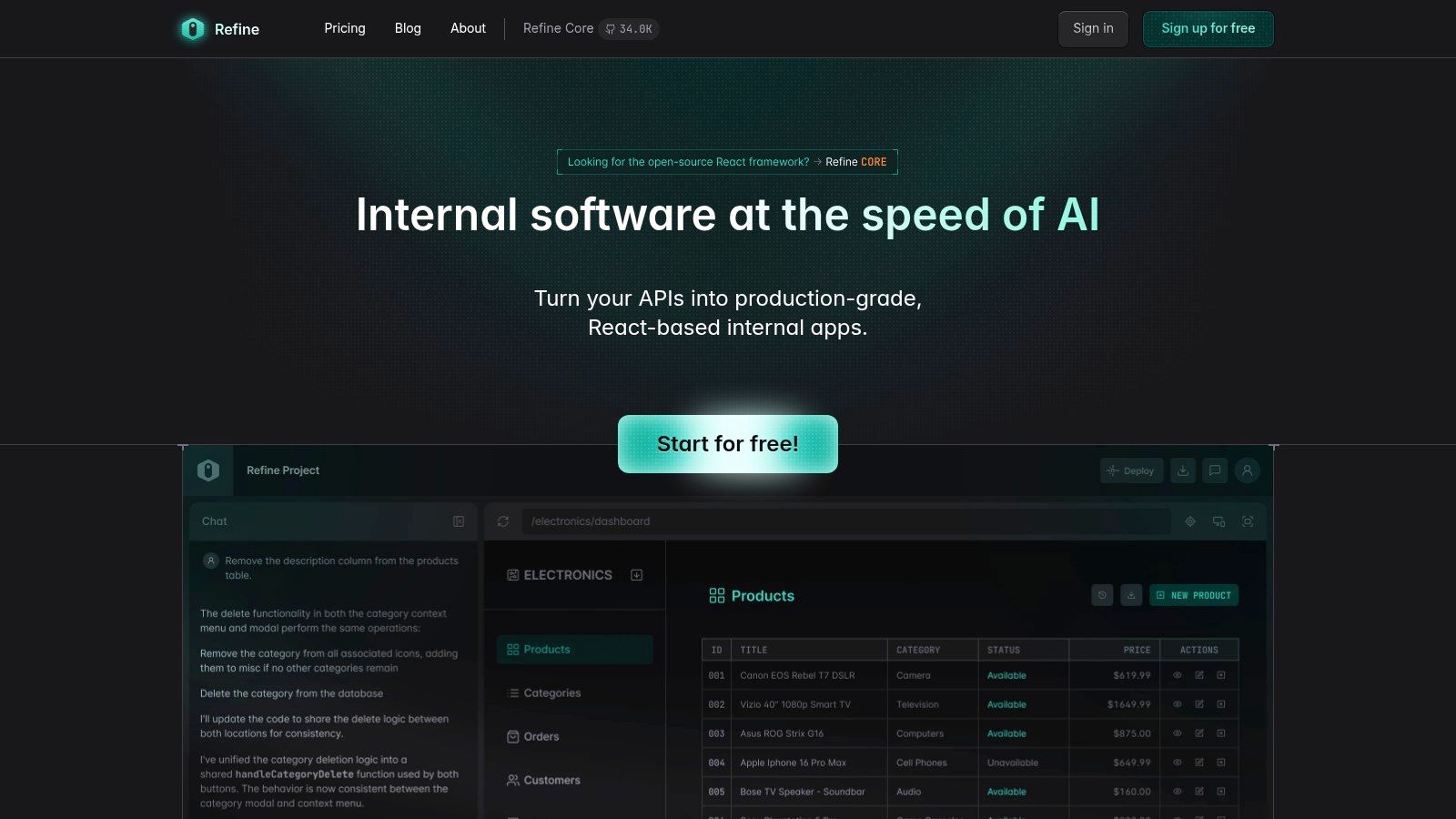
Its core advantage is its "headless" architecture. Refine manages the business logic but remains unopinionated about your UI, offering out-of-the-box integrations for popular component libraries like Ant Design, Material UI, Mantine, and Chakra UI. This allows teams to maintain their design system's integrity while leveraging Refine’s powerful data providers, which connect to any custom backend, REST API, or GraphQL endpoint. This makes it an excellent choice for building the operational backbone of a startup.
Key Considerations for Founders
- Development Speed & Cost: Refine is free and open-source. It dramatically reduces the time required to build CRUD (Create, Read, Update, Delete) interfaces, a common requirement for managing users, orders, or content. This speed allows a small team to build complex internal systems that would otherwise be cost-prohibitive.
- Use Case Specificity: While not a general-purpose framework like Next.js, its specialization is its strength. If your primary need is an admin panel or a highly functional data-grid interface, Refine is one of the best frameworks for React for that specific job, providing built-in support for permissions (RBAC), audit logs, and internationalization.
- Integration & Flexibility: Refine is not a monolith; it's designed to be integrated into existing projects. You can use it within a Next.js or Remix application, giving you the best of both worlds: a powerful meta-framework for your marketing site and a specialized tool for your internal dashboard.
| Pros | Cons |
|---|---|
| Dramatically speeds development of CRUD applications. | Niche focus on internal tools and admin panels. |
| Integrates with popular UI kits and backend services. | Not a general-purpose framework for building websites. |
| Strong built-in support for auth, i18n, and access control. | Smaller community compared to mainstream frameworks like Next.js. |
Website: https://refine.dev
9. Wasp
Wasp introduces a unique, declarative approach to building full-stack React and Node.js applications, positioning itself as a "Rails-like" framework for the modern web. It uses a custom configuration language (.wasp file) to define your app's core features like data models, authentication, and background jobs. Wasp then generates the boilerplate code for your React frontend, Node.js backend (with Prisma), and deployment configurations. This makes it an intriguing option for founders wanting to rapidly scaffold a SaaS or MVP with strong, opinionated conventions.
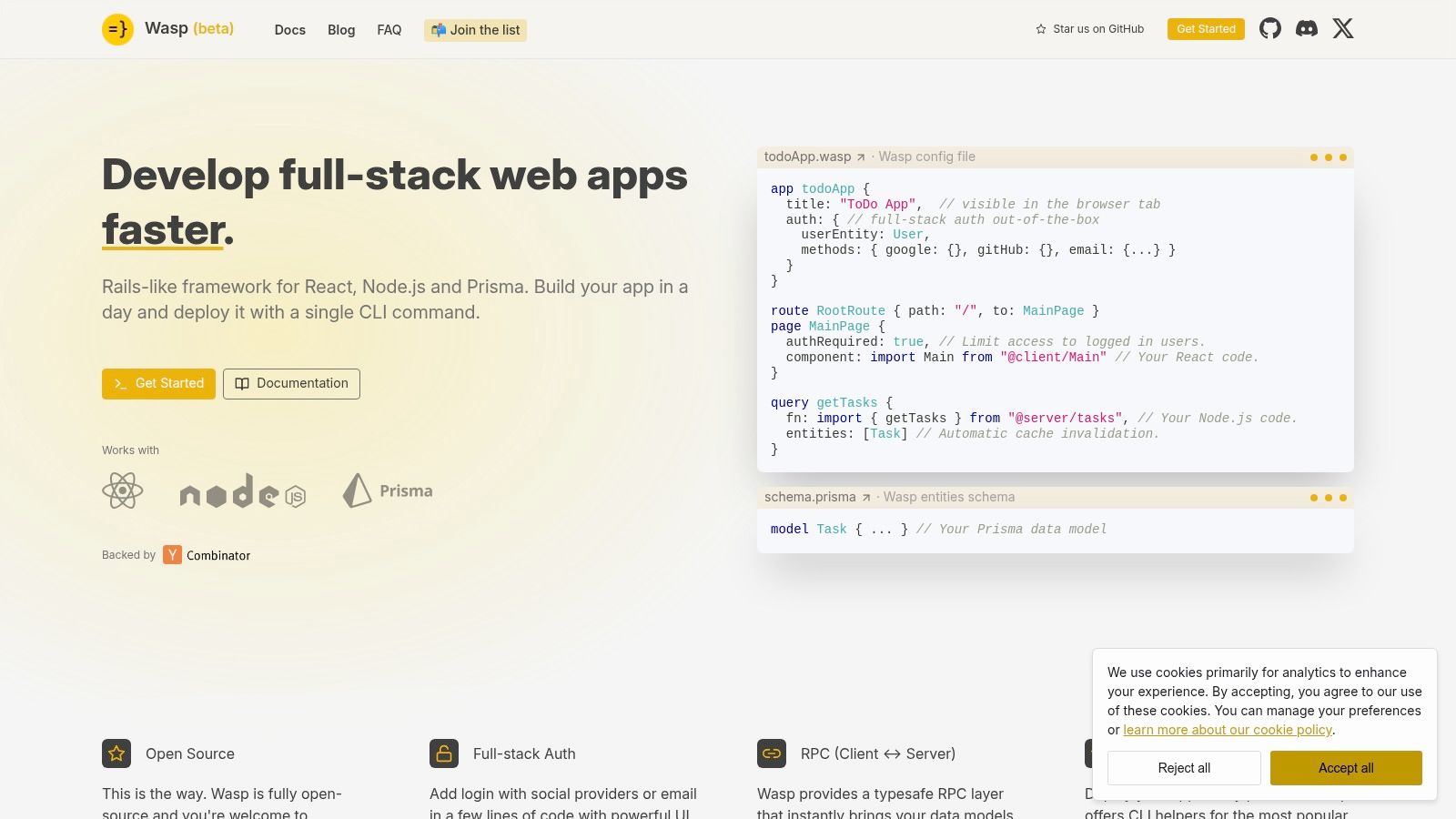
The core value proposition is its ability to eliminate tedious setup and connect frontend and backend logic with minimal friction. By defining an "action" or "query" in the Wasp file, the framework automatically generates fully-typed hooks for your React components and the corresponding API endpoints on the server. This significantly accelerates development for common SaaS features, reducing the cognitive load of wiring up a full-stack architecture from scratch. It’s a compelling choice among the best frameworks for React if your goal is maximum development velocity.
Key Considerations for Founders
- Developer Experience & Hosting: Wasp is open-source and free. The developer experience is centered around its CLI, which manages the entire development server and code generation process. For deployment, Wasp provides a simple
wasp deploycommand to build and push your application to platforms like Fly.io or Railway. - Ecosystem & Hiring: As a newer framework, its ecosystem is smaller and the talent pool is more niche compared to giants like Next.js. However, since it's built on React, Node.js, and Prisma, developers familiar with these technologies can become productive quickly. The key is finding talent willing to learn its declarative DSL.
- Migration Path: Wasp is designed for speed but doesn't lock you in. It offers an "eject" command that transforms your Wasp project into a standard Vite + Express.js monorepo. This provides a crucial escape hatch for founders who might outgrow the framework's conventions and need full, unopinionated control over their codebase.
| Pros | Cons |
|---|---|
| Extremely fast scaffolding for SaaS and MVPs. | The Wasp DSL introduces a new syntax and mental model to learn. |
| Built-in full-stack features like auth, jobs, and RPC. | Smaller ecosystem and community compared to major frameworks. |
| Eject path available if you need to customize beyond Wasp. | Abstraction can sometimes make debugging more complex. |
Website: https://wasp.sh
10. Shopify Hydrogen
For founders operating in the e-commerce space, Shopify Hydrogen is an opinionated, React-based framework designed specifically for building custom headless storefronts. Maintained directly by Shopify, it provides a comprehensive toolkit for developers to create unique, high-performance shopping experiences while leveraging Shopify's robust backend infrastructure for checkout, payments, and product management. This makes it an ideal choice for businesses outgrowing Shopify's standard themes and needing more creative control without rebuilding their entire commerce logic.
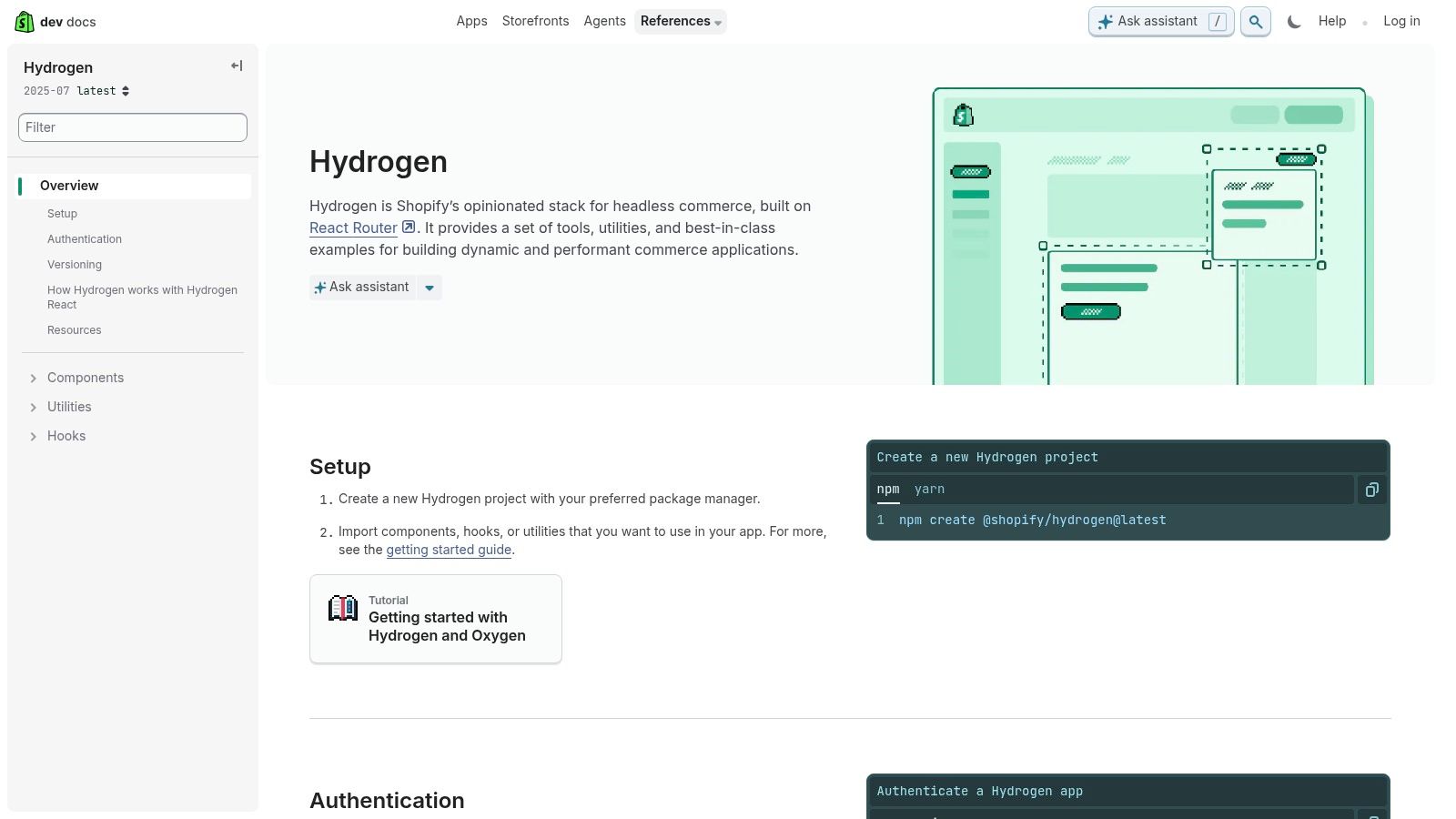
Hydrogen's primary advantage is its deep integration with the Shopify ecosystem. It comes with pre-built components, hooks, and utilities tailored for commerce, such as cart management, variant selection, and customer accounts. This dramatically accelerates development time. The framework is built on top of Remix, inheriting its strengths in server-side rendering and data fetching, ensuring fast page loads critical for e-commerce conversion rates. It is purpose-built to be one of the best frameworks for React when your goal is a custom Shopify storefront.
Key Considerations for Founders
- Developer Experience & Hosting: Hydrogen is open-source and provides starter templates to get up and running quickly. It is designed for seamless, one-click deployment to Oxygen, Shopify’s globally distributed edge hosting platform, which is included with Shopify Plus plans for optimal performance.
- Ecosystem & Hiring: While the Hydrogen talent pool is more niche than that for general frameworks like Next.js, developers with strong React and Remix experience can adapt quickly. The official Shopify documentation and community are excellent resources.
- Migration Path: This is the go-to path for existing Shopify merchants who need to transition from a theme-based store to a headless architecture. It allows you to keep your entire Shopify backend (products, orders, customers) intact, focusing only on building a new frontend.
| Pros | Cons |
|---|---|
| Purpose-built for Shopify headless commerce. | Highly specialized; not for non-Shopify projects. |
| Out-of-the-box commerce components and hooks. | Requires a Shopify Plus plan for production hosting. |
| Optimized for performance with Oxygen hosting. | Smaller talent pool compared to mainstream frameworks. |
Website: https://shopify.dev/docs/api/hydrogen
11. RedwoodJS / RedwoodSDK
RedwoodJS is an opinionated, full-stack React framework designed to take you from side project to startup with structured conventions. It tightly integrates React on the frontend with a GraphQL API and a Prisma database layer on the backend. For founders who want a "batteries-included" experience without the decision fatigue of piecing together a stack, Redwood offers a prescriptive, efficient workflow with powerful code generators for common tasks.
Its core philosophy is centered on convention over configuration, which simplifies development by providing a clear path for building features like auth, data fetching, and forms. The project is currently evolving into RedwoodSDK, shifting its focus toward a more modular approach optimized for Cloudflare-native deployments. This evolution aims to leverage edge computing for enhanced performance and scalability, making it a forward-looking choice among the best web frameworks available. This pivot is crucial for teams to consider when evaluating if the framework aligns with their long-term infrastructure goals.
Key Considerations for Founders
- Developer Experience & Tooling: RedwoodJS is open-source and free. Its CLI is a standout feature, with generators that scaffold out entire features, from database schemas to UI components, dramatically speeding up development. This end-to-end tooling is ideal for small teams needing to move quickly.
- Ecosystem & Hiring: As a more niche framework, the talent pool is smaller compared to giants like Next.js. However, its strong conventions and reliance on popular technologies like React, GraphQL, and Prisma mean experienced developers can become productive quickly.
- Migration Path: The integrated Prisma ORM provides a direct migration path for startups outgrowing Airtable. It simplifies the transition to a robust PostgreSQL database, enabling complex relational data models and performant queries right out of the box.
| Pros | Cons |
|---|---|
| Structured conventions great for scaling from MVP to production. | The project is evolving to RedwoodSDK, which may change its focus. |
| Excellent fit for teams who prefer a GraphQL-first architecture. | Teams must decide if classic Redwood or the SDK fits their roadmap. |
| Powerful CLI generators accelerate development. | Smaller community and ecosystem compared to larger frameworks. |
Website: https://redwoodjs.com
12. Blitz.js
Blitz.js is a full-stack toolkit built on top of Next.js, often described as bringing a "Ruby on Rails-like" developer experience to the React ecosystem. It's designed to make building full-stack applications faster by providing conventions, scaffolding, and a type-safe data layer out of the box. For founders looking for the power of Next.js but wanting to accelerate feature development, Blitz.js provides an opinionated framework that handles the boilerplate for you.
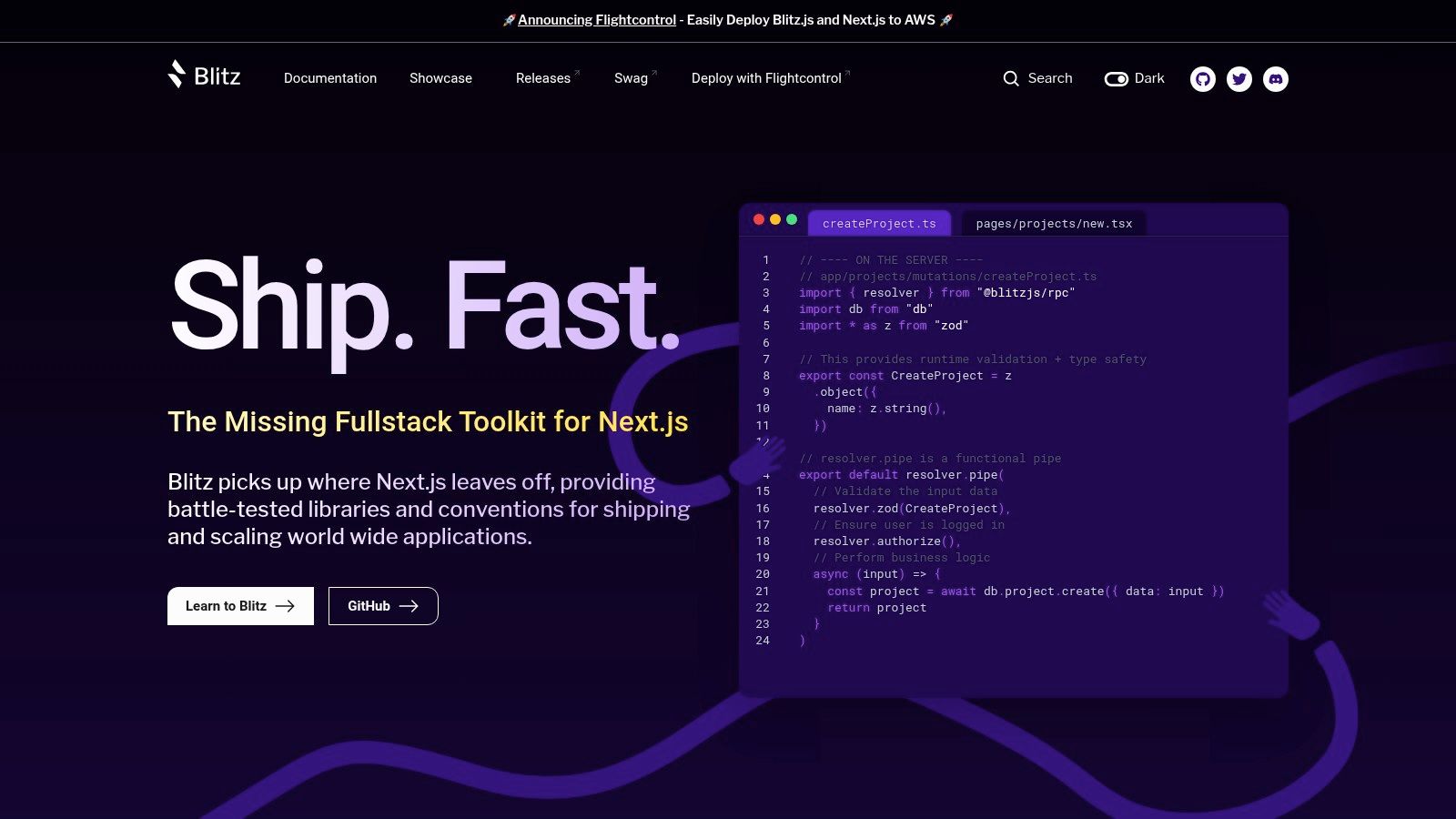
Its "Zero-API" data layer is a standout feature, allowing you to import server-side code directly into your React components without manually creating API endpoints. This is powered by a compile-time abstraction that handles the API creation and data serialization automatically, significantly speeding up CRUD (Create, Read, Update, Delete) operations. This approach simplifies the architecture, which is a major benefit for small teams migrating from integrated platforms like Bubble where the frontend and backend logic are closely linked.
Key Considerations for Founders
- Development Velocity: Blitz is open-source and free. Its code generators can scaffold entire features, including models, queries, and mutations, with a single command. This is incredibly valuable for building MVPs or rapidly iterating on product features, mirroring the speed that no-code tools initially provide.
- Ecosystem & Learning Curve: Since it's built on Next.js, you retain access to the entire Next.js and React ecosystem. However, the Blitz community is smaller, so finding solutions to highly specific issues might require more effort. Teams already familiar with Next.js will find the learning curve very manageable.
- Built-in Conventions: Blitz comes with pre-configured solutions for common needs like authentication and authorization, reducing setup time. For founders needing to implement user accounts and secure data access quickly, this built-in support is a significant advantage over starting from scratch.
| Pros | Cons |
|---|---|
| Speeds development of CRUD features. | Smaller community compared to raw Next.js. |
| Easy on-ramp for teams familiar with Next.js. | Documentation may not be as current as Next.js. |
| Zero-API data layer simplifies architecture. | Adds another layer of abstraction to learn. |
Website: https://blitzjs.com
Top 12 React Frameworks Comparison
| Framework | Core use case | Key features | Best for (target) | USP / Considerations |
|---|---|---|---|---|
| Next.js | Production React web apps (SSR/SSG/ISR) | App Router, React Server Components, Server Actions, API routes, built-in optimizations | Teams needing a full-featured, production-ready web foundation | Large ecosystem & Vercel-first deploys; learning curve, some Vercel coupling |
| React Router (v7) | Flexible routing & progressive full-stack adoption | File-style routes, loaders/actions, SSR/streaming, typegen | Projects that want router-first control and gradual SSR adoption | Lightweight, web-standards focus; requires more assembly than opinionated frameworks |
| Remix | Source of Remix patterns and roadmap (in transition) | Remix docs/history, pattern guidance, Remix 3 roadmap | Teams evaluating Remix lineage or migrating from older Remix versions | Good for learning Remix-style patterns; project currently in flux |
| Gatsby | Content-heavy sites and MDX workflows | GraphQL data layer, SSG/SSR/DSG, rich plugin ecosystem | Marketing sites, blogs, CMS-driven content sites | Strong plugin ecosystem and docs; community momentum has shifted—check long-term maintenance |
| Astro | High-performance content sites with minimal JS | Islands architecture, server-first rendering, multi-framework integrations | Performance-first marketing sites or blogs that need selective React | Excellent perf with minimal JS; less suited to heavy SPA dashboards |
| Expo | Cross-platform native (iOS/Android) + web apps | Expo SDK, file routing, Snack editor, EAS build/CI | Teams wanting one codebase for mobile + web and fast prototyping | Great DX and cloud build tools (EAS); some advanced EAS features are paid |
| TanStack Start | Typed, router-first full-stack React | Enterprise typed routing, SSR/streaming, server RPCs, Vite builds | Teams already using TanStack tooling and wanting strong type safety | Modern router-first design; RC/beta status and smaller ecosystem |
| Refine | Internal tools, admin panels, CRUD apps | Headless primitives, data providers, auth, RBAC, UI kit adapters | Rapidly shipping admin/back-office interfaces and SaaS dashboards | Speeds CRUD development with many adapters; focused on internal tools only |
| Wasp | Rapid SaaS/MVP scaffolding with conventions | Declarative .wasp DSL, built-in auth, RPCs, jobs, deploy helpers | Rapid prototyping for SaaS/MVPs that want opinionated defaults | Very fast scaffolding and eject path; new DSL and smaller ecosystem |
| Shopify Hydrogen | Headless Shopify storefronts | Commerce primitives, Storefront API integration, Oxygen deploy | Merchants building custom headless storefronts on Shopify | Purpose-built for e‑commerce; best with Shopify platform and plan considerations |
| RedwoodJS / RedwoodSDK | Opinionated full-stack with GraphQL-first conventions | Generators, GraphQL + Prisma, end-to-end tooling | Teams that prefer structured conventions and GraphQL-centric stacks | Good for scaling from side project to startup; project evolving toward RedwoodSDK (evaluate fit) |
| Blitz.js | Rails-like full-stack on top of Next.js | Generators/scaffolding, Prisma typesafe layer, built-in auth | Teams wanting rapid CRUD/product development with Next.js compatibility | Speeds feature delivery with familiar ergonomics; smaller community—verify current docs |
Final Thoughts
Navigating the ecosystem of the best frameworks for React can feel like an overwhelming task, especially when you're transitioning from the streamlined, visual world of no-code platforms like Bubble, Webflow, or Airtable. The journey from a working MVP to a scalable, production-grade application is a critical inflection point for any startup. Making the right technology choice here isn't just a technical decision; it's a strategic business move that will impact your product's performance, your team's velocity, and your ability to attract investment.
This guide was designed to cut through the noise and provide a clear, opinionated roadmap. We've explored the landscape, from the undisputed industry titan Next.js with its comprehensive feature set, to the elegant simplicity of Remix and its focus on web fundamentals. We've seen how specialized tools like Gatsby and Astro excel at content-heavy sites, while opinionated full-stack solutions like RedwoodJS and Wasp offer an accelerated path to building complex applications with integrated backends, authentication, and database management.
Key Takeaways for Founders and Product Leaders
Your decision should be rooted in your specific business needs, team skills, and long-term vision. Generic advice won't suffice.
- For the "Default" Scalable Web App: If you're building a dynamic, full-stack application and preparing for VC funding, Next.js remains the safest, most powerful bet. Its vast ecosystem, strong community support, and production-proven track record make it the industry standard for a reason. It provides the flexibility to handle everything from e-commerce to complex SaaS platforms.
- For the "No-Code to Pro-Code" Transition: Frameworks like Wasp and RedwoodJS are your closest allies. They abstract away significant boilerplate and provide a "batteries-included" experience that mirrors the integrated nature of Bubble, but with the power and ownership of a real codebase. This is a fantastic middle ground that reduces the learning curve for teams needing to ship features fast.
- For Performance-Critical Content Sites: If your business relies on stellar SEO, fast page loads, and a superior content experience (like a blog, marketing site, or documentation portal), Astro and Gatsby are tailor-made for you. Their focus on static generation and island architecture delivers unparalleled performance that is difficult to achieve with more dynamic frameworks.
- For Niche Use Cases: Don't overlook specialized frameworks. If you're building a headless e-commerce experience, Shopify Hydrogen offers a direct, optimized path. For complex internal tools or admin dashboards, Refine provides an incredible set of pre-built components and hooks to get you to a functional product in record time.
Your Actionable Next Steps
Before you write a single line of code, take a step back and map your migration strategy. The choice of framework is just one piece of the puzzle.
- Audit Your Core Features: What are the absolute non-negotiables? Secure user authentication? Subscription payments via Stripe? Complex data relationships that have outgrown Airtable? List them out and evaluate which frameworks offer the most direct path to implementing them.
- Assess Your Team's Expertise: Be realistic about your current team's skillset. If you have strong React developers, Next.js or Remix are natural fits. If your team is smaller or less experienced with backend development, the guardrails provided by RedwoodJS or Wasp can be a massive advantage, preventing costly mistakes.
- Prototype a Single, Critical Flow: Choose one core user journey from your no-code app, for example, user signup and onboarding. Try building just that small piece in your top two framework choices. This hands-on experience will reveal more about the developer experience, documentation quality, and potential roadblocks than any article ever could.
Ultimately, selecting one of the best frameworks for React is about empowering your team to build a durable, scalable, and valuable asset. You're moving beyond the limitations of rented platforms and taking true ownership of your intellectual property. This transition is a sign of success and a gateway to the next stage of your company's growth. Embrace the challenge, choose deliberately, and build the product your users deserve.
Feeling overwhelmed by the transition from a no-code MVP to a scalable, investor-ready tech stack? At First Radicle, we specialize in helping founders like you navigate this exact journey, implementing robust solutions with frameworks like Next.js. Let us handle the technical complexities so you can focus on growing your business by visiting us at First Radicle.