
Choosing the Best React Framework for Your Startup in 2026

You've validated your MVP on Bubble, Webflow, or a complex web of Zaps. It works, but it's slow, expensive, and hitting a ceiling. Congratulations, you've earned the best kind of problem: scaling. Now, you need to migrate to a production-grade stack that can handle real user load, secure customer data, and attract investors. This critical transition means moving beyond no-code limitations and building a platform you truly own.
The foundation of that new stack is often the frontend framework, and for most modern web applications, that means choosing the best React framework for the job. But the landscape is crowded. Next.js, Remix, Astro, and others each offer a different philosophy on performance, developer experience, and scalability. Making the wrong choice can lead to costly rewrites, slow development cycles, and a product that fails to meet user expectations. This isn't just a technical decision; it's a strategic one that directly impacts your ability to grow.
This guide is built for founders facing this exact challenge. We'll cut through the noise, providing an actionable comparison of the top 7 contenders with a direct focus on startup constraints like budget, team size, and time-to-market. We won't just list features; we'll provide production-readiness scores, recommended tech stacks for essentials like auth and payments, and a clear decision checklist. Consider this your roadmap for selecting the right React framework to build a durable, scalable, and fundable product.
1. Next.js
Next.js, maintained by Vercel, has become the de-facto production framework for React, earning its spot as a top contender for the best react framework for startups ready to scale. Its official website, nextjs.org, is more than just documentation; it's a comprehensive learning hub and deployment launchpad. For founders migrating from platforms like Bubble or Webflow, Next.js provides a structured, full-stack environment that combines frontend and backend logic into a single, cohesive codebase.
The framework's power lies in its hybrid rendering capabilities. It seamlessly blends Server-Side Rendering (SSR) for dynamic, user-specific content with Static Site Generation (SSG) for marketing pages and blog posts that need top-tier SEO and performance. This flexibility allows you to build complex applications, from interactive dashboards to e-commerce platforms, without compromising on speed or user experience.
Key Features & Production Readiness
Next.js is designed for production from day one. Its file-system based routing (the App Router) simplifies how you structure your application, automatically creating routes based on your folder and file names. This is a significant step up from the manual routing configurations required in simpler React setups.
Built-in optimizations are a core strength. The framework automatically handles image optimization (next/image), font loading (next/font), and script loading (next/script), solving common performance bottlenecks that can slow down user-facing applications. The introduction of React Server Components and Server Actions further streamlines development by allowing you to write server-side code directly within your React components, reducing the amount of client-side JavaScript and simplifying data fetching and mutations.
Recommended Stack & Migration Path
For a startup building a scalable application, a common Next.js stack includes:
- Authentication: NextAuth.js or Clerk for robust, secure user management.
- Database: A managed PostgreSQL provider like Supabase or Neon.
- Styling: Tailwind CSS for a utility-first, highly maintainable design system.
- Deployment: Vercel for a seamless, zero-configuration hosting experience tightly integrated with Next.js features.
Founder Insight: Next.js is the logical next step when your Zapier automations become too complex or your Airtable base hits its limits. By building a custom backend with Next.js Route Handlers, you gain full control over your business logic and own your intellectual property, a critical factor for VC fundraising.
Final Verdict: Is Next.js for You?
Next.js excels for teams that need an all-in-one solution for building and scaling full-stack applications. Its massive ecosystem and enterprise adoption mean you'll find extensive documentation, tutorials, and community support. While the learning curve for newer concepts like Server Components can be steep, the long-term payoff in performance and developer productivity is substantial. For those interested in a deeper dive, you can learn more about building scalable web applications with Next.js on firstradicle.com.
- Pros: Enterprise-grade ecosystem, unparalleled performance optimizations, and a smooth deployment path on Vercel.
- Cons: The App Router and Server Components can be challenging for beginners, and its tight integration with Vercel might feel opinionated for teams committed to other hosting platforms.
2. Remix
Remix, now under the Shopify umbrella, presents a compelling alternative for founders seeking the best react framework by focusing on web standards and progressive enhancement. Its official website, remix.run, serves as a clear and concise portal to its philosophy: building better websites with a focus on user experience and resilience. For teams moving beyond visual builders, Remix offers a robust, full-stack approach that leverages the foundational principles of the web, like forms and HTTP responses, to create incredibly fast and reliable applications.
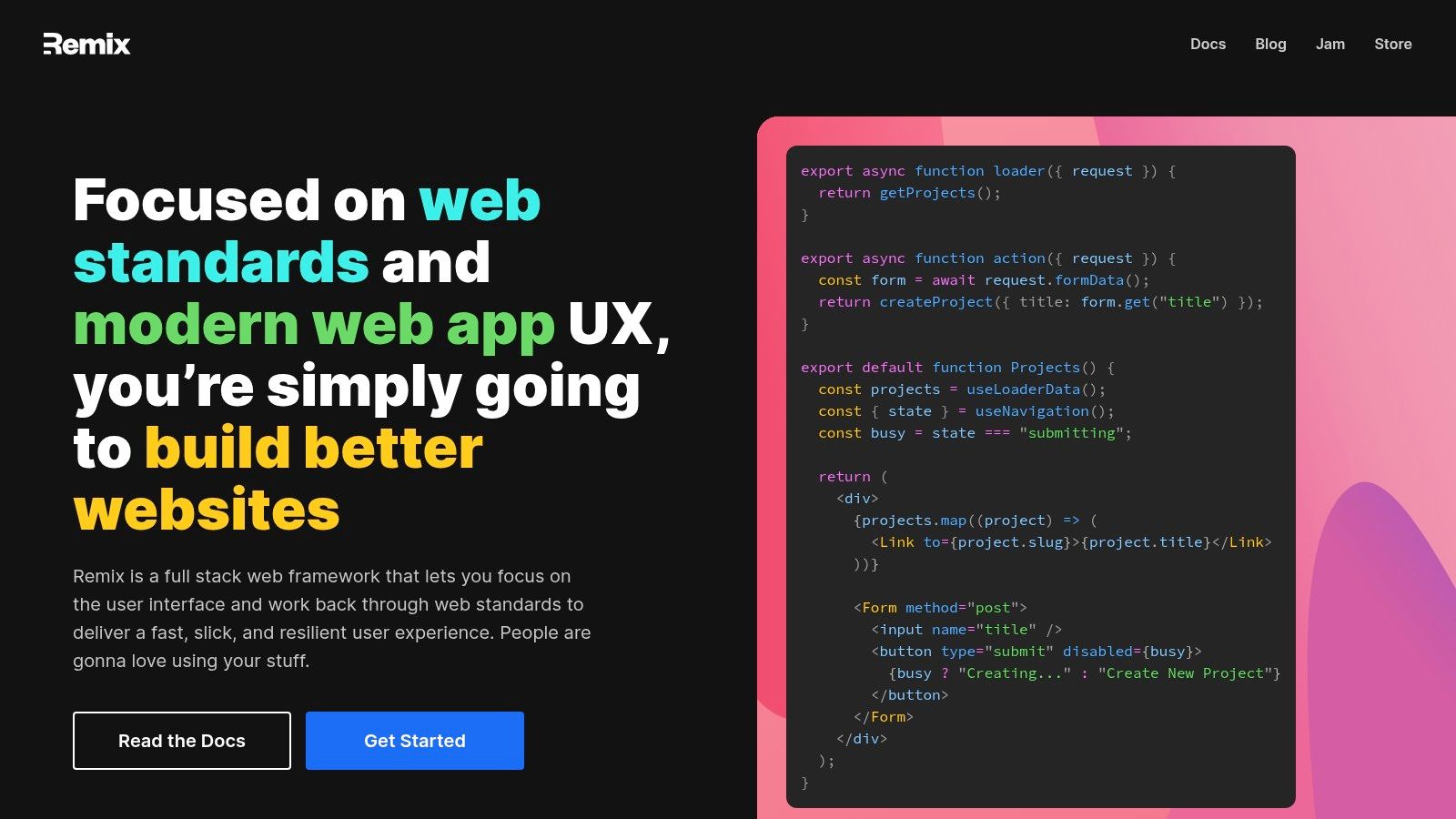
The framework's core strength is its data loading and mutation strategy, which uses route-based loader and action functions. This model simplifies data fetching and form submissions by aligning closely with how browsers work natively. The result is a user experience that feels snappy and works seamlessly even on slower networks, as Remix can render meaningful HTML on the server before any client-side JavaScript loads.
Key Features & Production Readiness
Remix is built for production, emphasizing stability and maintainability. Its nested routing system is a standout feature, allowing parent routes to manage layouts and data for child routes in a clean, hierarchical way. This also provides powerful error handling through ErrorBoundary components, which can gracefully catch and display errors within a specific part of your UI without crashing the entire application.
By embracing web standards, Remix applications are often less complex and easier to debug. Progressive enhancement is a first-class citizen; forms built with Remix work without JavaScript enabled, ensuring core functionality is accessible to all users. This deployment-target agnostic approach means you can run your app on traditional Node.js servers, modern edge runtimes like Cloudflare Workers, or anywhere in between, giving your startup ultimate hosting flexibility.
Recommended Stack & Migration Path
A powerful production stack for a startup using Remix could include:
- Authentication: Remix-Auth for a community-driven, session-based strategy.
- Database: A serverless PostgreSQL provider like Neon connected via Prisma.
- Styling: Tailwind CSS, which pairs well with Remix's route-based architecture.
- Deployment: Fly.io or Cloudflare for global distribution and edge computing capabilities.
Founder Insight: Remix is an excellent choice when your primary product involves complex user-input forms, like multi-step onboarding flows or data-heavy dashboards. Its action/loader pattern simplifies state management, often eliminating the need for client-side state libraries and reducing the risk of bugs common in complex no-code workflows.
Final Verdict: Is Remix for You?
Remix excels for teams that value long-term maintainability and want to build resilient, fast-loading applications by leaning on web fundamentals. Its focus on progressive enhancement makes it ideal for e-commerce or any application where accessibility and reliability are non-negotiable. While its ecosystem is growing, it's not as vast as Next.js, and developers accustomed to SPA-first thinking may need time to adapt to its server-centric model. For those interested in a deeper look, you can learn more about its architectural principles in this guide to software architecture best practices on firstradicle.com.
- Pros: Web-standards-first model promotes stability, excellent patterns for forms and data mutations, and deployment flexibility.
- Cons: Smaller community and package ecosystem compared to Next.js, and its server-focused patterns require a mental model shift for some React developers.
3. Gatsby
Gatsby has carved out a powerful niche as the best react framework for content-driven websites, making it a go-to choice for marketing teams and founders focused on building robust digital experiences. Its official hub, gatsbyjs.com, serves as the gateway to its rich ecosystem. For businesses whose primary asset is content, whether sourced from a dozen headless CMS platforms or a single Markdown folder, Gatsby provides an unparalleled data layer to unify it all.
The framework's core strength is its GraphQL data layer, which allows you to pull data from any source-APIs, headless CMSs like Contentful or Sanity, databases, or local files-and make it uniformly available across your application. While it started as a pure Static Site Generator (SSG), Gatsby has evolved to support Deferred Static Generation (DSG) for less critical pages and Server-Side Rendering (SSR) for dynamic content, offering flexibility for more complex use cases.
Key Features & Production Readiness
Gatsby is engineered for elite performance on content-heavy sites. Its build process pre-optimizes every aspect of the frontend, from generating multiple responsive image sizes automatically to inlining critical CSS. This results in incredibly fast load times, which is a major factor for SEO and user retention. The extensive plugin ecosystem is a massive accelerator, providing pre-built integrations for everything from sourcing content and adding analytics to implementing PWA features.
For production, Gatsby offers Gatsby Cloud, a specialized hosting platform designed to optimize its build and deployment process. However, it is platform-agnostic and deploys seamlessly to other modern hosts like Netlify and Vercel. Its maturity means the tooling is stable and well-documented, providing a reliable foundation for enterprise marketing sites, blogs, and documentation portals.
Recommended Stack & Migration Path
A typical Gatsby stack for a high-performance marketing site includes:
- Content Source: A headless CMS like Contentful, Sanity, or Strapi.
- Styling: Styled Components or Tailwind CSS for building a design system.
- Forms & Functions: Netlify Forms and Functions for handling user submissions and serverless logic.
- Deployment: Gatsby Cloud or Netlify for optimized build caching and hosting.
Founder Insight: If your company's growth is tied to content marketing and you're managing articles across WordPress, Help Scout, and a custom API, Gatsby is your solution. It unifies these disparate sources into a single, cohesive GraphQL API, allowing you to build a world-class digital experience without the backend chaos.
Final Verdict: Is Gatsby for You?
Gatsby is an exceptional choice for startups whose primary product is content or whose go-to-market strategy relies heavily on a high-performance marketing site. Its data layer and image optimization capabilities are best-in-class for these scenarios. While the ecosystem's momentum has somewhat shifted towards full-stack frameworks like Next.js, Gatsby remains an unbeatable contender for building blazing-fast, content-rich web experiences.
- Pros: Phenomenal performance for static sites, a powerful data layer for content aggregation, and a mature plugin ecosystem.
- Cons: The GraphQL data layer introduces complexity that can be overkill for simpler sites, and build times can become slow on very large projects.
4. RedwoodSDK (formerly RedwoodJS)
Redwood, which has evolved into RedwoodSDK, presents a compelling server-first vision for the modern web, positioning itself as a strong contender for the best react framework for teams building on the edge. Its official hub, rwsdk.com, showcases its tight integration with Cloudflare's ecosystem. For founders looking for an opinionated, full-stack framework that prioritizes simplicity and standards-based development, RedwoodSDK offers a clear path to building performant applications deployed globally.
The framework is architected for the edge from the ground up, leveraging a Vite-powered developer experience with Server-Side Rendering (SSR) and React Server Components. This focus makes it an ideal choice for applications that require low latency and a resilient infrastructure, such as interactive tools, real-time dashboards, and AI-powered services that benefit from being physically closer to the user.
Key Features & Production Readiness
RedwoodSDK is designed for a streamlined, "batteries-included" developer experience. It natively integrates with the full suite of Cloudflare services, including Workers for compute, D1 for databases, R2 for storage, and Queues for background jobs. This removes significant configuration overhead, allowing teams to focus on building features rather than managing infrastructure.
Its routing and middleware systems are built on standard Request and Response APIs, making the framework feel familiar to developers with experience in other modern web environments. A key advantage for production workflows is its local emulation of the edge environment via Miniflare. This allows developers to build and test their applications locally with high fidelity, ensuring that what works on their machine will work seamlessly when deployed to Cloudflare's global network.
Recommended Stack & Migration Path
For a startup leveraging RedwoodSDK's edge-native capabilities, a typical stack is self-contained within the Cloudflare ecosystem:
- Authentication: Integration with a provider like Clerk or building custom logic on Cloudflare Workers.
- Database: Cloudflare D1 for a serverless SQL database managed at the edge.
- Styling: Tailwind CSS for a consistent and scalable design system.
- Deployment: Cloudflare Pages and Workers, for which RedwoodSDK is explicitly optimized.
Founder Insight: RedwoodSDK is a strategic choice for startups building AI-native products. Its colocation of compute (Workers AI) and data (D1, R2) at the edge minimizes latency for inference tasks, providing a significant performance advantage over traditional, centralized cloud architectures.
Final Verdict: Is RedwoodSDK for You?
RedwoodSDK excels for teams that are "all-in" on the Cloudflare ecosystem and want a full-stack, convention-over-configuration framework that simplifies edge development. Its philosophy of minimal "magic" results in a more transparent and predictable development process. While its ecosystem is smaller than that of Next.js, its focused approach provides a powerful and productive environment for building the next generation of serverless, edge-first applications.
- Pros: Exceptional edge-native performance, streamlined full-stack developer experience with local emulation, and deep integration with Cloudflare services.
- Cons: Tightly coupled to the Cloudflare platform, which limits hosting flexibility, and a smaller community and package ecosystem compared to more established frameworks.
5. Blitz.js
Blitz.js, often described as "The Missing Fullstack Toolkit for Next.js," earns its place as a strong contender for the best react framework for founders who need to build and ship products at maximum speed. It operates as a powerful layer on top of Next.js, adding conventions and code-generation tools that eliminate boilerplate. Its official website, blitzjs.com, clearly communicates its value proposition: build, ship, and scale a full-stack application with a monolithic, zero-API architecture.
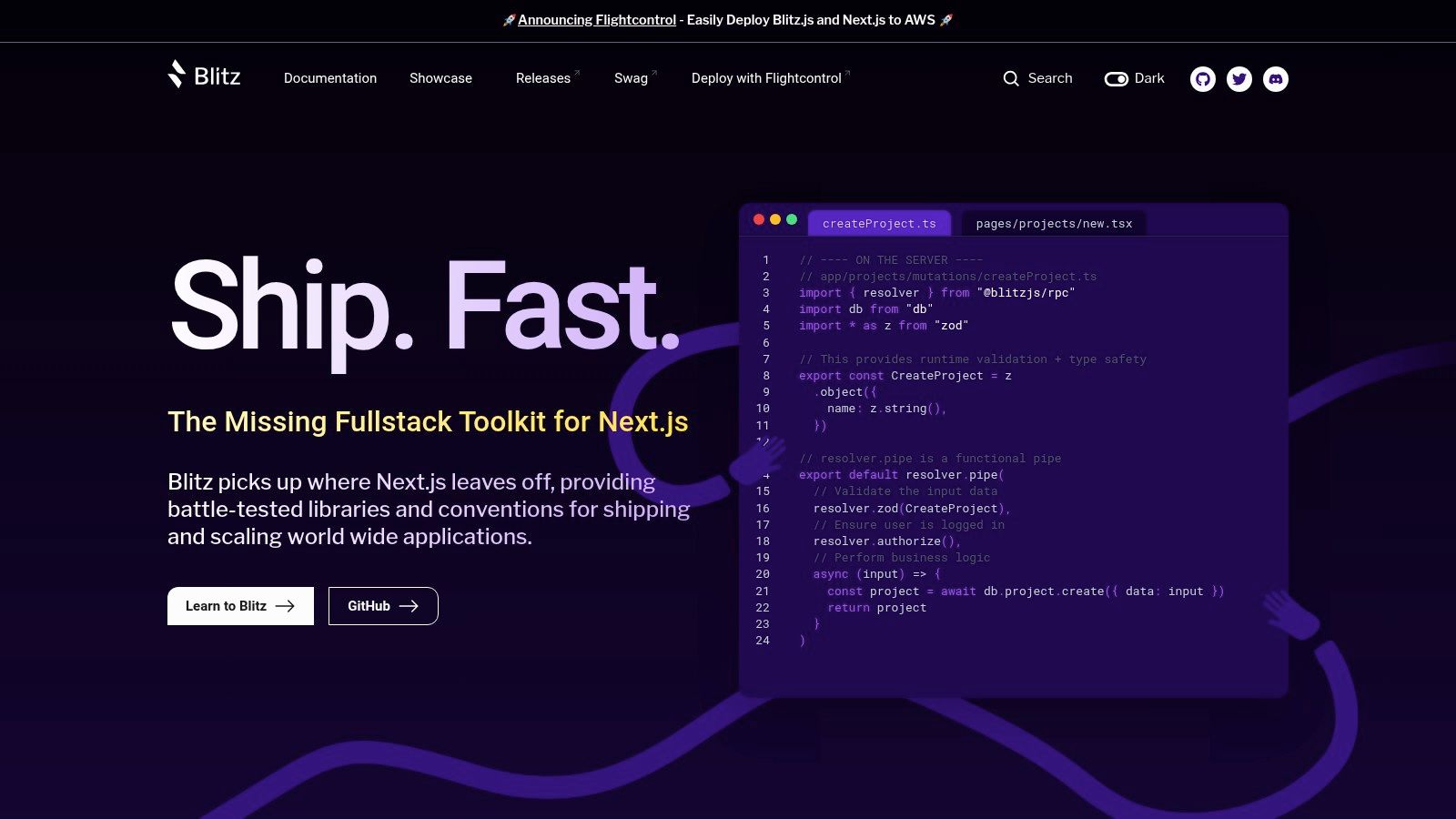
The framework's core innovation is its "Zero-API" data layer, which allows you to import server code directly into your React components. This approach provides end-to-end type safety from your database to your frontend, simplifying data fetching and mutations significantly. For startups moving fast, this means less time spent on API plumbing and more time focused on building features that matter to users.
Key Features & Production Readiness
Blitz.js is engineered for rapid prototyping without sacrificing production-grade quality. Its command-line interface (CLI) is a standout feature, allowing developers to scaffold entire CRUD (Create, Read, Update, Delete) models, including the database schema, server logic, and frontend components, with a single command. This convention-over-configuration philosophy enforces a consistent project structure, making it easier for new developers to join the team and get up to speed quickly.
The framework comes with built-in authentication that is secure, battle-tested, and easy to set up. It also provides "recipes," which are one-line commands to install and configure common libraries like Tailwind CSS or libraries for form management. By building on the solid foundation of Next.js, Blitz inherits all its performance optimizations, including Server-Side Rendering and Static Site Generation, ensuring your application is fast and scalable from day one.
Recommended Stack & Migration Path
A powerful stack for a Blitz.js application leverages its streamlined architecture:
- Authentication: Use the built-in, session-based auth system for a quick and secure setup.
- Database: Prisma is the default ORM, pairing perfectly with a PostgreSQL database from Supabase or Neon.
- Styling: Install Tailwind CSS with a simple
blitz install tailwindcommand. - Deployment: Deploy seamlessly to Vercel or any other platform that supports Next.js.
Founder Insight: Blitz.js is the ideal choice when speed is your primary competitive advantage. If your team needs to build a full-stack SaaS product, marketplace, or internal tool in weeks, not months, Blitz's scaffolding and Zero-API layer will give you an unparalleled development velocity.
Final Verdict: Is Blitz.js for You?
Blitz.js is perfect for teams that value speed and developer experience above all else. It drastically reduces the repetitive setup required for most full-stack applications, allowing founders to validate ideas and iterate faster. While its community is smaller than that of Next.js, its tight focus on full-stack productivity makes it a powerful tool. If you're looking for more information, you can learn about the principles behind custom backend development on firstradicle.com.
- Pros: Incredible development speed through code generation, built-in authentication and recipes, and end-to-end type safety with the Zero-API layer.
- Cons: It adds another layer of abstraction on top of Next.js, and its development is dependent on the Next.js release cycle.
6. Refine
Refine is an open-source, headless React framework purpose-built for data-intensive applications like internal tools, admin panels, and B2B SaaS dashboards. Its website, refine.dev, showcases its unique value proposition: accelerating the development of complex back-office applications without sacrificing flexibility. For founders whose operations are buckling under the weight of custom-built Retool apps or complex Airtable interfaces, Refine offers a path to a scalable, maintainable, and ownable codebase.
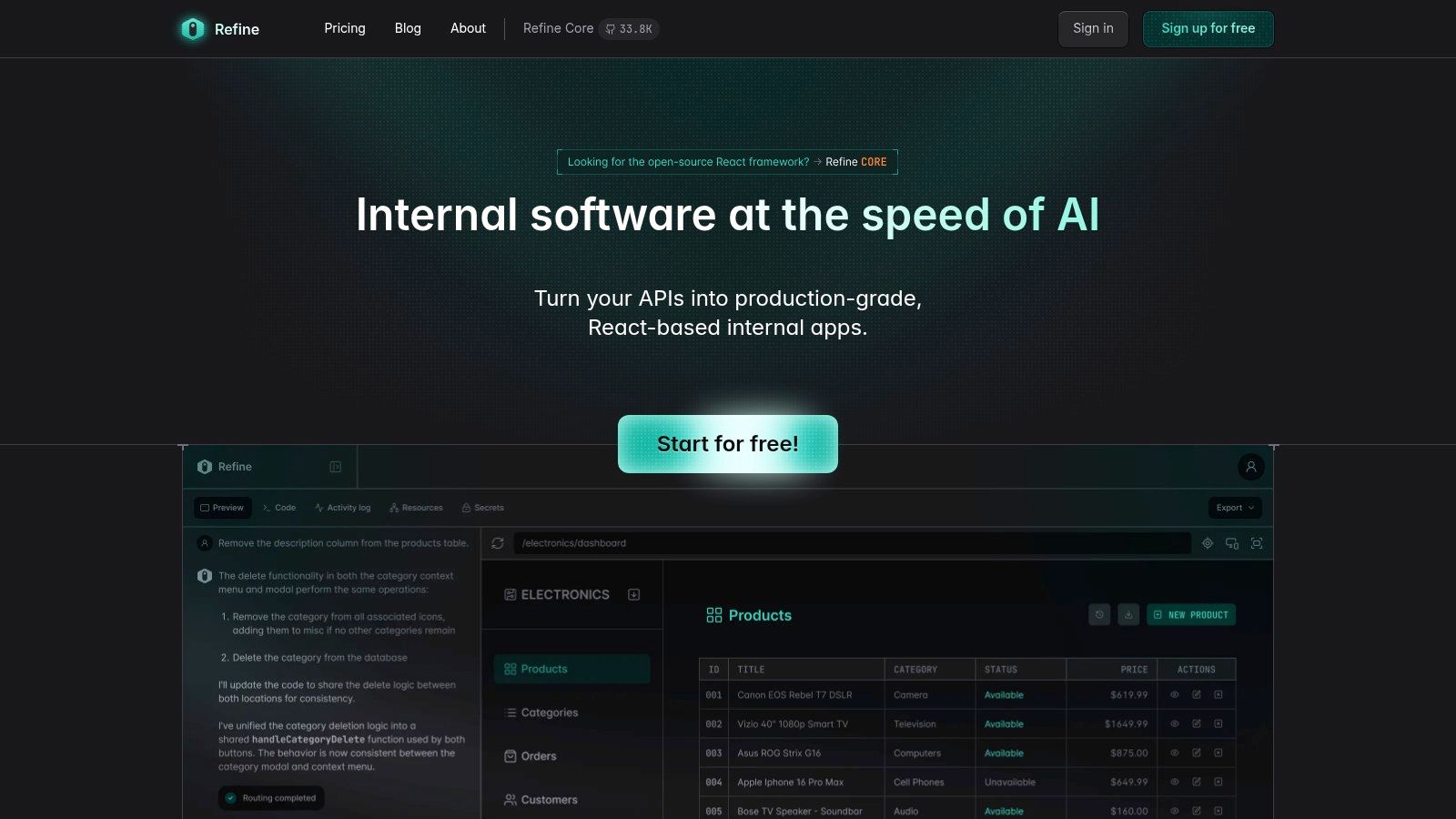
The framework's headless nature is its core strength. Unlike opinionated frameworks, Refine doesn't dictate your UI. It provides a powerful set of hooks, components, and data providers that handle the repetitive, complex logic of CRUD operations, authentication, routing, and access control. This allows your team to bring any UI library they prefer, such as Ant Design, Material UI, or Chakra UI, and focus on building features rather than reinventing the wheel.
Key Features & Production Readiness
Refine is engineered to get production-grade internal tools built fast. Its architecture is centered around Data Providers, which are simple adapters that connect your frontend to any backend, including REST APIs, GraphQL endpoints, and BaaS platforms like Supabase or Firebase. This abstraction makes it incredibly easy to switch data sources without rewriting your UI components.
The framework comes with out-of-the-box solutions for common enterprise needs, including robust authentication flows, role-based access control (RBAC), and internationalization (i18n). Because the entire codebase is React, it is fully exportable and self-hostable, giving you complete control over your data and infrastructure, which is a critical requirement for compliance and long-term scalability. This makes it a strong contender for the best react framework for internal application development.
Recommended Stack & Migration Path
For a startup building a sophisticated internal dashboard or customer-facing portal, a common Refine stack includes:
- UI Kit: Ant Design or Material UI (MUI) for a comprehensive set of enterprise-grade components.
- Data Source: Supabase for a seamless PostgreSQL backend with a direct Refine data provider, or a custom REST API.
- Styling: Your chosen UI kit's styling solution (e.g., Emotion with MUI) or Tailwind CSS.
- Deployment: Vercel or Netlify for the frontend, with your backend hosted on your preferred cloud provider.
Founder Insight: If your support team is living in a messy spreadsheet or a slow, custom-built admin panel, Refine is your escape hatch. It provides the speed of a low-code tool but with the power and extensibility of a full-code solution, allowing you to build the exact operational dashboard your business needs to scale.
Final Verdict: Is Refine for You?
Refine is the ideal choice for teams tasked with building data-heavy, CRUD-intensive applications. It shines brightest for internal tools, admin panels, and customer support dashboards where development velocity and reliable data handling are paramount. While it's not designed for building public-facing marketing websites, its specialization is its greatest strength, offering a highly optimized developer experience for a specific, critical business need.
- Pros: Radically accelerates internal tool development, highly unopinionated and flexible (bring your own UI/backend), and offers enterprise-ready features like auth and access control out of the box.
- Cons: Niche focus makes it unsuitable for content-driven sites like blogs or marketing pages, and its ecosystem is smaller and more specialized compared to general-purpose frameworks like Next.js.
7. Astro
Astro is a modern, content-focused web framework that positions itself uniquely in the React ecosystem. While not a pure React framework, its “islands architecture” makes it a compelling choice for founders building performance-critical sites. Its official website, astro.build, serves as an excellent entry point, showcasing its philosophy of shipping zero client-side JavaScript by default. For startups whose primary product is content-driven, like a blog, documentation site, or marketing hub, Astro offers a path to incredible speed by rendering React components only where interactive functionality is explicitly needed.
The framework’s power comes from its server-first rendering model with partial hydration. Instead of shipping a large JavaScript bundle to the client to make the page interactive (like a traditional Single Page Application), Astro renders the UI to static HTML on the server. You can then "hydrate" individual components, or "islands," with frameworks like React, Vue, or Svelte. This surgical approach ensures your site loads instantly, boosting Core Web Vitals and SEO performance, which is a critical advantage for content-led growth strategies.
Key Features & Production Readiness
Astro is built for speed and content management. It offers file-based routing similar to Next.js, making page creation intuitive. Its Content Collections API provides a type-safe way to manage and query local Markdown and MDX files, which is perfect for building blogs or knowledge bases without needing an external CMS.
Key production-ready features include built-in image optimization, middleware for handling server-side logic like authentication checks, and one-line deployment adapters for major platforms like Vercel, Netlify, and Cloudflare. This makes Astro a robust, performant choice that challenges dedicated static site generators like Gatsby while offering more flexibility for dynamic interactivity. It's an excellent candidate for the best react framework when your primary goal is content delivery with targeted user engagement.
Recommended Stack & Migration Path
For a startup focusing on content and performance, a common Astro stack includes:
- UI Components: React for interactive islands like a search bar or a newsletter signup form.
- Content: Local Markdown/MDX files managed with Content Collections for speed and simplicity.
- Styling: Tailwind CSS, which integrates seamlessly with Astro's component-based structure.
- Deployment: Netlify or Vercel for their powerful CI/CD pipelines and global CDN.
Founder Insight: If your company's growth depends on organic search and your marketing site on Webflow is becoming slow or expensive, Astro is the perfect migration target. You can rebuild your content-heavy pages for maximum SEO performance while still using React to embed complex, interactive features like a pricing calculator or a customer portal login.
Final Verdict: Is Astro for You?
Astro excels for teams building content-rich websites where initial page load speed is non-negotiable. Its ability to mix and match UI frameworks is a unique strength, allowing you to use the best tool for each component. While it’s not designed for building highly complex, state-heavy web applications like a social network or a project management tool, it is an unparalleled choice for marketing sites, e-commerce storefronts, and documentation platforms.
- Pros: Outstanding performance and SEO due to zero-JS-by-default architecture, and flexibility to use React components only where needed.
- Cons: Not a traditional React-only framework, which can be a mental shift for SPA developers. Building deeply interactive, stateful applications might be simpler in a full-stack React framework like Next.js or Remix.
Top 7 React Frameworks Comparison
| Framework | Implementation complexity | Resource requirements | Expected outcomes | Ideal use cases | Key advantages |
|---|---|---|---|---|---|
| Next.js | Moderate–high (App Router, RSC learning curve) | Standard Node hosting; optimized on Vercel; moderate build resources | Production-ready full‑stack apps with SSR/ISR and strong performance | Enterprise apps, e‑commerce, teams moving from prototype to production | Mature ecosystem, built‑in performance tooling, smooth Vercel path |
| Remix | Moderate (web‑standards patterns different from SPA) | Flexible — works on Node or edge runtimes; moderate server resources | Resilient, accessible UX with strong form/mutation patterns | Apps prioritizing progressive enhancement, complex forms, long‑term maintainability | Web‑standards‑first, robust loaders/actions, nested routing |
| Gatsby | Moderate (GraphQL data layer adds complexity) | Build‑heavy for large sites; static hosting; many plugins | Fast, content‑optimized static sites with excellent image handling | Content‑heavy marketing sites, blogs, documentation | Powerful data layer, mature image optimization, extensive plugins |
| RedwoodSDK | Moderate (opinionated server‑first + Vite/edge specifics) | Edge‑native (Cloudflare services recommended); local emulation tools | Edge‑performant SSR apps with simple developer experience | Teams deploying to Cloudflare edge who want full‑stack conventions | Native Cloudflare integration, Vite dev UX, minimal “magic” |
| Blitz.js | Low–moderate (conventions and scaffolding reduce boilerplate) | Similar to Next.js hosting; faster prototyping reduces dev cost | Rapid CRUD prototypes and consistent full‑stack apps with auth patterns | Startups, MVPs, teams needing rapid prototyping and CRUD apps | Batteries‑included scaffolding, strong TypeScript support, easy Next.js migration |
| Refine | Low (headless hooks/providers simplify common tasks) | Works with REST/GraphQL/SaaS backends; modest hosting needs | Fast delivery of internal tools and admin panels with RBAC/CRUD | Internal dashboards, SaaS admin interfaces, ops tools | Headless and UI‑agnostic, built‑in CRUD/auth/i18n integrations |
| Astro | Low–moderate (islands architecture differs from SPA) | Minimal client JS by default; supports many adapters for hosting | Highly performant, SEO‑friendly content sites with selective interactivity | Marketing sites, blogs, docs, SEO‑driven content projects | Zero‑JS‑by‑default islands, multi‑framework support, excellent perf |
The Road to Production: Making Your Final Decision
Navigating the landscape of React frameworks can feel overwhelming, but arriving at this point means you're equipped with the insights needed to make a strategic, founder-focused decision. We've journeyed through the server-side rendering powerhouse of Next.js, the web standards-driven architecture of Remix, and the static-site generation excellence of Gatsby. We also explored innovative solutions like Astro for content-heavy sites, and full-stack, "batteries-included" frameworks like RedwoodJS and Blitz.js that accelerate development by unifying the front-end and back-end.
The central takeaway is this: there is no single "best react framework" that universally outperforms all others. The optimal choice is a direct reflection of your product's requirements, your team's expertise, and your long-term business goals. Your decision is not just a technical one; it's a strategic investment in your company's future agility and scalability.
From Analysis to Action: Your Decision-Making Checklist
Before you commit, consolidate your findings by running your top contenders through this final checklist. This forces you to move beyond feature comparisons and focus on real-world implementation and business impact.
- Re-evaluate Your Core Product Need: Is your primary challenge delivering highly dynamic, interactive user experiences (favoring Next.js or Remix), or is it serving blazing-fast, content-rich pages (leaning towards Astro or Gatsby)? If your goal is rapid, monolithic full-stack development with tight conventions, RedwoodJS or Blitz.js might be the answer.
- Assess Your Team's Skillset (or Hiring Plan): Does your team have deep React experience but less back-end expertise? A framework like Next.js with its managed serverless functions offers a gentle on-ramp. Conversely, a framework like RedwoodJS, with its opinionated GraphQL and Prisma setup, requires a commitment to its specific architecture but can greatly boost productivity for teams aligned with its philosophy.
- Map Your Migration Path: For those moving from no-code platforms like Bubble or Webflow, the transition is more than just rebuilding UIs. You must consider data migration from proprietary databases to PostgreSQL, recreate complex business logic, and re-implement integrations previously handled by Zapier. How easily does your chosen framework's ecosystem support these tasks? Next.js and Remix have vast ecosystems that make finding libraries for auth (Clerk, Supabase Auth), payments (Stripe), and databases straightforward.
- Consider the Total Cost of Ownership: Think beyond the initial build. What does the hosting look like? Vercel offers a seamless experience for Next.js but can become costly at scale. How complex is the CI/CD pipeline? A simpler static site from Gatsby or Astro will be cheaper and easier to deploy on platforms like Netlify or Cloudflare Pages compared to a complex, serverful application.
Key Insight: Your final choice should be the framework that introduces the least friction between your current state and your goal of shipping a scalable, production-ready application. It's about maximizing your team's velocity and minimizing architectural risks.
Choosing the best React framework is a critical step, but it is only the beginning. The execution that follows, from meticulous data migration to deploying a secure and performant application, is where the real challenge lies. The path from a fragile no-code MVP to a robust, investor-ready tech stack is a specialized engineering problem that demands experience and focus. As you embark on this journey, remember that the goal is not just to build a product but to build a foundation for sustainable growth.
Choosing a framework is just the first step. If you're ready to migrate your no-code MVP to a production-grade stack without losing momentum, First Radicle specializes in turning fragile projects into scalable software in just six weeks. We handle the full-stack migration to modern technologies like Next.js and PostgreSQL, giving you a clean architecture and 100% IP ownership. Build a tech stack that investors will love and customers can rely on by visiting us at First Radicle.