
When to Evolve Beyond the Bubble Web Builder
The Bubble web builder is one of the most powerful tools in the no-code universe. It gives founders the ability to design, build, and launch complex web applications without needing to write a single line of code. For getting a Minimum Viable Product (MVP) off the ground, it's a game-changer, letting you turn a concept into a working product in weeks, not months.
The Founder's Dilemma of No-Code Success

For so many startups, the Bubble web builder is the perfect launchpad. It breaks down the barriers to tech development, allowing entrepreneurs to get their ideas in front of real users, collect feedback, and rapidly iterate. Think of it as the ultimate prototyping tool that just happens to be a fully functional application that can handle your first wave of customers.
But this early success often brings you to a crossroads. What happens when your MVP starts to feel less like a "product" and more like a real, growing business? The very platform that gave you your incredible launch speed can start to feel like it's holding you back. This isn't a failure—it's the best problem to have. It's a sign of success.
When Your Growth Creates a Problem
Your app is gaining traction, you're getting more users, and the data is piling up. Suddenly, your success is your biggest technical problem. The limitations baked into the no-code platform start to show, creating what we call the founder's dilemma: the tool that got you here might not be the one to get you there. This guide is for you, right at that pivotal moment.
We've put together a clear roadmap for founders, whether you're technical or not, to figure out what comes next.
We’re going to walk through:
- The early warning signs that your app is starting to burst at the seams.
- The real technical and business walls you'll hit as you scale.
- Your options for migrating, from trying it yourself to hiring specialists.
- How to build a scalable, investor-friendly tech stack for the future.
This leap from a no-code MVP to a custom-coded platform is a natural, exciting stage of growth. It means you’ve built something people genuinely want. Now it's time to build something that can last.
This guide is designed to take the stress and mystery out of a journey many successful startups face. If you're starting to think about what a truly durable application looks like, you can get a head start by reading our article on what makes a system enterprise-level.
The Strengths and Scaling Limits of No-Code
To really get why a project might need to move off of the Bubble web builder, we first have to appreciate what makes it so brilliant for getting started. At its core, Bubble is an idea-to-reality machine. It's hands-down one of the fastest ways to turn a concept into a working, data-driven web app. For building a Minimum Viable Product (MVP), it’s a game-changer.
Think of Bubble as a highly advanced set of digital LEGOs. You can click and drag your way to building surprisingly complex applications—two-sided marketplaces, social networks, sophisticated internal dashboards—all without touching a line of code. This visual-first approach is incredibly empowering, especially for founders who aren't engineers. It lets them build, test, and tweak their products in days, not months, saving a ton of time and money.
The Power of Rapid Prototyping
The real magic of Bubble is the feedback loop. You can ship a new feature in the morning, see how real users react to it by lunch, and push a revised version by the end of the day. That kind of agility is an enormous advantage when you’re still hunting for product-market fit.
This is why Bubble has become such a titan in the no-code space. Since its launch back in 2012, its growth has been staggering. It's on track to power over 4.69 million apps by mid-2025, with a community that’s already over 3 million strong. This isn’t just a fluke; it speaks to a bigger shift where teams can launch products up to 10x faster than the old way. It's no wonder Bubble grabbed 25% of the market share for web app builders in 2024. For more on this growth, check out the data from Radicle Science.
Where the LEGO Model Reaches Its Limits
But the LEGO analogy cuts both ways. You can build an incredible, detailed model of a skyscraper with LEGOs, but you’d never use them to build the actual building. A real skyscraper needs a steel frame, deep foundations, and complex systems designed to handle the immense pressures of the real world—things LEGOs just aren't made for.
A successful Bubble app eventually runs into the same problem. The very foundation that made it easy to build starts to buckle under the pressure of real-world scale. As your user base, data, and feature complexity grow, you start to feel the platform's constraints.
The table below breaks down how the very features that are strengths in the beginning can become serious limitations later on.
Bubble Strengths vs Scaling Limitations
| Feature | Strength (MVP Stage) | Limitation (Scaling Stage) |
|---|---|---|
| Development Speed | Launch features in hours or days, enabling rapid iteration. | Custom features become difficult or impossible to implement. |
| Database | Integrated, easy-to-use database for quick setup and management. | Performance degrades with large datasets, leading to slow queries. |
| Infrastructure | Fully managed hosting, no server management required. | Lack of control over server resources, leading to performance issues. |
| Cost | Low initial cost with predictable subscription plans. | Costs for capacity and third-party integrations can spiral. |
In short, you start to hit ceilings. The app might get sluggish during peak traffic. Your database searches start timing out. The monthly bill for all those necessary third-party plugins and connections to tools like Zapier and Airtable starts to look a lot less predictable.
The very things that make the Bubble web builder the perfect launchpad—its all-in-one nature and visual abstraction—become constraints when you need granular control, raw performance, and true ownership of your technology.
On top of that, investors often get wary. They ask tough questions about vendor lock-in and intellectual property, since with Bubble, you don't actually own the underlying source code. If you want a broader view on how different platforms stack up, our guide on the best no-code web app builders is a great place to start.
Warning Signs Your App Has Outgrown the Bubble Web Builder
Knowing when to move on from the Bubble web builder is a massive milestone for any startup. It's a fantastic tool for getting an MVP off the ground and proving your concept, but as you grow, you'll start to see the seams stretch. These aren't signs of failure; they’re growing pains—signals that you've built something people actually want to use.
The most obvious and painful symptom is performance. Everything just starts to feel slow. Pages that used to pop now take ages to load. Complex searches begin to time out. This isn't just a nuisance; it's a direct hit to your user experience and retention. A sluggish app will bleed users you fought hard to win.
Spiraling Costs and Technical Debt
Another red flag is a monthly bill that keeps creeping up. To plug the gaps in Bubble's native functionality, you start adding more and more third-party tools. Your Zapier bill explodes, you're paying for external databases, and you've created a tangled mess of integrations that feels incredibly fragile.
When your team starts building “workarounds for the workarounds,” you’re no longer using the platform for its strengths. You're just digging a hole of technical debt that makes it harder and harder to ship new features or innovate.
This flowchart maps out the tough questions founders face when performance, cost, or investor feedback start becoming serious problems.
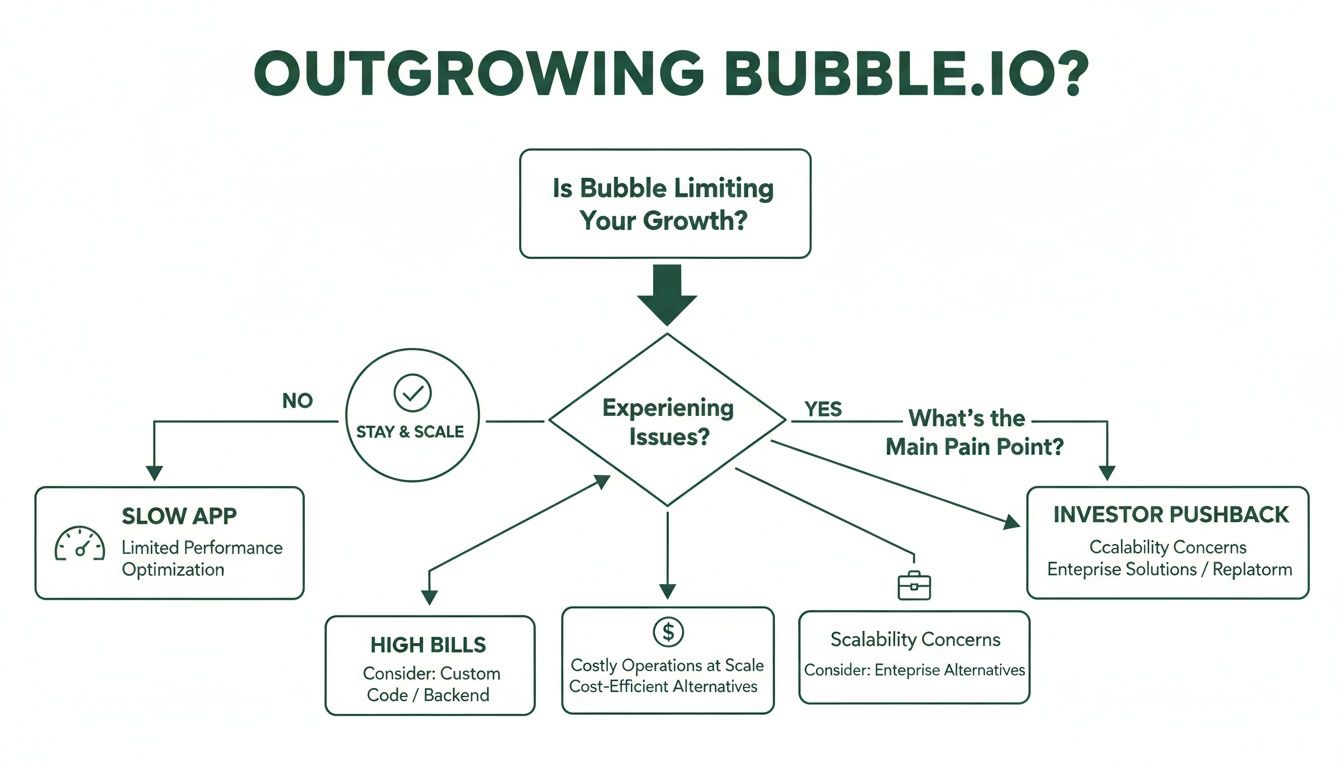
As you can see, things like a slow app, high operational costs, and nervous investors are all clear signs that your Bubble app is hitting a ceiling.
When External Pressures Force a Change
Sometimes, the push to migrate comes from the outside. You might hit a point where you need to meet serious security and compliance standards, like HIPAA or SOC 2, which can be a real struggle on Bubble's shared infrastructure.
And then there are the investors. It's incredibly common for VCs to raise an eyebrow when they see a no-code platform at the core of a scaling business. They worry about scalability, who owns the IP, and vendor lock-in, seeing it as a major risk. That conversation alone is often the final nudge a founder needs to start planning a move to a custom codebase.
The numbers here don't lie. A 2023 Bubble community survey revealed that 68% of users saw performance crashes with fewer than 10,000 monthly active users. During traffic spikes, load times shot up by 400%, causing 42% of founders to abandon their projects altogether. On top of that, enterprise users overspending on high-tier plans experienced integration failures in 55% of cases, costing them an average of $15,000 extra per year just on workarounds. You can dig into more of these growth challenges on Radicle Science.
Your Migration Roadmap from No-Code to a Custom Stack
Realizing your app has outgrown the Bubble web builder is the easy part. The hard part is figuring out what comes next. Moving from no-code to a custom stack is a huge step for any startup, and you’ve got a few different ways to get there. Each path comes with its own set of trade-offs in cost, time, and how much you, the founder, have to be involved.
Making the right call really boils down to your specific goals, your budget, and how fast you need to move. Let’s break down the options so you can choose a path that sets you up for growth, instead of getting you stuck in a project that drains your resources.
Option 1: The DIY Freelancer Approach
The first path many founders look at is hiring and managing freelancers themselves. On the surface, it looks like the most cost-effective option. You can hand-pick developers for the frontend, someone else for the backend, and maybe another expert for the database. You get a lot of control.
But here’s the catch: this route makes you the project manager. That’s a massive time sink, and it demands a fair bit of technical know-how. You’ll be the one juggling different freelancers who’ve never met, writing detailed project specs, and making sure the quality is there. The risk of things getting lost in translation is huge, and those small miscommunications can lead to big delays and a final product that feels stitched together. Often, the hidden costs of fixing these issues wipe out any initial savings.
Option 2: The Traditional Agency Rewrite
Your second option is to hire a traditional, full-service development agency. They’ll give you the whole package—project managers, designers, developers—to handle everything from start to finish. It’s a much more structured process and takes a lot of the day-to-day management off your plate.
The big downside here is the cost and the timeline. A complete rewrite with a traditional agency is a serious investment, often taking 6-12 months and costing well over $100,000. For a startup, that kind of timeline can be a killer.
While you're waiting for the new platform to go live, your competitors are shipping new features. That long of a development cycle can burn through your runway before you even get to launch. It’s the safe route, but it's also incredibly slow and expensive. Getting a handle on the basics can help you have more productive conversations; our guide on how to create a database is a good place to start.
Option 3: The Specialist Migration Agency
There’s a third, more modern path: working with a specialist migration agency. Unlike a generalist firm that does everything, these agencies do one thing and do it well: move apps from no-code platforms like the Bubble web builder to production-grade code. Their entire process is built for this exact job.
This approach has some serious advantages:
- Speed: They work on much faster timelines, often getting a full migration done in a fixed timeframe, like six weeks.
- Predictability: The projects are usually fixed-scope and fixed-price. You know exactly what you’re paying and what you’re getting, which ends the financial anxiety of open-ended agency retainers.
- Expertise: This is their bread and butter. The team knows the specific headaches of a no-code migration inside and out, from mapping your data correctly to perfectly recreating complex workflows in code.
By using a repeatable, proven playbook, specialist agencies give you the speed you'd hope for from freelancers with the reliability and structure of a traditional agency. It’s a balanced solution for founders who need to scale smart and fast.
How a Specialist Migration Delivers a New App in Six Weeks
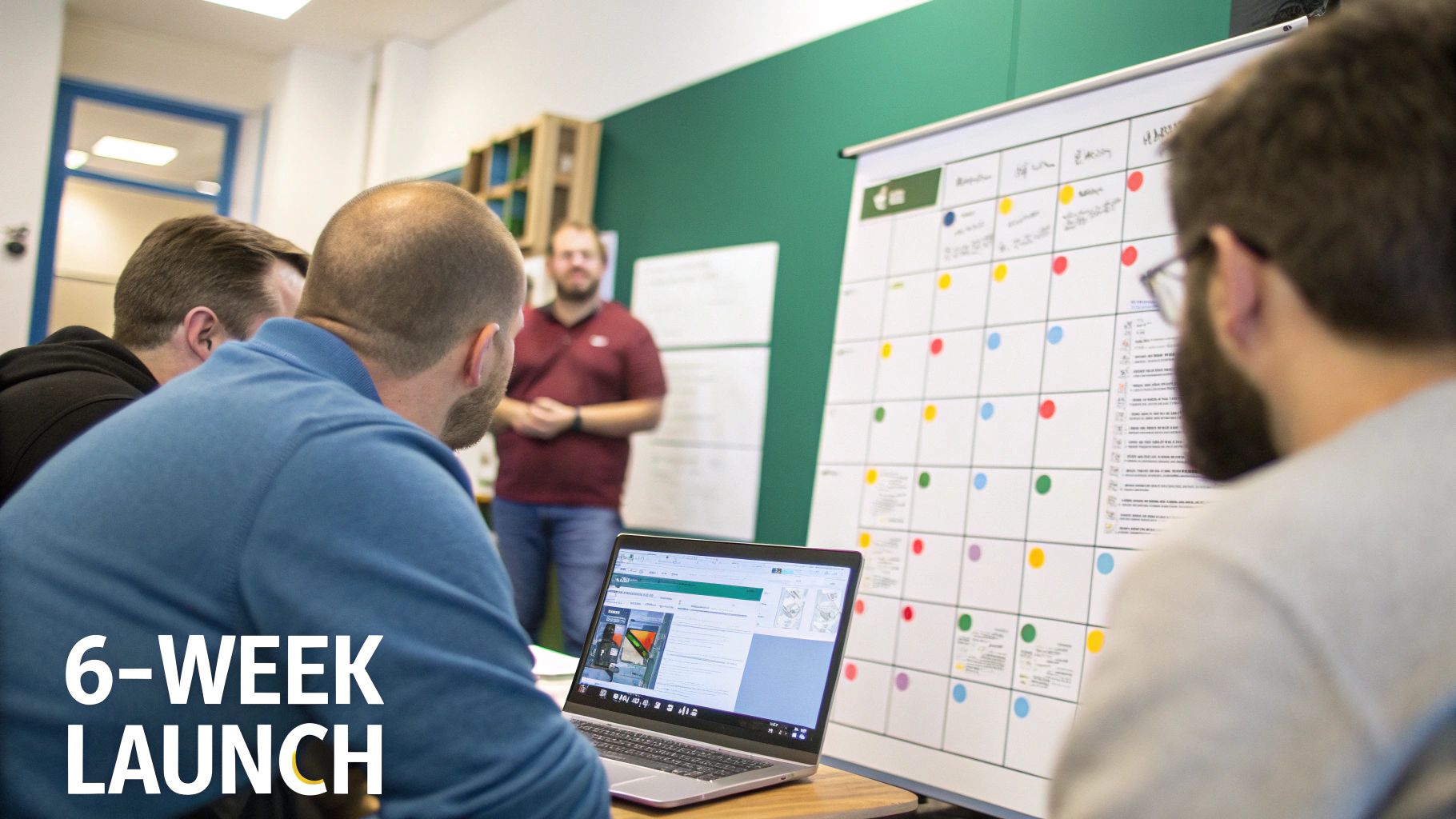
The thought of a six-to-twelve-month rewrite is enough to give any founder nightmares. The market doesn't wait, and that kind of timeline can easily burn through your runway before you even get a chance to launch. A specialist migration, on the other hand, is built for speed. It’s a focused process that can condense the entire rebuild into a predictable six-week sprint.
How is that possible? It's simple: we're not reinventing the wheel. We're rebuilding a product that already works on a foundation that's built to last. A specialist agency follows a battle-tested playbook, using your existing Bubble app as the blueprint. This completely bypasses the months of discovery and guesswork that bog down traditional development projects.
The whole journey is broken down into three clear, manageable phases. Each step is designed to keep things moving, deliver tangible results, and give you total clarity from start to finish.
Phase 1: The Blueprint and Schema Mapping
The migration kicks off with a laser-focused planning phase. We’re not just looking at what your users see; we're diving deep into the engine room of your app. The mission is to translate your Bubble app’s entire structure—its database, workflows, and user logic—into a detailed technical spec for a truly scalable system.
This initial phase involves:
- Schema Mapping: We painstakingly map every single field from your Bubble database to a new, high-performance PostgreSQL schema. This ensures nothing gets lost in translation and that your new database is optimized right out of the gate.
- Technical Architecture: We lay out the backend architecture, often using modern tools like Python, and define the frontend with a powerful stack like React and Next.js.
- Project Kickoff: Once you’ve approved the blueprint, we lock in a fixed scope and timeline. Everybody is on the same page before a single line of code gets written.
Phase 2: Six Weeks of Sprint Development
With the blueprint signed off, the real fun begins. This is an intense, six-week period of agile, sprint-based development. Instead of leaving you in the dark for months, we give you a front-row seat as your new application comes to life.
This phase is all about execution and transparency. We hold weekly demos where you can see the new features live on a staging server. This constant feedback loop ensures the final product perfectly matches your expectations.
While the sprints are running, we also tackle the critical task of data migration. Your user data is moved from the Bubble web builder to the new database in stages. It all culminates in a final sync right before launch, guaranteeing a completely seamless switch for your users.
Phase 3: The Handover and Full Ownership
The final phase is the handover, and it's a big one. Unlike the no-code world where you're essentially renting your platform, you now gain 100% ownership of your intellectual property. We transfer the complete, clean codebase to your private GitHub repository and give you the keys to all the infrastructure running on your cloud provider.
You walk away with a scalable, secure, and maintainable application that’s ready for its next chapter of growth. By making this move, you avoid becoming another cautionary tale. Statistically, Bubble web builder projects see a 72% churn rate when they hit scalability walls, with 81% of users reporting database timeouts once they cross the 5,000-row mark. A successful migration puts those limitations firmly in the rearview mirror.
Common Questions About Migrating from Bubble
Thinking about moving on from the Bubble web builder is a huge step. It’s a major investment in your company's future, so it’s completely normal to have a ton of questions.
We’ve heard all the common worries and concerns from founders facing this decision. Let's tackle them head-on with some straight answers, so you can see the path forward clearly.
Will I Lose All My User Data During the Migration?
Absolutely not. This is usually the first and biggest fear, but keeping your data safe is the top priority of any professional migration. A sloppy process isn't an option.
It all starts with a detailed plan. We meticulously map every single field from your Bubble database to its new home in a scalable database like PostgreSQL. Every user, every transaction, every piece of data is accounted for. The final switch happens during a very short, planned downtime window, so your users experience a seamless transition with zero data loss.
What Does a Migration from Bubble Typically Cost?
This is where things can get tricky because the price tag for leaving the Bubble web builder can vary dramatically. If you go the traditional agency route for a full rewrite, you could easily be looking at $100,000 or more, with the project dragging on for the better part of a year. Juggling a team of freelancers might look cheaper on paper, but that path is often full of hidden costs, missed deadlines, and a massive project management headache for you.
A specialist migration agency works differently. We treat it as a fixed-scope, fixed-timeline project. You get total certainty on the cost and a guaranteed result in a fraction of the time. It’s about delivering real value and taking the financial guesswork out of the equation.
This approach is all about getting your new platform launched quickly, without the budget blowouts that can derail a growing company.
Can My Team Manage the New Codebase After Handover?
Yes, and that’s the whole point. A proper migration isn't about trading one black box for another; it's about giving you freedom and control.
We build the new application on a modern, well-documented tech stack with clean, easy-to-understand code. Once we're done, we hand over everything: the complete codebase in a private GitHub repository and all the infrastructure keys. Any competent developer—whether they’re on your team now or someone you hire in the future—can jump right in, maintain the system, and start building new features. You're no longer locked into any single vendor.
Is Migrating Worth It if My Bubble App Still Works?
If your app is getting sluggish, your Zapier and Airtable bills are climbing, or you're getting ready to talk to VCs, then yes—it’s absolutely worth it. Waiting until your app completely breaks is a dangerous game. It puts your revenue and your customers’ trust at risk.
Moving proactively is a smart, strategic investment. It cuts down your operational costs, makes your app far more reliable, and opens the door for real growth. More importantly, it secures your intellectual property and proves you have a scalable tech foundation, making your company infinitely more attractive to investors. It’s not just an expense; it’s a powerful competitive advantage.
If your success is pushing the limits of no-code, First Radicle can help. We turn fragile Bubble projects into production-grade software in six weeks, guaranteed. Find out how we do it.