
A Founder's Guide to Building Scalable Web Applications
That rush of getting your MVP out the door with Bubble, Webflow, or Airtable is incredible. It’s proof your idea has legs. You validated the market, got real users, and did it all without sinking a fortune into engineering.
But now, you’re starting to feel the friction. This isn't a failure—it's the opposite. It's the critical turning point every successful startup hits, where the tools that got you here won't get you where you need to go.
When Your No-Code MVP Hits a Growth Wall
The journey from a clever, scrappy MVP to a robust, ownable asset is a rite of passage. The very platforms that gave you speed and agility are now becoming the bottlenecks that throttle your growth. It’s time to trade the training wheels for an engine.
Recognizing the Tipping Point
The signs you've outgrown your no-code stack are often subtle at first, then they become impossible to ignore. A little lag during peak hours becomes a full-blown outage. A few Zapier bills you barely noticed are now a major line item on your P&L.
You're probably hitting this wall if you’re nodding along to any of these:
- Performance Bottlenecks: A marketing campaign goes viral and your app grinds to a halt. The user experience suffers, and you look unreliable at the worst possible moment.
- Soaring Operational Costs: Your Zapier bill is eye-watering. You're drowning in a sea of premium subscriptions for various tools that are duct-taped together, creating a confusing and expensive "subscription sprawl."
- Hitting Platform Ceilings: You've blown past the record limits in Airtable or are wrestling with Bubble’s database constraints, forcing your team into bizarre, time-consuming workarounds.
- Preparing for Due Diligence: You're heading into a fundraising round, and VCs are asking tough questions about your tech stack, intellectual property, and your plan to handle 10x growth.
We've documented this entire playbook in our guides on how to migrate from Bubble to production-grade code.
The moment your team spends more time fighting your no-code platform than building features for your customers, you’ve hit the wall. This is your signal to invest in an ownable, scalable asset.
The Strategic Shift to Ownership
Migrating your app isn’t just a technical upgrade; it's a fundamental business decision to build long-term, defensible value. When you own your codebase, you control your destiny. No more surprise price hikes, platform limitations, or outages beyond your control.
To give you a clearer picture, let's break down the key differences between your current MVP and the production-grade application you're building toward.
No-Code MVP vs. Scalable Web App Key Differences
This table highlights the high-level trade-offs and shows why making the switch is so crucial for long-term growth.
| Attribute | No-Code MVP (e.g., Bubble, Webflow, Airtable) | Scalable Web App (e.g., React, Python, PostgreSQL) |
|---|---|---|
| Primary Goal | Speed to market, concept validation | Reliability, performance at scale, feature depth |
| Ownership | Rented from a platform; vendor lock-in | Fully owned intellectual property |
| Scalability | Limited by platform's architecture and pricing tiers | Designed for horizontal scaling; virtually limitless |
| Performance | Slows under load; interpretive overhead | Highly optimized; direct control over infrastructure |
| Customization | Constrained by pre-built elements and plugins | Complete freedom to build any feature or integration |
| Data Integrity | Basic; often lacks true relational constraints | Enforced at the database level (foreign keys, transactions) |
| Cost Model | Per-user, per-workflow, or per-record fees; scales poorly | Pay-for-what-you-use infrastructure; scales efficiently |
| Security | Dependent on the platform's security practices | Full control to implement custom security measures (OWASP) |
As you can see, the shift is from a platform that gets you started to an asset that lets you compete and win.
This transition from a functional-but-fragile MVP to a robust platform is precisely why the global web development services market is projected to hit $125.4 billion by 2030. The data is stark: over 70% of no-code projects stall after their initial traction, often because they lack a powerful backend like PostgreSQL or a modern frontend framework like React. This migration isn't just about survival; it's about turning your product into a defensible asset, ready for serious growth.
Creating Your Migration Blueprint
Jumping straight into code without a clear plan is the fastest way to derail your migration. I've seen it happen. A solid blueprint is your best defense against scope creep, budget overruns, and a final product that just misses the mark.
Think of this phase as de-risking the entire build. This is where you translate your no-code setup into a clear set of requirements for an engineering team. It forces you to get brutally honest about what really matters for V1 of your production-grade app, making the whole project predictable and—most importantly—successful.
This is the classic journey: you get traction with a no-code MVP, hit the inevitable growth ceiling, and then it's time to build something that can truly scale.
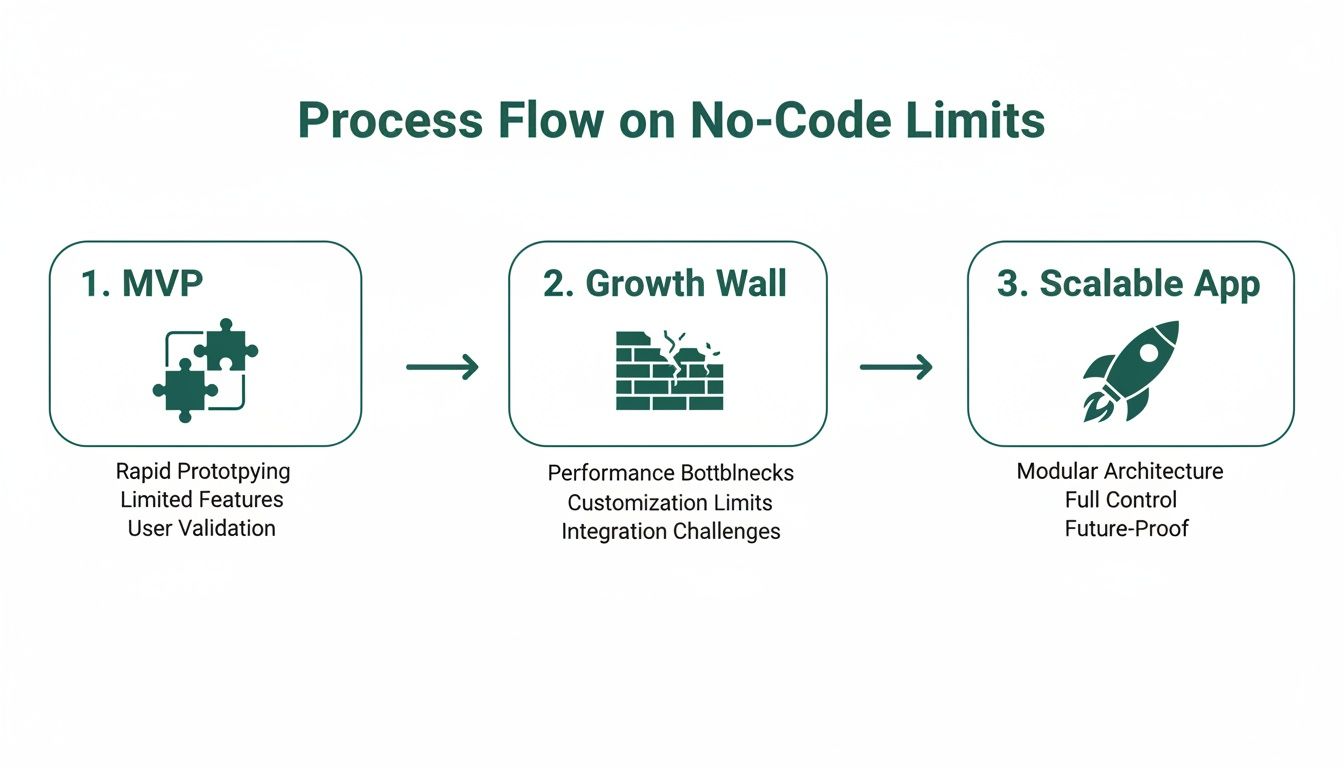
This transition point is where so many promising products stumble. A good blueprint ensures you don't.
Translate Your No-Code Schemas
Your current data structure, whether it's an Airtable base or a Bubble database, is the heart of your application. The very first thing to do is map this structure into a logical schema for a real relational database like PostgreSQL. This isn't just a copy-paste job; it’s your first big chance to optimize for scale.
For instance, a "multi-select" field in your Airtable probably needs to become a proper many-to-many relationship using a join table in PostgreSQL. This one change ensures data integrity and makes complex queries ridiculously faster down the road. You need to document every single one of these mappings. For a deeper look at this process, check out our guide on database migration best practices.
A well-designed database schema is the bedrock of any scalable web app. Getting this right from the start prevents countless performance headaches and makes adding new features so much easier later on.
Audit Your Automation Workflows
Zapier, Make, or whatever else you're using is probably the glue holding your MVP together. Your migration blueprint has to account for every critical workflow. Start by auditing your Zaps and identifying the actual business logic they represent.
- User Onboarding: What really happens when a new user signs up? Document the sequence of welcome emails, CRM updates, and internal Slack notifications.
- Payment Processing: Map the entire flow. From a user clicking "purchase" to the final confirmation email, including all the Stripe webhooks, subscription updates in your database, and failure notifications.
- Core App Logic: Are there automations that are central to your product's function, like generating a weekly report or processing user-submitted data? List them out.
This audit isn't just a list. It's the functional spec for the backend logic your engineers will build with clean, reliable Python code. A good software architecture diagram is the perfect way to visualize how these new services will connect and replace your Zaps.
Ruthlessly Prioritize Your Feature Set
Your no-code app is probably cluttered with features that were easy to add but are rarely used. This migration is your chance to focus on what delivers 80% of the value. Trying to replicate every single feature from day one is a classic, costly mistake.
Get practical. Create a simple list and categorize every feature:
- Must-Have: These are non-negotiable. Think user authentication, the primary user action, and payment processing. If the app can't function or make money without it, it's a must-have.
- Should-Have: Important features that make the app better but aren't deal-breakers for the initial launch. These are perfect candidates for a fast-follow release.
- Nice-to-Have: Features that add polish but are not critical. Push them to the bottom of the backlog. No exceptions.
This ruthless prioritization is what makes a focused six-week build possible. It ensures your initial launch is lean, stable, and delivers the core functionality your users actually depend on. Everything else can wait. This is the blueprint that keeps your build on track and on budget.
So, you’ve outgrown your no-code MVP. That’s a great problem to have. Now comes the critical decision: choosing the right tech stack to carry your vision forward. This isn’t just about rebuilding what you have; it’s about laying a foundation that can handle real scale, complexity, and whatever your roadmap throws at it.
A common mistake I see founders make is picking tech based on what's trending on Hacker News instead of what’s right for the job. For most web applications graduating from the MVP stage, a powerful, pragmatic, and battle-tested trio is React/Next.js for the frontend, Python for the backend, and PostgreSQL for the database. Let’s break down why this stack just works.
Why React and Next.js for the Frontend
Your UI is your product. If it feels slow or clunky, users will leave. While your no-code tool got you a clickable interface, React, supercharged with the Next.js framework, delivers a genuinely professional experience.
Next.js gives you server-side rendering (SSR) and static site generation (SSG) right out of the box. What does that mean for you? Blazing-fast page loads. This isn't a minor tweak; it's a massive factor in user retention. More importantly, it’s a huge SEO win. Search engines can easily crawl pre-rendered content, something many no-code tools built on client-side rendering really struggle with.
- Exceptional Performance: Pages feel instantaneous, creating that snappy, responsive experience users expect from a serious product.
- Built-in SEO: Server-side rendering makes your application visible to Google from day one, helping you drive organic traffic without fighting your tools.
- Component-Based Architecture: React's modular nature means we can build reusable UI components. This speeds up future development and keeps your design language consistent as you grow.
This isn’t just an upgrade; it’s a transformation from a functional prototype to a high-performance platform that builds user trust.
The Power of a Python Backend
Those clever Zapier workflows and Airtable automations that held everything together? They were smart, but they were also brittle and surprisingly expensive. A custom Python backend rips out that fragile web of integrations and gives you a single, authoritative source of truth for your business logic.
Python’s clean syntax and enormous ecosystem make it a fantastic choice for building a solid, scalable server. Its real strength is its versatility. Today, you might just need to handle user signups and process payments. But tomorrow? You can use the exact same language and team to build out complex data analysis features or plug in a machine learning model for personalization. Frameworks like Django or FastAPI provide the guardrails to build quickly while enforcing best practices.
By replacing dozens of SaaS subscriptions with a single Python backend, you not only slash your operational costs but gain total control over your application's logic. This is the moment you stop renting your core business processes and start owning them.
PostgreSQL: The Gold Standard for Data Integrity
Your data is your most valuable asset. While Airtable or Bubble’s internal database got you started, they simply lack the hardcore features needed to guarantee data integrity when the stakes are high. Enter PostgreSQL, the open-source relational database renowned for its rock-solid reliability and strict adherence to SQL standards.
Unlike the sometimes-chaotic flexibility of a no-code database, PostgreSQL lets you enforce strict rules. You can define concrete relationships between tables, ensure data types are always correct, and use transactions to guarantee that multi-step operations—like processing a customer’s order—either succeed completely or fail safely without corrupting your data.
This level of reliability isn’t optional when you're handling real user data and financial transactions. It’s the bedrock of a scalable, trustworthy application.
To put it all together, here’s a quick framework that maps the no-code limitations you're likely facing to the solutions this production stack provides.
Tech Stack Decision Framework
| Component | No-Code Limitation | Production-Grade Solution & Benefit |
|---|---|---|
| Frontend | Slow client-side rendering, poor SEO, limited UI customization. | React/Next.js: Delivers sub-second page loads via SSR/SSG for better user experience and organic search traffic. Full control over UI/UX. |
| Backend | Brittle workflows (e.g., Zapier), high costs from multiple SaaS tools, scattered business logic. | Python (Django/FastAPI): Centralizes all business logic into a single, testable codebase. Drastically reduces SaaS costs and latency. |
| Database | Poor data integrity, weak relational querying, hitting record limits (e.g., Airtable's 50k limit). | PostgreSQL: Enforces data consistency with transactions and constraints. Enables complex queries that are impossible in no-code DBs. Scales to billions of records. |
| Scalability | "Capacity" limits hit during traffic spikes, unpredictable performance, no control over infrastructure. | Modular Architecture: The stack is designed for horizontal scaling. You can scale the database, backend, and frontend independently as bottlenecks arise. |
| Ownership | Locked into a proprietary platform, vendor risk, limited data export options. | Open-Source Stack: You own your code and your data. No vendor lock-in. Full control to host anywhere and customize everything. |
Making this shift isn't just a technical upgrade. It's a business decision that unlocks future growth, provides stability, and gives you complete ownership over your product and its destiny.
Kicking Off the Six-Week Build Sprint
Okay, the blueprint is locked in and we’ve picked our tech stack. Now it’s time to actually build the thing. This is where we translate all those plans and diagrams into a real, production-ready product.
We tackle complex migrations like this with a tightly structured, six-week agile sprint. The whole point is to eliminate surprises. We work in weekly cycles, and each week ends with a demo on a staging server where you see exactly what we’ve built. This rhythm keeps you in the loop and lets you give feedback early and often, so we can pivot before a small tweak becomes a major rewrite.
This isn’t just about churning out code. It’s about disciplined, focused execution that turns your vision into working software, week by week.
Key Milestones in a Six-Week Sprint
A six-week timeline is ambitious, but it’s absolutely doable if you’re ruthless about prioritization. We focus on getting the core, business-critical features live first. This creates a stable foundation we can build on later, ensuring the most important parts of your app are battle-tested from day one.
Here’s how a typical sprint breaks down:
- Weeks 1-2: Secure Foundations & Authentication. First things first. We set up the project structure, get the CI/CD pipeline running, and build a rock-solid authentication system. Getting user login, registration, and password management right is non-negotiable for security and user trust.
- Weeks 3-4: Core Logic & Key Integrations. With the foundation in place, we start building the heart of your application. This is where we rip out old Zapier workflows and replace them with efficient Python backend logic. We’ll also integrate essential third-party services like Stripe for payments.
- Weeks 5-6: Data Migration & Final Polish. The last two weeks are all about the details. We tackle the critical data migration, refine the user interface based on your feedback, and run through comprehensive testing. This phase culminates in a zero-downtime data transfer to the new PostgreSQL database and squashing any final bugs.
This structured approach turns what feels like a monolithic, terrifying migration into a series of manageable, weekly goals. Instead of a risky "big bang" launch, you get a predictable process with constant validation.
The Zero-Downtime Data Migration
For most founders, the biggest source of anxiety is the cutover. Are we going to lose customer data? Is the site going down? A well-planned migration makes these fears a non-issue. The goal is a seamless switch that your users will never even notice.
We achieve this by treating the migration as a multi-step process, not a flip of a switch. We start by doing an initial data sync from your old platform (like Bubble or Airtable) to the new PostgreSQL database in a staging environment. Then, we run validation scripts to check for data integrity, making sure every record and relationship is mapped perfectly.
When it's time to go live, we pick a low-traffic window, run a final "delta" sync to catch any new data that came in, and then switch the DNS over to the new application. The result? Zero data loss and zero downtime.
Building for Scale from Day One
Building scalable web applications isn't a feature you tack on at the end; it's a principle that’s baked in from the first line of code. Throughout the sprint, we enforce practices that ensure your application is ready to grow with you.
Automated Testing is a huge part of this. Every piece of core business logic is covered by tests that prove it works as expected. This creates a safety net, allowing us to add features or refactor code down the road without worrying about breaking something mission-critical. In fact, about 73% of organizations now rely on architectures like microservices, where automated testing is the only way to maintain stability.
Continuous Integration/Continuous Deployment (CI/CD) pipelines are also set up right from the start. This automated workflow tests every code change and deploys it to a staging environment automatically. This drastically reduces the chance of human error and makes deployments a boring, routine event—which is exactly what you want.
At the end of the six weeks, you don't just get a working app. You get the keys to a clean, well-documented codebase in a private GitHub repository that you own completely. It’s a scalable, secure, and maintainable asset built to be the foundation of your business for years.
Engineering for Performance and Security
A scalable app doesn't just survive a user surge; it performs flawlessly under pressure and fiercely protects the data it holds. This isn’t a final checklist item. It's a mindset you bake into every line of code. Viral growth is a fantastic problem to have, but it’s still a problem if you’re not ready for it. Building a fast, resilient, and secure platform from day one is your only real insurance policy.
We're moving past basic functionality here. We're talking about the guts of an enterprise-ready application. A slow page load or, worse, a security breach, instantly shatters user trust. These foundational engineering practices are what make an application genuinely trustworthy.
Slashing Latency with Strategic Caching
One of the quickest performance wins comes from taking the load off your database. Every time a user requests data that rarely changes—like a product catalog, a user profile, or your blog posts—hitting the database is just wasteful. This is exactly what a caching layer is for.
We use tools like Redis, an in-memory data store, to hold temporary copies of this frequently accessed data. When a request comes in, the app checks Redis first. If the data is there, it’s returned in milliseconds, completely bypassing a comparatively slow database query. It’s a simple strategy, but it can make your application feel incredibly fast.
Think of caching as your application’s short-term memory. It keeps the most important information ready for immediate recall, preventing the system from having to do deep, time-consuming searches for every single request.
Decoupling Workflows with Message Queues
Not every task needs to happen right now. When a user signs up, should they be forced to wait while your server generates a welcome email, updates your CRM, and pings a Slack channel? Absolutely not. Forcing these background tasks to run synchronously creates painful, unnecessary delays.
This is where a message queue like RabbitMQ or AWS SQS is a game-changer. Instead of handling these tasks immediately, the application just publishes a "job"—like "send welcome email to user 123"—to the queue. Separate, independent worker processes then pick up these jobs and execute them in the background. The user’s web request, meanwhile, has already finished.
This model gives you three massive advantages:
- Improved Responsiveness: The user-facing side of your app stays snappy and fast.
- Enhanced Reliability: If the email service is down, the job can be retried later without the user ever knowing there was a problem.
- Independent Scaling: You can spin up more background workers based on the queue length, without touching your web servers.
For a deeper dive into these concepts, our collection of articles on https://blog.firstradicle.com/tag/application-scaling/ offers more detailed insights.
Enabling True Horizontal Scaling
The holy grail of a scalable architecture is horizontal scaling—the ability to handle more traffic by simply adding more servers. This is only possible if you build a stateless architecture.
In this setup, no single server stores user-specific data or session information. Every request from a user contains all the information needed to process it, meaning any server can handle any request. A load balancer sits out front, distributing traffic evenly across the pool of servers. If one server gets overloaded or fails, traffic is automatically routed to the healthy ones. This is how you build a resilient system that can scale almost infinitely. To truly ensure your web application thrives, you'll need to know how to optimize website performance by focusing on a robust and resilient infrastructure.
Hardening Your Application Against Threats
Performance is useless if your app is a leaky sieve. Protecting user data isn't optional, so we build security into the application from the ground up, starting with the OWASP Top 10. This is the industry-standard checklist for preventing the most common and critical web application security risks.
Our security process covers a lot of ground:
- Input Validation: We sanitize and validate everything a user sends us to shut down attacks like SQL Injection and Cross-Site Scripting (XSS).
- Secure Authentication: This means strong password policies, multi-factor authentication (MFA), and bulletproof session management.
- Access Control: Users should only ever be able to see and do what they are explicitly authorized for. Nothing more.
- Dependency Scanning: We constantly scan all third-party libraries for known vulnerabilities and patch them immediately.
With edge computing expected to hit $261 billion globally in 2025, the demand for ultra-low latency and robust security is only getting more intense. In a world where a one-second delay can slash conversions by 7%, engineering for performance and security isn’t a feature—it’s the entire foundation of a successful product.
So, What Happens After the Code is Deployed?
The migration is done. The last pull request is merged, and your new app is live in the wild. Pop the champagne, because that's a huge win. But this isn't the finish line—it's the starting line of a whole new race.
You’ve officially traded the operational chaos of no-code for the strategic high ground of owning a real technology asset. This is a fundamental shift, and it’s how you build long-term value.
Instead of wrestling with the "subscription sprawl" from a dozen different tools, you now have a single, clean cloud hosting bill. That clarity is gold for financial forecasting. You’ve turned a messy, unpredictable operational expense into a manageable line item. That’s predictability. That’s control.
It's Not Just Code, It's Your IP
Beyond predictable costs, owning your intellectual property (IP) is a massive lever for growth. The next time you walk into a VC pitch, a proprietary, well-documented codebase is a powerful, defensible asset.
It proves you've graduated from a rented prototype and are building an enduring business. It preemptively answers the tough due diligence questions about scalability and technical maturity.
This jump from a rented platform to an owned asset is what separates hobby projects from scalable businesses. No-code tools get you off the ground fast—a staggering 72% of users launch apps in under three months—but they simply weren't built for sustained, heavy use. By moving to your own cloud-native stack, you're plugging into a market where global public cloud spending is projected to hit $723.4 billion in 2025. You're building where the serious growth happens. You can dig into more stats on the future of cloud computing with CloudZero.
Keeping Your New Engine Finely Tuned
Ownership comes with responsibility. You wouldn't buy a race car and never change the oil. A practical maintenance plan ensures your investment keeps delivering value long after launch. This doesn't need to be some heavyweight, bureaucratic process. It just needs to be consistent.
A smart go-forward strategy just focuses on a few key areas:
- Proactive Security Monitoring: Don't wait for a breach. Regularly scan your third-party libraries for vulnerabilities and patch them as soon as updates are available.
- Dependency Updates: Keep your core frameworks and libraries current. You'll get performance boosts and critical security fixes for free.
- Performance Monitoring: Set up tools to track things like server response time, database query performance, and error rates. You want to spot issues before your users do.
- Disciplined Feature Development: Create a clean, simple process for scoping, prioritizing, and deploying new features without breaking what already works.
Owning your tech stack isn't just about controlling the code; it’s about controlling your destiny. It’s the freedom to innovate without asking for permission, scale without hitting a ceiling, and build a business that investors get genuinely excited about.
Common Questions About Ditching Your No-Code MVP
Making the leap from a no-code MVP to a real, scalable web application is a big move. It’s also one of the most common inflection points we see with founders. Here are the questions that come up time and time again.
When Is the Right Time to Migrate?
You’ll feel it before you can prove it with data. The right time is when you start experiencing obvious growing pains.
Key triggers are usually performance lags that actively hurt the user experience, or when you start hitting hard platform limits, like Airtable's infamous record caps. Sometimes, the trigger is your Zapier bill spiraling out of control, making your operational costs totally unsustainable.
Another massive catalyst? Fundraising. The moment investors start asking pointed questions about tech ownership, scalability, and defensibility, you know it’s time to build an asset you actually own.
Will I Lose My Existing User Data?
Absolutely not—if it's done right. A professional migration isn't a simple export/import. It involves a meticulous data transfer plan where we map every field from your Bubble or Airtable setup directly to a new, clean PostgreSQL schema.
This is a phased process, not a "flip the switch" moment. We run validation scripts to ensure every record, relationship, and user account is transferred with complete accuracy. The final cutover is carefully managed to guarantee zero data loss and a seamless transition for your users.
What Is the Real Cost Difference?
Initially, no-code feels like a bargain. But that changes fast. As you scale, the costs from multiple subscriptions, usage-based automation tools like Zapier, and pricey third-party plugins start to add up. It's not uncommon for these costs to blow past the predictable infrastructure expenses of a custom application.
A custom app gets rid of the "subscription sprawl" that plagues so many scaled no-code projects. You’re trading a chaotic, ever-increasing operational expense for a lean, predictable one. That’s a story investors love to hear, and a budget you can actually forecast.
Ready to turn your no-code MVP into a scalable asset you truly own? First Radicle specializes in migrating fragile projects to production-grade software in just six weeks. Get your guaranteed build plan today.