
A Guide to Custom Backend Development for Startups
You've done the hard part. You launched an MVP using tools like Bubble, Webflow, or Airtable—a massive win for any founder. You proved your idea has legs, and you did it fast.
But now, as you're gaining real traction, that brilliant prototype is starting to feel less like a rocket ship and more like a cage.
Hitting the No-Code Ceiling and What Comes Next

Think of your no-code MVP as a meticulously built LEGO model. It was the perfect tool to test your concept quickly, pivot on a dime, and validate your business without writing a single line of code. It got you to market and proved people wanted what you were building.
The problem is, you can't build a skyscraper with LEGOs. As your user base grows and the feature requests pile up, you'll inevitably hit that critical point known as the "no-code ceiling." It’s that frustrating moment when the very tools that fueled your early success become the primary obstacles to your growth.
Recognizing the Warning Signs
This ceiling isn't a sudden crash. It's a slow burn—a gradual pile-up of frustrating limitations and costs that escalate month over month. The signs are subtle at first, but they become impossible to ignore.
You're probably hitting this ceiling if you’re nodding along to any of these:
- Performance Bottlenecks: Your app slows to a crawl or just flat-out crashes during peak traffic. A poor user experience isn't just annoying; it's a reputation killer.
- Spiraling Operational Costs: That monthly bill for Zapier, Airtable, and a dozen other plugins isn't a minor expense anymore. It's a significant line item on your P&L.
- Inflexible Feature Development: You've got a game-changing feature on your roadmap, but the platform's rigid logic or database structure simply can't handle it. Innovation grinds to a halt.
- Data and Security Gaps: You're handling sensitive user data, but your off-the-shelf tools weren't built for robust security protocols, exposing you to serious compliance and liability risks.
This transition isn't just a technical upgrade; it's a strategic business decision. Moving to custom backend development is about pouring the permanent foundation for your skyscraper—one that can support future growth, protect your intellectual property, and give investors real confidence.
When wrestling with these limitations starts to consume more of your time than actually building your business, it's a clear signal. You’ve outgrown your starter kit. The next logical step is to invest in a scalable, ownable asset: a custom backend built for where you're going, not just where you are.
What Is Custom Backend Development, Anyway?
Let's cut through the jargon. Imagine your app is a high-end restaurant.
The frontend is everything your customers see and touch—the stylish dining room, the intuitive menu, the ambiance. It’s the user interface, likely built with something slick like React or Next.js to make a great first impression.

The backend is the professional kitchen, the vault, and the main office all rolled into one. It’s the engine running the entire show, completely hidden from the diners but responsible for everything they experience.
Your Kitchen, Your Rules
Think of your backend as having three core jobs:
- The Kitchen: This is where the magic happens. Customer requests come in, and your unique business logic—your "secret recipes"—are executed to perfection. It’s what makes your service uniquely yours.
- The Secure Vault: This is where you store sensitive customer data, login credentials, and payment info. It’s built like a fortress, with security as its only job.
- The Main Office: This is the control center. It talks to other services (like payment gateways or email providers), manages inventory (your data), and makes sure the whole operation runs without a hitch.
Using a no-code platform is like renting space in a shared commercial kitchen. It's functional, but you have to use their appliances and follow their rules. Custom backend development is building your own professional kitchen from scratch, designed specifically for your menu and built to handle the dinner rush.
A custom backend isn’t just about writing code. It's about owning your entire business operation. You design every workflow, secure every piece of data, and build a system that won’t buckle when there’s a line out the door.
Why Your No-Code MVP Will Eventually Need This
This distinction becomes critical the moment you start to grow. It's why the custom software development market is exploding, with forecasts showing it will grow by USD 53.7 billion between 2024 and 2029. That's a 9.4% annual growth rate fueled by founders hitting the exact same walls you are.
A purpose-built backend gives you what no-code platforms fundamentally can't: total control. You can build signature features nobody else has, serve customers at lightning speed, and—most importantly—own your intellectual property.
Making this leap is a big decision. If you're weighing your options, a good guide on outsourcing custom software development can help you figure out how to find the right technical team. In the end, a custom backend is what turns a promising MVP into a durable, scalable business.
Key Signs You Have Outgrown Your No-Code Solution
Your no-code MVP was a stroke of genius. It got your idea off the ground, validated your market, and landed you those critical first users. But the platform that gave you wings is now starting to feel like a cage. The cracks are showing, and these aren't just minor glitches—they're clear signals you're pushing your tools well past their breaking point.
Spotting these signs early is everything. If you ignore them, you're heading for a world of frustrated users, lost revenue, and a constant state of putting out fires. The leap from a scrappy MVP to a scalable business happens the moment you realize your foundation needs a serious upgrade.
Performance Degradation Under Load
The most glaring red flag? Your app is slow. Painfully slow. When you first launched, it was snappy and responsive. But as more users signed on, you started noticing lag during peak hours. Now, a shoutout on social media or a successful marketing campaign feels less like a win and more like a threat to your stability.
This happens because most no-code platforms run on shared infrastructure with hard limits. You're simply hitting the ceiling of what they can offer. When users are met with sluggish load times or outright crashes, their trust evaporates. Poor performance is a direct tax on your growth.
You built your MVP on a quiet side street, which was perfect for getting started. But now you need to merge onto the highway. Custom backend development is about building your own dedicated on-ramp to handle high-speed traffic without causing a pile-up.
Spiraling Operational Costs
In the beginning, your subscriptions were a rounding error. A small fee for Bubble, a basic Airtable plan, and a few hundred tasks on Zapier were all you needed. Now, your monthly bill is a complex mess of premium plugins, higher-tier platform fees, and thousands of automated "zaps" that add up to a serious operational expense.
You're paying a premium for workarounds that a properly designed system would handle for free. These aren't investments in growth; they are recurring taxes on inefficiency. A custom backend consolidates these scattered costs into a single, predictable infrastructure expense that you actually control.
Scalability and Feature Roadblocks
Your product roadmap is packed with brilliant ideas, but your development team keeps hitting the same wall: "The platform just can't do that." Whether it's a complex data relationship, a unique user workflow, or integrating a specialized third-party API, you find your innovation blocked by the rigid guardrails of your no-code tools.
This is a critical sign. Your technology should be an accelerator, not a gatekeeper. When you can’t build the features your customers are begging for, you’re not just stalling your product—you’re handing your competitors an advantage on a silver platter. You can read more about making this jump in our guides on no-code migration.
Security and Compliance Gaps
As your user base grows, so does your responsibility to protect their data. No-code platforms offer decent baseline security, but they were never built for the rigorous compliance standards of industries like finance or healthcare. If you're handling sensitive information, you need granular control over data encryption, access logs, and security protocols—things a shared platform can't provide.
Relying on a generic platform for enterprise-level security is a massive gamble. A data breach isn't just a technical problem; for a young company, it can be an extinction-level event.
The Investor Question
Finally, one of the loudest signals comes from the people writing the checks. When you walk into a due diligence meeting, VCs will immediately scrutinize your tech stack. Answering "it's built on Bubble" can raise serious red flags about your ability to scale, your ownership of the IP, and your long-term technical defensibility.
Investors fund assets, and a proprietary, custom-built backend is a valuable one. A clever no-code app, on the other hand, is often seen as a temporary rental. The demand for robust, scalable solutions is precisely why the global web development market is projected to grow by USD 40.98 billion by 2029. Discover more insights on the web development market.
Your Migration Roadmap from No-Code to Custom
Moving off a no-code platform feels like a huge leap. It can seem complex, even a little scary, but it doesn't have to be. With a clear roadmap, the whole process becomes predictable and surprisingly straightforward.
We don't do "big bang" launches where you flip a switch and pray. Instead, think of it like building a new, state-of-the-art facility right next to your old one. We build the entire thing—foundation, walls, plumbing—and get it fully operational before a single customer ever steps inside. This guarantees a smooth, zero-downtime transition.
Phase 1: The Blueprint
You can't build a skyscraper without a blueprint, and you can't build a backend without one either. The first phase is all about deep discovery. We start by mapping out every single part of your existing no-code app.
This means we document every database table in Airtable, trace every workflow in Zapier, and understand the business logic that makes your product your product. But we aren't just copying and pasting. We're looking for the cracks—the bottlenecks, the slow queries, the inefficient workflows—so we can design a new architecture that’s not just scalable, but smarter.
The deliverable from this phase is a crystal-clear plan that includes:
- Database Schema: A logical, performance-oriented design for your new PostgreSQL database.
- API Endpoints: A complete list of all the communication channels your frontend and backend will use.
- System Architecture: A high-level diagram showing how every piece of the puzzle fits together.
This blueprint becomes our north star for the entire project. If you're planning this journey, getting the foundation right is everything. Our guide on database migration best practices breaks down exactly how to approach this critical step.
Phase 2: Sprint-Driven Development
With the blueprint signed off, we start building. This isn't a six-week black box where you wonder what's happening. We work in agile, two-week "sprints," focusing on shipping specific, tangible pieces of your backend.
Sprint 1 might be all about user authentication and profiles. Sprint 2 could tackle the payment gateway integration. This methodical rhythm means you see constant, measurable progress. And every single week, we demo what we’ve built on a private staging server so you can see it, touch it, and give feedback.
This iterative process kills surprises. You watch your custom backend come to life, piece by piece. This gives you the power to steer the ship, ensuring the final product isn't just what we planned, but exactly what you envisioned.
This is where your unique business logic—the secret sauce of your app—gets translated from architectural diagrams into clean, tested code. All the custom backend development, from third-party APIs to secure data handling, happens here in these focused sprints.
Phase 3: Launch and Handover
Once the new system is fully built, rigorously tested, and you’ve given the green light, we schedule the launch. This is a meticulously planned event, always timed for a low-traffic window to make the switch seamless.
We execute the data migration, moving every record from your no-code tools into your new, powerful PostgreSQL database. The actual cutover is swift. We update the DNS, and suddenly your users are hitting the new, faster infrastructure. They won't notice a thing, except maybe that the app feels a lot snappier.
After a successful launch, we hand everything over. That includes:
- Full Code Ownership: We transfer the entire codebase to your private GitHub repository. You own 100% of the intellectual property.
- Infrastructure Control: You get the keys to your cloud infrastructure (like AWS), putting you in complete command.
- Dedicated Support: We stick around to iron out any kinks and make sure your team feels confident running the new system.
This structured roadmap turns a potentially chaotic migration into a controlled, predictable, and incredibly powerful evolution for your business.
To make this even clearer, here’s what the typical timeline looks like:
Your Six-Week Custom Backend Rollout Plan
This week-by-week schedule breaks down the entire migration into manageable steps. It's our commitment to transparency, so you always know exactly what's happening and what's next.
| Week | Key Activities | Primary Outcome |
|---|---|---|
| 1 | Discovery & Architecture: Deep dive into existing no-code setup, map workflows. | A signed-off architectural blueprint, database schema, and API endpoint list. |
| 2 | Sprint 1 - Core Models: Build foundational database models, user auth & profiles. | A functional authentication system on a private staging server. |
| 3 | Sprint 2 - Business Logic: Implement core features, payment integrations. | Key application features are live and testable on the staging environment. |
| 4 | Sprint 3 - Integrations & Polish: Connect third-party APIs, refine features. | All core functionality is complete and end-to-end tested. |
| 5 | QA & Pre-Launch: Rigorous testing, bug fixing, and data migration rehearsal. | A stable, production-ready application and a finalized launch plan. |
| 6 | Launch & Handover: Execute data migration, DNS switchover, and provide support. | Your new custom backend is live, and you have full ownership of all assets. |
This six-week plan is a battle-tested process that takes the guesswork out of migration. It’s designed to get you from a constrained no-code setup to a scalable, custom backend without missing a beat.
Choosing the Right Tech Stack for Growth
Picking the right technologies for your custom backend is more than a technical task—it's a strategic business decision. It dictates how fast you can scale, how quickly you can innovate, and frankly, how attractive your company looks to investors.
Think of it like laying the foundation for a skyscraper. You need something that doesn't just hold up the first floor today, but can support another 50 stories tomorrow without cracking. The goal isn't to chase the shiniest new framework. It's to choose a mature, powerful, and widely-supported combination that becomes a genuine business asset.
For startups graduating from no-code tools, a proven stack we see succeed time and again is React/Next.js for the frontend, Python for the backend, and PostgreSQL for the database. Let's dig into why this trio works so well.
This is a bird's-eye view of what that migration actually looks like. It's a structured process, not a chaotic overhaul.
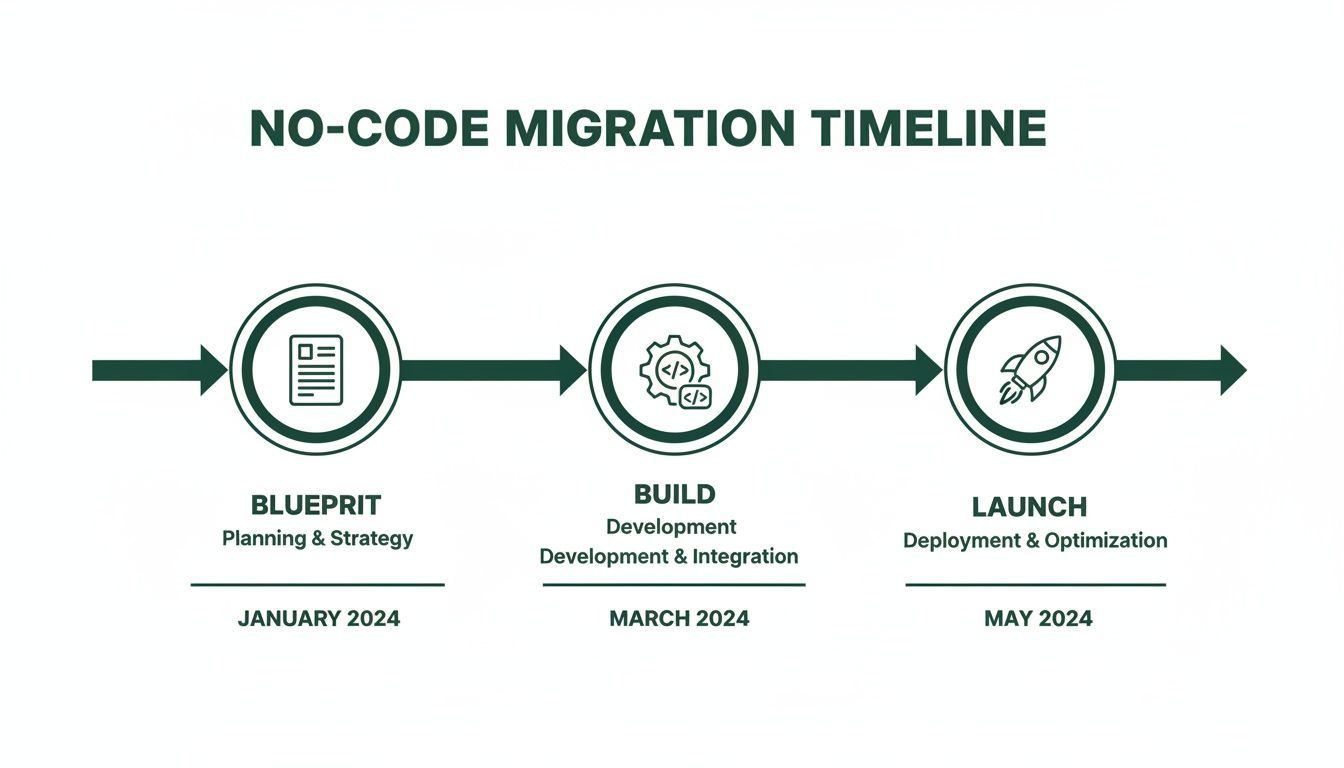
We break it down into clear phases—Blueprint, Build, and Launch—to make sure the transition is controlled, predictable, and doesn't disrupt your business.
Frontend: Modern User Interfaces with React and Next.js
Your user interface is your digital storefront. It's the first thing your customers touch. React, backed by Meta, is the undisputed industry standard for building the kind of interactive, dynamic UIs that users now expect.
When you pair it with Next.js, you get applications that are blazingly fast. This isn't just a "nice-to-have"; speed is a massive factor for both user satisfaction and how you rank on Google. This combination directly solves the sluggishness that plagues no-code platforms as they scale, leading to better engagement and higher conversion rates.
Backend: Power and Versatility with Python
The backend is the engine of your application, and Python is an exceptional choice to power it. It’s famous for its clean, readable syntax, which translates to faster development and simpler maintenance down the road.
But Python’s real superpower is its versatility. Today, you might just need a simple API to handle user accounts. But what about next year? You might want to build in complex AI features or run sophisticated data analytics. Python’s massive ecosystem of libraries means it can handle all of that and more. It’s a language built for the long haul, ready to adapt as your ambitions grow.
Database: Enterprise-Grade Scalability with PostgreSQL
If you've been using Airtable as your database, you've probably felt the ceiling. You've hit row limits, struggled with slow queries, or been frustrated by its lack of relational integrity. PostgreSQL is the cure for those headaches.
It's a serious, enterprise-grade, open-source database trusted by giants like Apple, Spotify, and Instagram to manage truly massive amounts of data.
PostgreSQL is engineered from the ground up to handle millions of records and complex queries without breaking a sweat. It provides the data integrity, security, and raw performance that a growing business absolutely needs—things a spreadsheet-style database was never designed to deliver.
This combination of React, Python, and PostgreSQL isn't just powerful; it's also one of the most popular and well-supported stacks on the planet. This means finding skilled developers to maintain and evolve your application is far easier and more cost-effective.
As you plan your infrastructure, you'll also want to consider self-hosting options like Terraform, ECS, and AWS to gain full control over your environment. Investing in the right foundation is the core principle of effective application scaling.
The Business Case for Custom Backend Development

Moving past your no-code MVP isn’t just about getting a technical facelift; it's a critical financial move. The upfront cost for custom backend development can look big on paper, but you have to stack it against the hidden, compounding costs of sticking with a system that's already holding you back. The real ROI isn’t just in new features—it’s about building a business that’s more efficient, durable, and fundamentally more valuable.
Think about what you're spending right now. That climbing monthly bill for Zapier, Airtable, and other platform subscriptions is a direct tax on your growth. You're paying to patch together brittle workarounds for things the platforms were never meant to do. A custom backend swaps those recurring fees for a predictable infrastructure cost that actually gets cheaper on a per-user basis as you scale.
From Cost Center to Core Asset
This move reframes your technology from a monthly expense into a tangible asset on your balance sheet. When your business logic is yours—tucked away in a private code repository—you're no longer just renting someone else's platform. You're building equity.
That's a distinction investors and potential acquirers care about deeply.
A proprietary tech stack is your moat. It defends your unique processes and customer data, giving you a competitive edge that's impossible to copy on a generic platform. This directly boosts your company's valuation and signals to the market that you're in it for the long haul.
A custom backend doesn't just make your app faster; it fundamentally changes your company's financial profile. You transition from paying recurring platform "rent" to owning a valuable piece of intellectual property that appreciates over time.
Real-World Impact on Growth and Funding
Let's walk through a common scenario. We worked with a SaaS startup built on Bubble that was wrestling with performance lags. They were bleeding over $5,000 a month just to keep their tangled web of Zapier automations from collapsing. The system was so fragile they were terrified to launch any real marketing campaigns, knowing a traffic spike could crash the whole thing.
After we migrated them to a custom Python backend with a PostgreSQL database, everything changed:
- Operational Cost Reduction: They killed their expensive subscriptions, slashing their monthly ops spend by over 40%. That cash went straight back into their growth budget.
- Enhanced Reliability: The new system handled a viral traffic spike—triple their previous peak—without breaking a sweat. This led to a huge jump in sign-ups and far better user retention.
- Successful Due Diligence: Six months later, they went out to raise a seed round. The VCs were seriously impressed by their proprietary, scalable tech. Owning their IP was a key factor that got them through technical due diligence and helped them close the funding.
This isn't a hypothetical. The business case is crystal clear. Custom backend development is an investment in stability, efficiency, and your future. It's the move that lets you stop plugging leaks and start building a truly defensible, scalable, and fundable tech company.
Common Questions About Backend Migration
Moving away from the no-code tools that got you here can feel like a leap of faith. As a founder, you're probably not a backend engineer, and you need straight answers without the technical fluff.
Let's cut through the noise and tackle the big questions we hear from founders every day. My goal is to give you the clarity you need to make this move with total confidence.
Will My Business Experience Downtime During the Migration?
No. A professionally-handled migration is designed for zero downtime. Think of it like this: we're building a brand-new, high-performance engine for your car in a separate garage. Your current car (your live app) keeps running just fine, completely unaware of the work being done.
We build and stress-test the entire custom backend in a staging environment that's completely invisible to your users. The final switch—where we move your data and point traffic to the new engine—is carefully scheduled for your quietest hours. The only thing your users will notice is that suddenly everything feels faster and more solid.
How Will I Manage the New System as a Non-Technical Founder?
This entire process is designed for you, the non-technical founder. We don't just hand over a folder of code and disappear. We deliver a clean, well-documented system that any competent developer can pick up and immediately understand.
During the handover, we'll walk you through everything you need to know. More importantly, we offer ongoing support, acting as your dedicated tech partner. This means we can handle updates, maintenance, and new features, letting you stay focused on what you do best: growing the business.
Owning your IP means the entire codebase—the unique logic of your application—is your company's exclusive property, stored in a private repository that you control. This is a critical asset that increases your company's valuation and is a standard requirement for most venture capital investors.
Is a Custom Backend More Expensive Than Sticking with No-Code?
There's an upfront investment, yes, but a custom backend almost always becomes cheaper as you grow. Take a hard look at your monthly bills right now. When you add up the core no-code platform subscription, the half-dozen premium plugins, and the thousands of tasks you're paying for in Zapier, those costs are already spiraling.
A custom solution puts a stop to that death-by-a-thousand-subscriptions. It also saves you from the very real and very expensive costs of a platform crashing during a marketing push or a data breach from a poorly maintained plugin. The investment pays for itself by building a stable foundation that doesn't charge you more for your own success.
Ready to build a scalable foundation for your startup? First Radicle specializes in turning fragile no-code projects into production-grade software in just six weeks. Book your Unblock Session today.