
Define Enterprise Level Beyond the Buzzwords
You built something incredible with no-code tools like Bubble or Airtable, and it took off. You found that magic product-market fit, users are signing up, and your business is scaling. But now, you’re starting to feel the friction.
This guide is for you. We'll break down what “enterprise-level” actually means and give you clear signals to know when it’s time to upgrade your engine from a no-code MVP to a true production-grade system built for the long haul.
When Your App Becomes a Victim of Its Own Success
The app grinds to a halt during peak hours. Your complex workflows are held together by a fragile web of expensive Zaps. You're spending more time plugging holes than you are building new features that your customers want. This isn’t failure—far from it. You’ve just pushed your initial toolkit to its absolute limit.
Your success has simply outgrown the platform you started on, and the cracks are beginning to show.
Think of it this way: you built a brilliant go-kart and dominated the local circuit. But now you’ve been invited to compete in Formula 1. The machine that got you here just isn't built for the new challenges ahead. The speed, reliability, and precision you need for this next phase require a completely different vehicle.

Recognizing the Warning Signs
This transition point usually shows up as a series of distinct growing pains. They're the tell-tale signs that you’re hitting the ceiling of your current setup. Worse, they often create a vicious cycle of putting out fires instead of making real progress.
Here’s what to look out for:
- Performance Degradation: Your app feels sluggish or even becomes unresponsive as more people use it at the same time.
- Scalability Ceilings: You live in constant fear that a successful marketing campaign or a viral tweet could bring the whole system crashing down.
- Operational Inefficiency: Your team is sinking more and more time into manual workarounds for processes that ought to be automated.
- Security and Compliance Gaps: You can't implement the tough security measures needed to protect user data or pass industry audits like SOC 2 or HIPAA.
This is the crossroads where you have to make a tough call: keep patching the go-kart or start building the Formula 1 car. The decision you make right now will define your company's potential for growth, its security posture, and its ultimate value.
What Does Enterprise Level Actually Mean for a Growing Business?
Let's cut through the jargon. When people throw around the term "enterprise level," it’s not just about the size of your company. It’s about the demands you’re placing on your software and what it can handle. It signals that you're moving past a functional prototype and into a mature, reliable, and secure application that's ready for serious business.
To really get what enterprise level means, we have to look past the surface features. Think of it as a standard of quality and resilience built on three core pillars: unwavering reliability when things get busy, rock-solid security to protect your customers, and a design that’s ready for future growth, not held back by it.
The Three Pillars of Enterprise Readiness
Making this jump is a big deal. It’s the moment your technology stops being a temporary fix and becomes a permanent, valuable asset. These three pillars are the absolute must-haves for your business to operate professionally and have a real shot at competing.
- Unwavering Reliability: Your app has to work flawlessly, especially when you get that big sales spike from a marketing launch. No crashes, no slowdowns, and definitely no lost revenue because the system couldn't keep up.
- Fortified Security: You're holding onto customer data, and that's a huge responsibility. It needs to be protected with institutional-grade measures, from secure logins all the way to end-to-end data encryption. This is how you build trust and avoid disaster.
- Future-Proof Scalability: Your tech stack should be a launchpad for growth, not a bottleneck. It needs to be built to handle 10x or even 100x your current user load without forcing you to start over from scratch.
Moving to this standard aligns your business with the massive investments companies are making in solid technology. The global enterprise software market was valued at nearly $900 billion with 11.9% year-over-year growth, a number that really highlights how crucial it is to build solutions that are made to last. If you're curious, you can explore more about the enterprise software market to see the full picture.
An enterprise-level system is one that your customers, partners, and investors can depend on completely. It transforms your application from a promising idea into a durable piece of business infrastructure.
The table below offers a practical, side-by-side look at the differences between a typical no-code MVP and a true enterprise-level application. It really helps clarify the jump you're making and sets the stage for the specific technical criteria we'll dive into next.
No-Code MVP vs Enterprise-Level Application
| Characteristic | Typical No-Code MVP | Enterprise-Level Application |
|---|---|---|
| Performance | Slows down under moderate user load | Handles thousands of concurrent users seamlessly |
| Data Structure | Limited by platform constraints (e.g., Airtable bases) | Robust, scalable database (e.g., PostgreSQL) |
| Security | Basic platform-provided security features | Advanced, custom security protocols (e.g., OWASP standards) |
| Ownership | Rented technology, limited IP | 100% code ownership and full intellectual property |
| Customization | Restricted to platform's feature set | Unlimited potential for custom features and logic |
As you can see, the shift is fundamental. It's not just about adding a few features; it’s about rebuilding the foundation to support a much bigger vision.
The Eight Pillars of an Enterprise-Grade Tech Stack
So, what does it really mean to have an "enterprise-grade" tech stack? Let's get past the buzzwords and look at the specific, measurable standards that separate a professional, scalable system from one that's just getting by.
Think of these eight pillars as the non-negotiable architectural principles for building software that lasts. They’re the foundation for a business that can operate professionally, scale without chaos, and build a defensible, long-term asset. If you ignore them, you're essentially building a skyscraper on a shaky foundation. It might look impressive for a bit, but it's bound to crumble under real-world pressure.
1. Performance and Scalability
This is all about your application's ability to handle growth without breaking a sweat. An enterprise-grade app doesn't just crash because your latest marketing campaign went viral or thousands of users decided to log on at the same time. It's engineered from the ground up to manage increasing loads efficiently.
Scalability isn't just a vague concept; it means your system can expand its capacity to meet rising demand. You achieve this with a combination of clean code, a powerful database like PostgreSQL, and cloud infrastructure that can automatically spin up more resources when traffic surges.
2. Robust Security
For an enterprise-level product, security isn't a feature you tack on at the end—it's woven into the very fabric of the design. We're talking about way more than just basic password protection. It means actively implementing battle-tested standards, like those from the Open Web Application Security Project (OWASP), to shield against the most common attacks.
This also includes non-negotiable practices like end-to-end data encryption, secure authentication methods, and regular, rigorous security audits. Your customers are trusting you with their data. Enterprise-level security is how you earn that trust and protect your business from a breach that could be catastrophic.
3. High Availability and Reliability
Reliability is simple: it's the promise that your application will actually be there when your users need it. The gold standard for high availability is 99.9% uptime, often called "three nines." That translates to less than nine hours of total downtime over an entire year.
You don't get there by accident. This level of reliability is the result of redundant systems, automated failover mechanisms, and proactive monitoring. It ensures that a single point of failure—like one server going down—doesn't take your whole business offline, protecting both your revenue and your hard-won reputation.
The infographic below shows how reliability, security, and scalability form the bedrock of any true enterprise-level architecture.
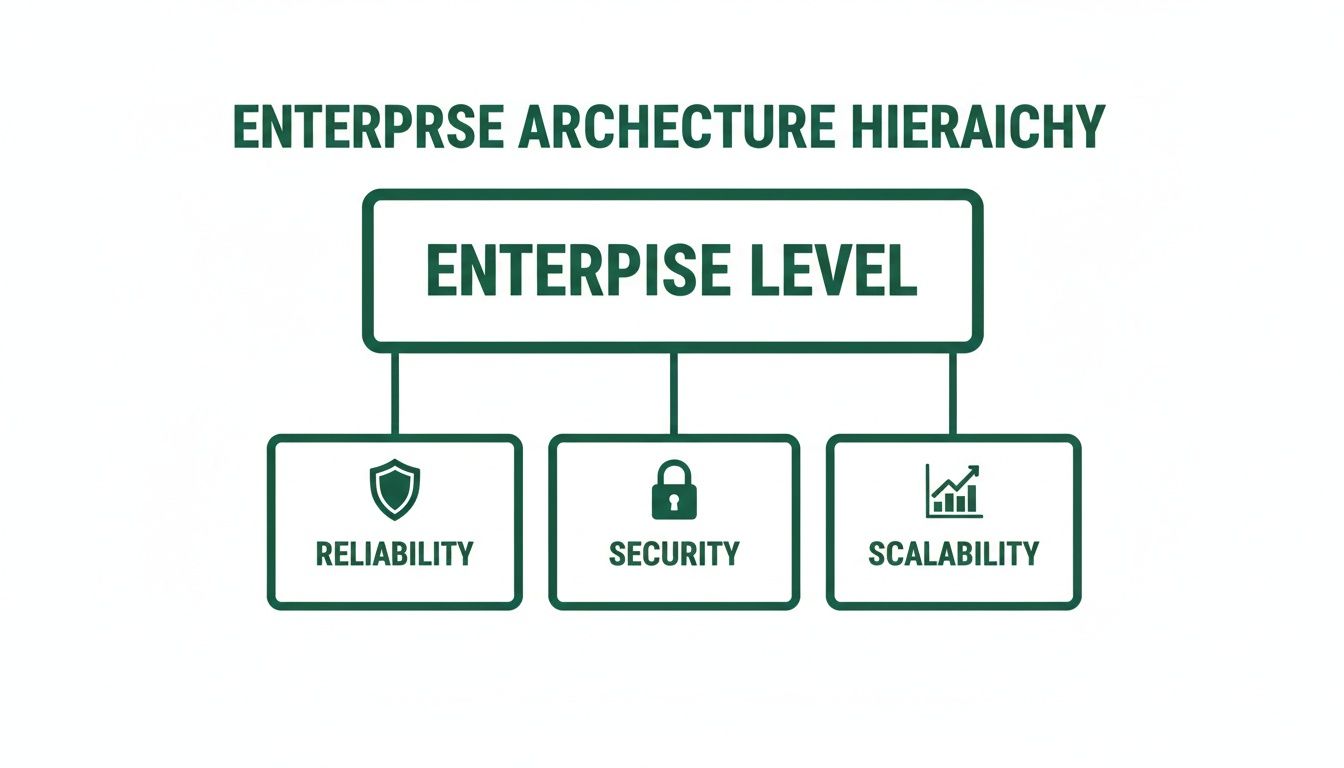
Without these three pillars holding everything up, any other fancy features are just built on unstable ground.
4. Advanced Observability
Let's be blunt: you can't fix what you can't see. Observability gives your team deep visibility into your system's health through three types of data:
- Logs: Records of every event that happens.
- Metrics: Key performance measurements.
- Traces: The complete journey of a single user request.
This data is what allows your engineers to find the root cause of an issue in minutes instead of days, spot performance bottlenecks, and make smart, data-driven decisions to improve the user experience. It's the difference between guessing what's wrong and knowing what to fix.
5. Automated Testing
Enterprise-level software runs on a comprehensive suite of automated tests. This isn't just a "nice-to-have"; it's a critical process for ensuring quality and preventing things from breaking. These tests—from small "unit" tests to broad "end-to-end" (E2E) tests—run automatically every single time a developer makes a change.
This systematic approach to quality assurance is what gives your team the confidence to build and ship new features quickly, knowing there's a safety net ready to catch bugs before they ever see the light of day.
6. Sophisticated Deployment
Pushing new code live should be a routine, low-risk event, not a stressful, all-hands-on-deck emergency. A mature deployment process uses what's called Continuous Integration and Continuous Deployment (CI/CD) pipelines to automate the entire build, test, and release cycle. This is how you deliver updates to users quickly, consistently, and reliably.
7. Infrastructure and Code Ownership
Finally, a true enterprise-level stack means you own it—all of it. You have complete control over your cloud environment, your database, and, most importantly, your codebase. This intellectual property (IP) is a real, tangible asset that dramatically increases your company's valuation.
This level of ownership is absolutely central to systems like enterprise resource planning (ERP) software, a market projected to hit $225.4 billion by 2035. There's a reason large enterprises hold 41% of the market share in that space: their complex operations demand total ownership and control over their technology. You can read the full research about the rapid growth of the ERP software market.
Building this kind of robust system requires a deliberate, thoughtful approach. To learn more, check out our guide on software architecture best practices.
Clear Signals It’s Time to Migrate From No-Code
So, how do you know when you’ve truly pushed your no-code platform past its breaking point? Recognizing this critical moment isn't about waiting for a single, catastrophic failure. It’s about spotting a pattern of painful symptoms—telltale signs that your technology is holding your business back.
Think of these signals as your early-warning system. Ignoring them just lets technical debt pile up, leading to frustrated customers and missed opportunities for growth. Ask yourself if any of the following scenarios sound a little too familiar.
When Costs Outweigh Convenience
One of the most concrete signals is purely financial. Take a hard look at your monthly bills. Are your subscriptions for tools like Zapier and Airtable creeping up to the cost of a junior engineer's salary? If so, that’s a clear sign you're paying a premium to patch up a system that just can't keep up.
What started as a smart, cost-effective solution has morphed into a complex web of expensive workarounds. This spending pattern shows you're forcing a platform to do things it was never meant to do. That money is far better invested in your own custom software—an asset that will cut operational costs in the long run.
You’re holding your breath during every major marketing campaign, half-expecting the site to crash under the load. This constant anxiety is a sign that your infrastructure lacks the reliability required to define enterprise level performance.
When You Start Saying No to Customers
Your product roadmap should be driven by what your customers want, not by what your platform can't do. Are you constantly telling customers "no" to valuable feature requests simply because your no-code stack can’t handle the complexity? This is a massive red flag.
When your technology dictates your business strategy, you’ve lost control. An enterprise-grade system empowers you to say "yes" to innovation. It lets you build the exact features your users are asking for, solving their problems and earning their loyalty.
When Investors Question Your Foundation
Finally, pay attention to the tough questions from people who evaluate businesses for a living. Are potential investors raising concerns about your tech stack’s ability to scale? Are they pointing out the risks of not owning your core intellectual property?
These aren't just minor details; they're fundamental questions about your company's long-term viability. When the investment community sees your technology as a liability instead of an asset, that’s an undeniable signal that a migration is overdue. The switch to owning your code is essential for building a valuable, fundable company. Understanding the difference between a flexible database and a rigid server is a great starting point, which you can explore in our guide comparing databases and servers.
Your Migration Checklist and Strategic Next Steps
Making the leap from a no-code MVP to a full-code, enterprise-ready system is a huge milestone. It’s more than just a technical upgrade; it's the moment you commit to building a truly durable, long-term asset for your business. This is the move that unlocks your next phase of growth on a platform built for serious scale and reliability.

First things first, let’s take a hard look at your current setup. Use this checklist—based on the eight pillars we've just walked through—to find your weakest links and figure out what to tackle first.
- Performance: Does your app grind to a halt or crash when user traffic picks up?
- Security: Can you implement security measures that go beyond a simple login screen?
- Reliability: Have you lost money due to downtime in the last six months?
- Observability: When something breaks, can you pinpoint the root cause quickly, or is it a guessing game?
- Testing: Does every new feature release feel like a gamble because you don’t have an automated testing safety net?
- Deployment: Is pushing updates a manual, stressful, and error-prone ordeal?
- Infrastructure: Do you have complete control over your hosting and server environment?
- Ownership: Do you own 100% of your codebase? Is it a defensible piece of intellectual property?
Charting Your Path Forward
If you answered "no" to a few of these, it's a clear signal that it's time to get serious about migration. A successful transition isn’t a chaotic scramble; it's a phased, deliberate process. It starts with defining your exact requirements, choosing a modern tech stack (like React, Python, and PostgreSQL), and following a plan that keeps your users happy and your business running smoothly.
This transition is an investment that pays for itself. You’ll see it in lower operational costs, faster development cycles, and, most importantly, the creation of a valuable, defensible asset. It’s how you get your company ready for serious growth and investor interest.
Speaking of investors, this move puts you in a much stronger position. Enterprise software is a hot spot, with U.S. VC investment in the sector showing a 43% year-over-year growth. A solid, enterprise-grade tech stack is non-negotiable for attracting the capital you need to scale. You can read more about the rise of enterprise software investment on Precedence Research.
At First Radicle, this is exactly what we do. We specialize in turning promising but fragile no-code projects into rock-solid, production-grade software. To see how we bring a vision to life, check out our guide on the web design to code process.
Common Questions About Moving from No-Code to Enterprise
Making the leap from a no-code platform to a full-code system is a big decision. It’s totally normal for founders to have questions about the cost, complexity, and ultimate payoff. Let's tackle the most common concerns to shed some light on why this is such a critical step for building a business that lasts.
Think of this migration as a strategic investment in your company's future. You're turning a temporary tool into a permanent, valuable asset that you truly own.
Can I Just Keep Optimizing My No-Code Application?
You can definitely squeeze more life out of your no-code setup for a while, but it’s crucial to understand you’re working with a hard ceiling. You're essentially building on rented land, meaning you're always at the mercy of the platform's performance limits, feature roadmaps, and surprise pricing updates. It's like patching leaks on a ship instead of building a stronger hull.
As your user base grows and your data gets more complex, you'll inevitably hit a wall. This usually shows up as sluggish database queries, crippling API rate limits, or the frustrating inability to build the exact custom logic your customers are asking for. You end up shaping your business strategy around your tool's limitations, not the other way around.
An enterprise-level architecture flips that script and gives you total control. You can build a system perfectly molded to your business—one that can grow with you, free from someone else's restrictions.
Isn't a Full-Code Migration Incredibly Expensive and Slow?
The idea of a custom software project often brings to mind horror stories of endless timelines and runaway budgets. But modern development and specialized migration services have changed the game, making the whole process much more predictable and efficient than most founders think.
By using proven frameworks, ready-made foundational components, and a focused, agile approach, a full-stack application can come together in a surprisingly tight and predictable timeframe. When you weigh this one-time investment against the creeping monthly costs of complex Zapier workflows, multiple SaaS subscriptions, and the revenue you lose from poor performance, a purpose-built system often pays for itself very quickly.
What Happens to My Data During the Migration?
Data integrity is our absolute top priority. A professional migration is a carefully planned and staged process designed for a smooth, secure transfer with zero data loss. It’s a methodical handoff, not a risky jump.
The migration follows a few key steps:
- Schema Mapping: We meticulously map your current data structure from platforms like Airtable to a new, powerful PostgreSQL database built for serious scale.
- Staging and Testing: During development, we run periodic data syncs to a staging server. This lets you test the new application using real, up-to-date information.
- Final Sync: Right before the big launch, we execute a final, complete data migration. This ensures your new system is 100% current from the moment it goes live.
How Does Owning My Code Help with Fundraising?
Venture capitalists and smart investors back defensible, scalable assets. A business held together by a web of third-party tools has very little intellectual property (IP) and screams "technical risk." To investors, showing you are enterprise level means proving you have a rock-solid technological foundation.
When you own 100% of your codebase in a private repository, you're not just showing them a product; you're showing them a tangible, proprietary asset that can be secured, scaled, and evolved. This ownership makes their investment less risky, justifies a higher valuation, and is a non-negotiable part of passing any serious due diligence process.
Ready to transform your no-code MVP into a scalable, enterprise-level asset? First Radicle specializes in migrating fragile projects to production-grade software in just six weeks, guaranteed. Build your defensible tech stack with us.