
What Is a Digital Commerce Solution for Scaling Startups?
That no-code app you built on Bubble or Webflow was a brilliant move. It got you off the ground and proved your idea had legs. But now, you're starting to feel the growing pains.
The app is getting sluggish. Your Zapier bills are creeping up every month. And that killer feature your customers are begging for? You just can't build it with the tools you have. This isn't a sign of failure—it's the classic sign that you've succeeded and are ready for the next level.
From No-Code Prototype to Scalable Business
Think of your journey so far like building a concept car with LEGOs. You’ve assembled something amazing that proves people want what you're selling. Now, it's time to graduate from the plastic bricks and engineer a real vehicle—one that’s fast, reliable, and built for the long haul.
This is exactly where a professional digital commerce solution comes into play. It’s the custom-built engine that transforms your fragile Minimum Viable Product (MVP) into a scalable, fundable business.

Why This Upgrade Is a Strategic Move
Let's be clear: moving on from your no-code stack is way more than just a technical fix. It's a fundamental business decision. The setup you have now—likely a patchwork of different tools duct-taped together with automations—was perfect for getting started quickly and cheaply.
But as your business grows, those connections become brittle. They get expensive. They break.
This guide is here to walk you through the core concepts of a true digital commerce solution, showing you precisely how it solves the pain points you're likely feeling right now. Many founders find success launching with a no-code web app builder, but nearly all of them eventually need a stronger foundation to truly scale.
A custom digital commerce solution isn't about throwing away what you've built. It's about rebuilding it on a foundation that can actually support your ambitions—whether that's handling a viral traffic surge or impressing sharp-eyed investors.
Key Advantages of a Professional Stack
Making this transition isn't just about solving problems; it’s about unlocking potential. A dedicated solution brings immediate and long-term benefits that you simply can't get from off-the-shelf tools.
Here’s what you stand to gain right away:
- Full Ownership and Control: You get 100% ownership of your intellectual property (IP). For any founder heading into VC due diligence, this is absolutely non-negotiable.
- Limitless Customization: You can finally build the exact features your customers are asking for, free from the constraints of platform limitations or third-party plugins.
- Scalable Performance: A purpose-built backend won't buckle under pressure. It's designed to handle high traffic volumes smoothly, ensuring your customer experience is flawless, even during your busiest moments.
- Reduced Operational Costs: Those expensive, per-transaction automations? You can replace them with efficient, integrated systems, which often leads to a significant drop in your monthly operational overhead.
We’ll dive into each of these benefits in more detail, giving you a clear roadmap for when and how to make this critical transition for your business.
What Is A True "Digital Commerce Solution," Really?
Let’s be honest. Your no-code MVP is brilliant. Think of it like a pop-up shop: it was quick to launch, let you test the market, and proved your concept works. But as you grow, you're hitting its limits.
A true digital commerce solution is the next step up—it's your flagship store on 5th Avenue. It’s not just a website; it's a robust, scalable business engine built to handle serious traffic and deliver a flawless customer experience.
The frontend, maybe built with a modern library like React or a framework like Next.js, is your stunning storefront. It loads in a flash and feels incredibly intuitive, drawing customers in. Behind the scenes, the backend—powered by something solid like Python or Node.js—is your hyper-efficient warehouse and logistics system. And the database, perhaps PostgreSQL, is your perfectly organized, secure ledger for every customer and inventory item.
Moving Beyond Patchwork Automations
A real digital commerce solution isn't a collection of different apps held together with digital duct tape. It’s one seamless system where all the parts are designed to work together perfectly. This gets rid of the brittle, patchwork automations common in no-code setups, where one broken Zap can bring everything grinding to a halt.
This shift is about more than just better tech. It's about taking complete control of your business. You own the entire stack, from the pixels your customer sees to the logic running on your server. This gives you bulletproof security and, critically, 100% intellectual property (IP) ownership. For any founder heading into a VC meeting, proving you own your code isn't just a plus—it's a requirement.
And the timing couldn't be better. The digital commerce market is exploding, on track to hit a staggering USD 4.7 trillion in 2025 and an almost unbelievable USD 19.6 trillion by 2035. This isn't just growth; it's a fundamental shift in how business is done, where owning your own scalable infrastructure is the only way to compete. You can dive deeper into the data on digital commerce market growth to see just how massive this opportunity is.
Comparing No-Code MVP vs Production-Grade Solution
To really drive the point home, let's put the two approaches side-by-side. It becomes clear pretty quickly why a custom solution is the only path forward for a serious business.
| Feature | No-Code MVP (Bubble/Webflow/Airtable) | Production-Grade Solution (React/Python/PostgreSQL) |
|---|---|---|
| Scalability | Capped by platform limits; performance degrades quickly under heavy traffic. | Built for scale from day one; can handle viral surges without breaking a sweat. |
| IP Ownership | You're essentially renting the technology. You don't own the underlying code. | You have 100% ownership of the code and infrastructure, stored in your own private repo. |
| Customization | Limited to what the platform's plugins and pre-built modules allow. | Truly limitless. If you can dream it, your developers can build it. |
| Security | You're totally reliant on the platform's security measures. Hope they're good enough. | You control your own destiny with custom security layers and OWASP-aligned practices. |
| Operational Costs | Starts cheap, but hidden fees for add-ons and automations stack up fast. | Higher upfront cost, but dramatically lower operational expenses over the long term. |
| Investor Readiness | Raises red flags for VCs around scalability, IP ownership, and long-term viability. | Seen as a defensible, valuable asset that gives investors the confidence to write a check. |
As you can see, the difference is night and day. A production-grade solution isn't just a better website; it’s a core business asset.
It's the foundation that frees you to stop worrying about whether your tech can keep up and start focusing exclusively on growth, innovation, and delighting your customers.
Making the leap to a professional stack is a powerful signal. It tells the world—and your investors—that you’ve graduated from the validation stage. You're no longer just testing an idea; you're building a durable, competitive, and highly valuable company ready for its next chapter.
Telltale Signs You’ve Outgrown Your No-Code Setup
Your no-code app has been fantastic, hasn't it? It helped you bring your idea to life, validate your market, and win over those first crucial customers. But growth has a funny way of exposing the limits of the very tools that got you started. So, how do you know when it’s truly time to graduate to a real digital commerce solution?
The signs aren’t usually subtle. They show up as creeping performance issues, ballooning monthly bills, and strategic brick walls that stop your growth in its tracks. Spotting these red flags is the first step toward building a business that can actually achieve your long-term vision.
Performance Bottlenecks Are Costing You Customers
The most pressing signal is when your platform’s performance starts to actively harm your business. Slow load times are more than just a minor inconvenience. Think about it: research has shown that a mere one-second delay in page load time can slash conversions by 7%. For a business on the rise, that’s real money left on the table.
When your app starts timing out during busy periods or, even worse, crashing completely, you're not just losing a sale—you're damaging your brand's reputation. A user who bounces from a slow or broken site probably isn’t coming back. This isn’t just a bug; it’s a clear sign your no-code foundation is cracking under the weight of your success.
These problems often pop up in a few key areas:
- Slow Database Queries: Your Airtable base was great for 100 users, but now with thousands, even simple searches feel like they take forever.
- API Timeouts: Your app depends on other services to function, but under a heavy load, those connections start dropping, breaking critical parts of the user experience.
- Unresponsive User Interface: The front-end built in Bubble or Webflow starts to feel sluggish. Clicks and actions lag, leaving your users frustrated and wondering if the site is broken.
Your Monthly Bills Are Out of Control
No-code platforms hook you with low startup costs, but their pricing models are often built to penalize scale. As your user base and transaction numbers climb, so do those monthly invoices from Zapier, Make, and the platform's own tiered plans. It’s a classic case of death by a thousand paper cuts.
You find yourself constantly upgrading plans just to handle a little more traffic, or you see your automation costs spiraling. Suddenly, you're paying a small fortune just to keep the lights on.
When the combined monthly cost of your no-code stack starts to look like the salary of a junior developer, you've hit a critical tipping point. You're now paying a premium for inefficiency, essentially renting your technology instead of investing in a valuable asset you actually own.
This financial drain is a clear sign that the short-term savings of no-code are becoming a long-term liability.
Growth Is Blocked by Platform Limitations
This one is maybe the most frustrating. You know exactly what your customers need next. Your product roadmap is filled with game-changing features that would set you apart from the competition... but you simply can’t build them. You're stuck.
This wall appears when you need functionality that goes beyond a pre-built plugin. Maybe it’s a complex pricing algorithm, a highly customized user dashboard, or a specialized integration with an obscure but essential API. Hitting this limit means you’ve officially outgrown the sandbox. It's time for the freedom that a proper codebase provides.
You Are Preparing for a Funding Round
Finally, a huge catalyst for making a change is the need to get ready for fundraising. Savvy investors will put your tech stack under a microscope, and a business running entirely on rented no-code platforms can raise some serious red flags. They’re going to ask tough questions about:
- Scalability: Can this tech actually support 10x or 100x growth?
- IP Ownership: Do you own the core code that powers your business, or are you just a paying customer of another company?
- Security: How are you protecting sensitive customer data and ensuring you meet compliance standards?
Walking into a VC pitch with a fragile, non-proprietary tech stack puts you on the back foot from the very beginning. Moving to a professional digital commerce solution isn’t just a tech upgrade; it’s a strategic decision that makes your company a far more defensible and fundable asset.
So, Where Do You Go From Here? Evaluating Your Migration Options
You've successfully validated your idea with a no-code MVP, and now it’s time for the next big step. Deciding to move off your initial platform is a major turning point. The path you take now will define your company’s future—affecting everything from your budget and timeline to your ability to truly scale.
This isn’t just a tech decision; it's a core business strategy.
You essentially have three roads you can go down: commit to an advanced all-in-one platform, assemble your own team of freelancers, or bring in a specialized agency. Each has its own set of pros and cons, and the "right" choice really comes down to what you, the founder, value most.
Let's unpack these so you can see which one feels right for you.
The Advanced Platform Path
Jumping to a platform like Shopify Plus or BigCommerce Enterprise is a common first thought. These platforms are designed to be a serious upgrade from no-code tools, offering a relatively quick migration and a ton of built-in features to handle serious sales volume.
But there’s a trade-off. Speed and convenience come at the cost of control. Once you're in their ecosystem, you play by their rules. You’re limited by their feature set, their pricing, and their development roadmap. If you have a unique idea for a customer experience or a feature that truly sets you apart, you might find yourself hitting a wall, forced to use clumsy workarounds—or just giving up on it entirely.
This route works best for businesses with a straightforward e-commerce model that don’t need a lot of custom work. You're trading bespoke flexibility for a managed, stable environment.
The Freelance Team Approach
Hiring a team of freelancers from marketplaces like Upwork or Toptal can seem like the best of both worlds—total creative freedom with potentially lower costs. You get to hand-pick your team and build a digital commerce solution that matches your vision perfectly. You own everything.
The catch? You’re now the general contractor on a major construction project. This path is loaded with hidden risks. The quality of work can be all over the place, and trying to manage a team of strangers across multiple time zones is a massive time-suck. And what happens when your lead developer gets a full-time job and disappears? The whole project can grind to a halt.
Without a technical co-founder watching over the architecture and code quality, the freelance approach can quickly become a nightmare. You risk ending up with a fragile, poorly built product that’s a pain to maintain and riddled with technical debt from day one. It's a high-reward strategy, but it's also incredibly high-risk.
The Specialist Agency Partnership
Your third option is to partner with an agency that lives and breathes this stuff—one that specializes in migrating businesses from no-code tools to professional-grade software. This approach aims to give you the best of both worlds: the predictable, high-quality result of a platform, but with the complete ownership and control of a custom build.
A specialist agency doesn't just bring developers; they bring a battle-tested process. They’ve seen all the common mistakes and know how to avoid them. They turn a scary, open-ended technical project into a well-defined business investment with a fixed timeline and a clear budget. What you get at the end is a rock-solid, scalable asset that investors will take seriously.
This is the ideal path for founders who can't afford to get it wrong. If you want to minimize your own stress, guarantee a great outcome, and build a valuable piece of technology, this is the way to go. You can learn more by checking out our guide on the best web frameworks for building scalable applications.
Comparing Your Three Migration Paths
To make this decision a little easier, let's lay out the trade-offs side-by-side. Think of this as your cheat sheet for figuring out which path aligns with your company's most important goals.
| Approach | Best For | Key Benefit | Primary Risk |
|---|---|---|---|
| Advanced Platform | Standard e-commerce models needing speed and reliability without deep customization. | Speed to Market: Get up and running on a powerful, stable platform quickly. | Vendor Lock-in: Limited innovation and being tied to the platform's ecosystem and fees. |
| Freelance Team | Founders with technical oversight and a high tolerance for project management risk. | Maximum Flexibility: The ability to build absolutely anything you can imagine. | Inconsistent Quality: High risk of poor execution, delays, and budget overruns. |
| Specialist Agency | Founders seeking a predictable outcome, IP ownership, and minimal personal overhead. | Guaranteed Outcome: A reliable, high-quality build delivered on a set timeline and budget. | Higher Upfront Cost: Requires a larger initial investment compared to hiring individual freelancers. |
In the end, this decision boils down to one question: what are you optimizing for? Are you prioritizing short-term speed, long-term flexibility, or a predictable, high-quality result? Your answer will point you down the right path.
Your Six-Week Migration Plan to a Custom Stack
Moving your business off a comfortable no-code platform and onto a custom stack can feel like a leap into the unknown. It sounds big, risky, and expensive. But it doesn't have to be. With a solid process, that intimidating project becomes a predictable, manageable, six-week plan.
A structured roadmap takes the guesswork out of the entire journey. It puts you, the founder, back in control, letting you oversee the process with confidence because you know exactly what your technical partner should be doing at every stage.
Let’s walk through what those six weeks actually look like.
Phase 1: Handover and Discovery (Weeks 1-2)
The first two weeks are all about getting on the same page and creating a rock-solid blueprint. No one should be writing a single line of code yet. Instead, your technical partner will dive deep with you to map out your existing data schema from tools like Airtable or Bubble's internal database.
This is a critical step. It ensures every user record, product detail, and past order has a planned destination in the new system. The goal here is to lock down the exact project scope, confirming which core features need to be rebuilt and in what order. Think of it as the survey before you build a house—doing this meticulous prep work now prevents very expensive surprises down the road.
Phase 2: Sprint-Driven Development (Weeks 3-5)
With the blueprint signed off, the next three weeks are all about focused, agile development. This phase is broken down into short, intense work cycles called sprints. The beauty of this approach is that you see progress every single week, rather than waiting for a big, nerve-wracking reveal at the end.
Your dev team will spin up a staging server, which is essentially a private, working version of your new app. At the end of each week, they'll push the latest updates there for you to click around, test, and give feedback.
This constant feedback loop is the most important part of the entire process. It kills the "big reveal" anxiety and guarantees the final digital commerce solution is exactly what you wanted, giving you plenty of chances to make small adjustments along the way.
Phase 3: Harvest and Launch (Week 6)
The final week is launch week. This is where all the careful planning from Phase 1 really pays off. The team runs the final data synchronization, pulling over all the latest information from your old system into the new one.
At the same time, they'll set up the production infrastructure on your own cloud account (like AWS or Google Cloud), which means you have full ownership and control from day one. The process wraps up with the handover of your powerful new assets:
- A Private GitHub Repository: You get 100% of the intellectual property—the clean, well-documented codebase for your application.
- A Scalable Cloud Environment: Your new digital commerce solution is live on an infrastructure that won't buckle under a sudden rush of traffic.
- Full Ownership: You're no longer renting your tech. You now own a valuable, defensible business asset.
This structured timeline helps show how different talent options, from freelancers to specialized agencies, fit into your company's growth.
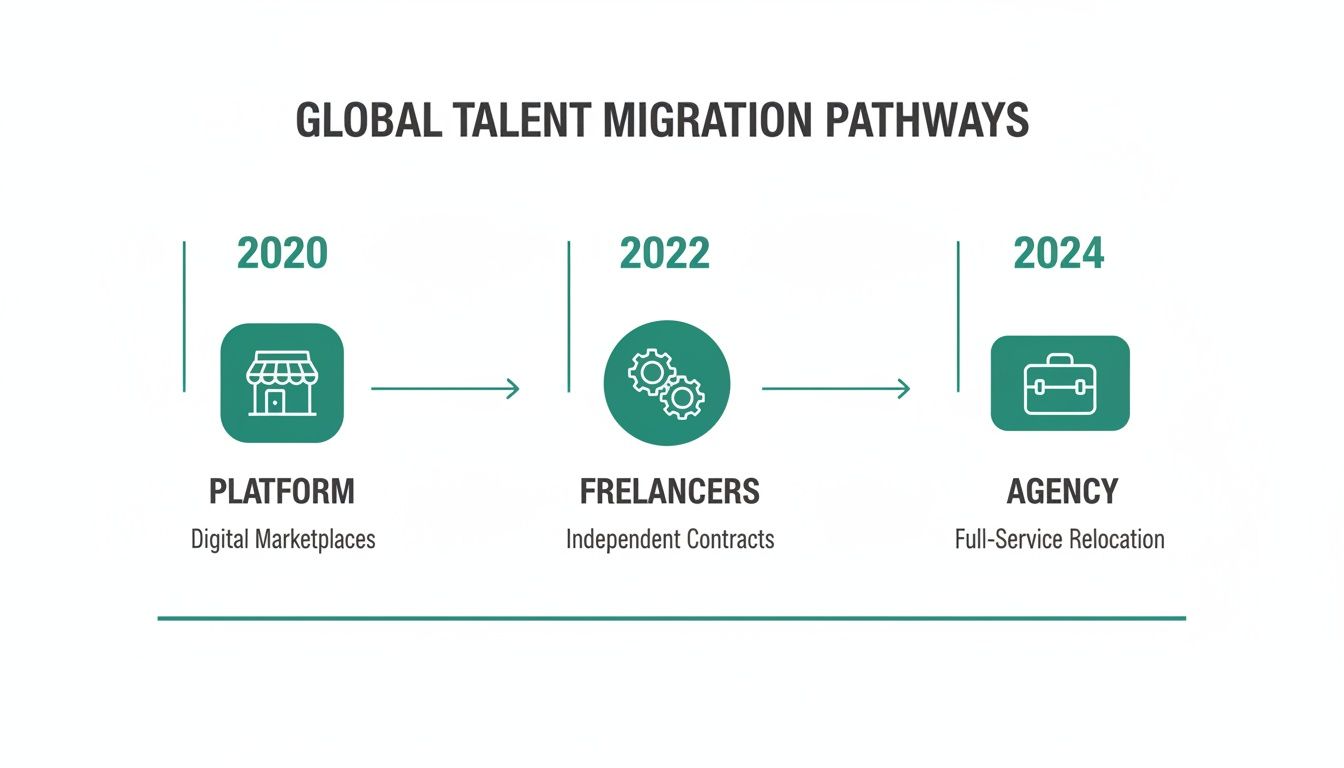
As the timeline suggests, while platforms get you started quickly, a dedicated agency gives you that structured, full-service migration path you need to build a real, long-term asset.
This transition is especially crucial for founders with global ambitions. The cross-border e-commerce market is expected to explode from USD 551.23 billion in 2025 to a mind-boggling USD 2,006.98 billion by 2034, thanks to digitalization in emerging economies. If you’re hitting the limits of Airtable or a Webflow frontend, you'll need a backend that can handle international payments, sync inventory across time zones, and navigate complex regulations. Only a custom solution can truly deliver that. You can dig into more research on the cross-border e-commerce market to see just how big this opportunity is.
Unlocking Growth by Owning Your Technology
This whole process is about more than just patching up today's headaches. Think of it as a strategic investment in your company's future—the kind that unlocks serious growth down the line. When you're done, you'll have 100% IP ownership sitting in a private GitHub repository. That’s a powerful, defensible asset you can take straight into a fundraising meeting.
With a clean, modular architecture, your team can suddenly ship new features faster. Onboarding a new developer stops being a month-long ordeal. You’re essentially swapping out a messy garage full of workarounds for a well-oiled machine built for innovation. It's the moment your project truly becomes a business asset.
Building a Resilient Foundation
Suddenly, things like automated testing and solid security aren't expensive add-ons you tack on later. They're baked right into the foundation of your new digital commerce solution. This is how you build deep, lasting customer trust and make your business resilient when things inevitably go wrong. You’re not just plugging holes in a leaky dam; you're building a fortress.
By tearing out those brittle, costly automations and replacing them with a backend built for the job, you’ll see operational costs drop. Viral traffic spikes? They become a non-issue. Your customer experience stays smooth precisely when it matters most. To dig deeper into this, check out our guide on custom backend development.
The goal is to build a tech foundation that can evolve with your vision for years to come, giving you the freedom to innovate without being held back by technical debt or platform limitations.
Gaining a Competitive Edge
This upgrade is what gets you ready to compete. The e-commerce market is fierce and getting fiercer. Global sales are projected to hit USD 7.5 trillion in 2025, a huge leap from USD 5.7 trillion in 2023. You're up against nearly 31 million other e-commerce sites, all fighting for the attention of 2.71 billion shoppers.
The businesses that win will be the ones with clean, modern tech stacks and full ownership of their IP. A guaranteed six-week migration fortifies you against those huge traffic surges and prepares you for the intense scrutiny you'll face from VCs. You can explore more digital commerce statistics and trends to get a clearer picture of the battlefield.
Frequently Asked Questions About Moving Off No-Code
Taking the leap from a no-code tool you know and love to a custom digital commerce solution is a big move. It’s totally normal to have questions—and a few anxieties—about what this means for your data, your daily workflow, and your timeline. Let's tackle the big ones.
How Do I Know My Data Will Be Safe When Moving From Airtable or Bubble?
This is probably the biggest concern we hear, and for good reason. A professional migration isn't a simple copy-paste job; it's a careful, multi-step operation planned with military precision to ensure zero data loss.
First, we map out your entire data structure, field by field. Then, we transfer everything to a private staging server—think of it as a perfect, offline replica of your new app. You get to click around and check every last customer record and order yourself. Only when you give us the thumbs-up does the final switch to the live environment happen.
Will I Still Be Able to Make Quick Content Changes on My Own?
Definitely. You won't be using a drag-and-drop editor for the application's core architecture anymore, but you’ll gain something much better for content: a headless Content Management System (CMS).
This is a straightforward, user-friendly dashboard that lets your team update blog posts, tweak product descriptions, or publish new landing pages without ever having to ask a developer for help. For bigger feature changes, you'll have a proper development process that’s a world away from fighting with no-code platform limits.
Can My App Really Be Rebuilt in Just Six Weeks?
Yes, absolutely. A six-week timeline is realistic because we're not starting from a blank page. We're rebuilding the core features you’ve already proven work with your MVP.
An experienced team relies on battle-tested architectural patterns and reusable components, not reinventing the wheel. This lets us focus all our energy on reconstructing your app's essential functions within a predictable, sprint-based schedule. You get a rock-solid foundation, built fast, that’s ready for you to scale.
Ready to replace your fragile no-code app with a scalable asset? First Radicle turns your MVP into production-grade software in six weeks, guaranteed. Learn more about our fixed-timeline migration process.