
Modernizing Legacy Applications: A Roadmap to Scalable, Production-Ready Systems
Your no-code MVP was a brilliant shortcut. It helped you prove your concept, find product-market fit, and land those crucial first users. But now, that same tool is groaning under the weight of your success. It's gone from a strategic asset to a major liability.
This is where modernizing legacy applications comes in. It’s the essential move that turns your fragile prototype into a scalable, fundable company.
When Your No-Code App Can't Keep Up
Think of your no-code MVP as a concept car—sleek, fast, and perfect for the auto show. It proves the idea works. But you'd never try to drive it across the country. That's the exact moment many founders find themselves in, where the very tool that built their business is now actively holding it back.

This isn't just a technical problem; it's a growth ceiling. The warning signs might seem small at first, but they quickly snowball into major issues that can kill your momentum and scare away investors.
The Breaking Points of No-Code Scalability
The shift from a clever prototype to a struggling system happens slowly, then all at once. Founders tend to hit a series of predictable breaking points that scream for a more robust, code-based solution. These aren't minor hiccups—they're fundamental failures that hurt your users and your bottom line.
Here’s what that looks like in the real world:
- Brittle Automations: That intricate web of Zapier or Make.com workflows you built becomes a house of cards. One tiny API change from a third-party service, and your entire operation grinds to a halt. Suddenly, you're dealing with lost data and angry customers.
- Performance Bottlenecks: As more users sign up, your Bubble or Webflow app starts to lag. Pages take forever to load, especially during peak hours, creating a terrible user experience that sends your hard-won customers packing.
- Hitting Platform Limits: You slam into a hard wall, like Airtable's row limits or a no-code platform's caps on database queries. All of a sudden, you can't onboard new users or store critical data without resorting to clumsy, expensive workarounds.
This isn't a niche problem; it's a massive trend. The market for legacy application modernization is on track to hit $46.50 billion by 2030. Why? Because companies are realizing that old systems are sucking up as much as 80% of their IT budgets just on maintenance, leaving nothing left for innovation.
Modernizing your application is not an admission of a flawed start—it's proof of a successful one. It signifies that your business has outgrown its initial framework and is ready for a foundation built for the future.
Ultimately, this move is about building the bridge from a rickety MVP to a durable, scalable company. It’s about creating a true technical asset that can support your vision, help you secure funding, and unlock sustainable growth for years to come. For founders ready to take that next step, learning how to turn your site into an app can be a powerful part of that journey.
Let’s be honest: technical debt isn’t just some abstract term engineers throw around. It's a real, compounding tax on your startup's growth.
Think of it like this: you used a credit card to launch your MVP quickly. Smart move. But now, the high-interest payments are starting to bite, and they're eating into the money you need to actually grow the business. Every day you put off modernizing, that debt gets bigger.
This isn't a theoretical problem that lives on a whiteboard. It shows up in very real ways on your monthly P&L. Every time a Zapier task fails, every manual data fix your team has to make, and every new subscription you add to patch a leaky system is another payment on that high-interest debt. It's easy for these costs to quietly spiral from a few hundred to thousands of dollars a month—cash that should be funding growth, not just keeping the lights on.
The Financial Drain of a Brittle Stack
The most immediate pain you'll feel is operational inefficiency. As your user base grows, so does the strain on your no-code or low-code setup. A traffic spike from a viral post should be a reason to celebrate, but for a brittle system, it often means a crash and a sudden stop in revenue.
These financial leaks aren't always obvious. They hide in plain sight:
- Spiraling Subscription Costs: Your monthly bill for tools like Airtable, Zapier, and a dozen other plugins starts to look suspiciously like a part-time engineer's salary. You're renting functionality instead of owning it.
- Lost Revenue from Downtime: When your Bubble or Webflow app goes down during peak hours, you’re not just losing sales. You’re eroding customer trust and damaging your brand's reputation.
- Wasted Team Hours: Your team ends up spending their days on manual workarounds and fixing broken automations instead of focusing on what actually matters: acquiring customers, talking to users, and building a better product.
The Strategic Price of Inaction
Beyond the direct hit to your bank account, technical debt charges a steep strategic price. This is where the long-term health of your company is truly at stake. When your entire operation runs on third-party platforms, you don't really own your tech—and that's a massive red flag for any serious investor.
"Legacy systems can become budget black holes, with some reports showing they consume up to 80% of an annual IT budget just for maintenance. This leaves little room for innovation and directly stifles a company's ability to compete."
This reality hits startups particularly hard. For one, it becomes nearly impossible to attract top engineering talent. Great developers want to solve interesting problems with modern, scalable tools, not fight against the limitations of a closed-source platform. This talent gap makes building a truly defensible product almost impossible.
The rest of the market is already moving. The demand for legacy software modernization is projected to explode from $15 billion in 2025 to $45 billion by 2033. This surge in spending, detailed in reports from firms like Data Insights Market, signals a broad awakening. Companies are realizing that modernization isn't just a nice-to-have; it's a competitive necessity that can unlock 30-50% savings on operational costs.
Ultimately, clinging to a no-code MVP long after you've found product-market fit is like building your dream house on rented land. Modernizing your application is the act of buying the property and creating a lasting asset. As you map out this transition, it’s also crucial to get the foundation right, which means learning about managing database changes to ensure a smooth migration from day one.
Choosing Your Modernization Strategy
So, you’ve decided to move beyond your no-code setup. Smart move. But the big question is: how? The path you pick now will dictate the cost, timeline, and ultimately, the success of your entire project. Fortunately, there's a well-trodden framework for this known as "The 5 R's" of modernization.
Think of your current application built on Bubble or Webflow as your first house. It got you started, but now you need something bigger, stronger, and built for the long haul. Each of the "5 R's" is a different way to handle this upgrade, from simply moving to a better neighborhood to tearing the whole thing down and building your dream home from scratch.
Understanding the Five Core Strategies
You don't always have to start with a blank slate. Getting a handle on these five paths helps you match your technical plan to your real-world business goals, budget, and how much risk you're willing to take on. Each one presents a different trade-off between speed, cost, and long-term payoff.
Let's break them down with a simple analogy:
- Rehost (Lift and Shift): This is like moving your entire house, as-is, to a new piece of land with better utilities. The house doesn't change, but you get the benefits of the new location (like moving a server from a closet to the cloud).
- Replatform (Lift and Reshape): Here, you move the house but also upgrade the foundation and hook it up to modern plumbing and electrical systems. You’re making small but important tweaks to take advantage of the new environment without a gut renovation.
- Refactor: This is a major renovation. You're not moving, but you're tearing out the old kitchen and rejiggering the layout to improve the internal flow. In code terms, you're optimizing what you already have to make it faster and easier to work with.
- Rebuild: This is the big one. You demolish the old house and build a brand-new, custom home on the same land. You keep the original idea but create a modern, efficient, and solid structure from the ground up.
- Replace: This is like selling your old property and just buying a new, off-the-shelf home that someone else built. You get rid of the old application entirely and switch to a SaaS product that does the job.
For founders graduating from a no-code MVP, the conversation almost always narrows down to two options: Rebuild and Replace. Why? Because with platforms like Bubble, you don't actually own the underlying code or infrastructure. That means rehosting, replatforming, and refactoring are usually off the table.
The goal isn't just to escape your current platform's limits; it's to build a genuine technical asset that you own, control, and can scale. This is precisely why rebuilding is the most common path for successful no-code to code migrations.
The decision tree below nails the core choice founders face. You can either keep patching the old system and watch technical debt pile up, or you can invest in a modern foundation designed for growth.
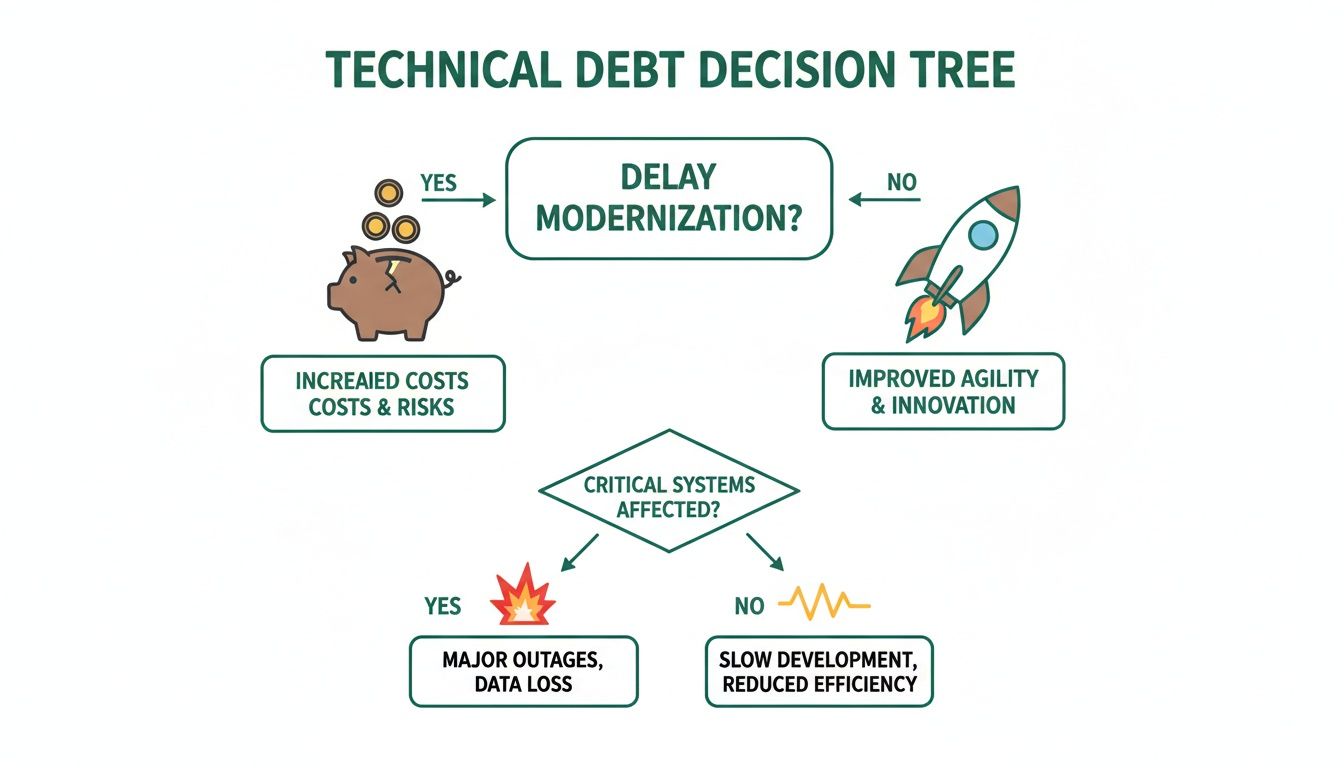
This visual drives home a critical point: putting off modernization isn't a neutral choice. It's an active decision with real financial consequences down the line. Moving forward is an investment in your company's future agility.
Comparing Your Modernization Options
Picking the right strategy requires a clear-eyed look at the trade-offs. While a quick fix might seem tempting, it often just kicks the can down the road without solving the root problems. For founders, the decision always comes down to balancing what you need right now with your long-term vision.
To help you weigh the effort against the reward, this table breaks down the five strategies side-by-side.
Comparing Application Modernization Strategies (The 5 R's)
| Strategy | Analogy | Typical Use Case | Effort & Cost | Business Impact |
|---|---|---|---|---|
| Rehost | Move the house | Migrating an old on-premise app to a cloud server to reduce infrastructure costs. | Low | Minimal. Lowers hosting bills but doesn't fix core application issues. |
| Replatform | Move & upgrade foundation | Moving an application to the cloud and switching to a managed database service. | Low-Medium | Moderate. Improves performance and cuts down on maintenance overhead. |
| Refactor | Renovate the kitchen | Restructuring parts of a monolithic codebase to improve maintainability and performance. | Medium | Significant. Makes the app easier to update and debug but keeps the core architecture. |
| Rebuild | Demolish & build new | Recreating a Bubble app from scratch using a modern stack like React and Python. | High | Transformational. Creates a scalable, secure, and fully-owned technical asset. |
| Replace | Sell & buy new | Switching from a custom-built CRM to an off-the-shelf solution like Salesforce. | Varies | High. Solves the business problem quickly but offers zero competitive differentiation. |
When it's all said and done, for a startup chasing venture-scale growth, the Rebuild strategy is almost always the answer. It's the most direct path to creating a defensible and valuable company. It's the move that turns a fragile MVP into a production-grade system ready for viral traffic, top engineering talent, and serious investment.
Knowing When It's Time to Go From No-Code to Code
So, how do you know when you’ve reached the end of the no-code road? It’s rarely a single, catastrophic event. Instead, it’s a slow burn—a collection of small annoyances, performance lags, and frustrating workarounds that gradually morph into serious business risks.
Recognizing these signals early is crucial. These aren’t just abstract tech problems; they're concrete issues that hurt your customer experience, handcuff your team, and eat into your profits. If you wait for the system to break completely, you're not being frugal—you're gambling with the growth you've worked so hard to achieve.
The table below outlines the most common warning signs we see. Think of it as a checklist. If you find yourself nodding along to more than a few of these, it’s probably time to have a serious conversation about modernizing your application.
Warning Signs Your No-Code App Needs Modernization
| Signal Category | Specific Warning Sign | Associated Business Risk |
|---|---|---|
| Technical Performance | Your app slows to a crawl or crashes during peak traffic (e.g., after a marketing push). | Poor user experience, high bounce rates, and lost customer trust. |
| Technical Performance | You're constantly hitting API rate limits from third-party services, breaking key features. | Unreliable service, forcing you into expensive plans that don't fix the core issue. |
| Technical Performance | You're nearing database limits (like Airtable's row limits or Bubble's query constraints). | Risk of data loss, corruption, and an inability to store critical business information. |
| Operational & Financial | Your monthly bill for tools like Zapier and other integrations is surprisingly high. | Unsustainable operational costs that scale poorly and drain cash reserves. |
| Operational & Financial | Your team spends hours on manual data entry or clunky workarounds for simple tasks. | Lost productivity, low employee morale, and high potential for human error. |
| Operational & Financial | The cost of adding new features via plugins and extensions is becoming prohibitive. | Spiraling subscription costs and a complex, brittle system that's hard to maintain. |
| Strategic & Growth | You can't build a key feature on your roadmap because the platform doesn't support it. | Inability to innovate, loss of competitive advantage, and a stalled product. |
| Strategic & Growth | Investors raise concerns about your tech stack's scalability, security, or lack of IP. | Difficulty securing funding, signaling a lack of long-term technical viability. |
| Strategic & Growth | You need to meet compliance standards (like HIPAA or SOC 2) that your current setup can't handle. | Legal and financial risks, inability to enter regulated markets. |
Seeing these signs doesn't mean your no-code choice was a mistake; it means you've succeeded to the point where you've outgrown your initial tools. It's a classic good problem to have, but it's a problem that needs a solution before it stifles your future growth.
Technical Performance Degradation
The most obvious growing pains usually show up as performance bottlenecks. The snappy, responsive app you launched now feels sluggish, unreliable, and frustrating, especially as your user count climbs. These aren't just occasional bugs; they are consistent patterns of failure that directly harm the user experience.
You know you’re in trouble when these things happen over and over:
- You Consistently Hit API Rate Limits: Your app depends on other services to function, but you’re constantly getting error messages because you’ve exceeded your request quota. This not only breaks core features but also pushes you into pricey subscription tiers that don’t address the underlying architectural flaw.
- Performance Suffers Under Load: Your site slows to a crawl or, even worse, crashes during a traffic spike. A successful marketing campaign should be a reason to celebrate, not a technical disaster that turns away excited new users.
- Database Limitations Become a Roadblock: You’re bumping up against the row limits in Airtable or hitting query constraints in Bubble. Your team is forced to invent fragile, complicated workarounds just to manage essential data, which opens the door to data loss and corruption.
Financial and Operational Drains
Beyond slow load times, the financial burden of a maxed-out no-code stack starts to become undeniable. The initial appeal of low costs gives way to a messy tangle of expensive subscriptions and manual processes that silently bleed your company dry.
The decision to modernize is often framed as a technical one, but it's fundamentally a business decision about scalability and survival. When your monthly Zapier bill surpasses the cost of a junior engineer, you are no longer saving money—you are funding inefficiency.
This isn't just an anecdotal trend. A massive 78% of US enterprises are planning to modernize at least 40% of their legacy applications by 2026. This data points to an urgent, widespread shift away from brittle systems toward robust software built for the long haul. You can explore more data on this industry-wide move at Radixweb.
Strategic and Investor-Facing Hurdles
Finally, the most critical signals are often strategic. These are the roadblocks preventing you from executing your long-term vision and securing the capital you need to scale. This is the point where your technology stops being an enabler and becomes your biggest liability.
Pay close attention to these red flags:
- You Can't Build a Critical Feature: Your product roadmap is at a standstill because your no-code platform simply lacks the capability to build the unique feature that would set you apart from the competition.
- Investors Question Your Tech Stack: During due diligence, potential investors start asking tough questions about scalability, security risks, and the fact that you don't actually own your core intellectual property.
- New Compliance Requirements Emerge: Your business is expanding into a new market with strict data privacy rules (like HIPAA or SOC 2), and you realize your current stack is nowhere near compliant.
When these issues start popping up, modernizing your app is no longer a "someday" project. It becomes a critical, proactive investment in the future of your company.
Your Playbook for a Six-Week Migration
Making the jump from a no-code platform to your own codebase is a huge milestone. It can feel like a monumental task, but it doesn't have to be. With a clear, time-boxed plan, the process of modernizing legacy applications stops being an overwhelming unknown and becomes a predictable, manageable project.
This playbook lays out a path to get you from a fragile MVP to a powerful, scalable system in just six weeks. It's not some open-ended consulting gig; it's a focused sprint with a clear finish line.
Phase 1: The Foundation (Week 0)
Before anyone writes a single line of code, we have to get on the same page. This first week is all about deep discovery and alignment. The goal is simple: make sure the engineering team completely understands your current app, its business logic, and exactly what you want to achieve.
This isn't just a technical exercise; it's about translating your vision into a solid engineering blueprint. Here's what has to happen:
- Comprehensive Schema Mapping: We’ll dig into your existing data, whether it’s in Airtable or Bubble's internal database. From there, we design a new, optimized database schema in a robust system like PostgreSQL that not only holds your current data but is built to handle future growth.
- Consolidating Access and Keys: We'll securely gather all the credentials needed—API keys for services like Stripe or Twilio, admin access to your no-code platform, you name it. Getting this done upfront means the development team can move fast without hitting frustrating roadblocks.
- Finalizing Scope and Goals: This is our final handshake on the core features, user flows, and business objectives. We lock in the "what" and the "why" before anyone starts building. A clearly defined scope is the foundation of a project that finishes on time and on budget.
Phase 2: Sprint-Driven Development (Weeks 1-6)
With the blueprint locked in, we shift into six weeks of focused, agile development. This phase is built for speed and transparency, so you're never left wondering what's happening. No "black box" development here—you'll see real progress every single week.
The whole point of this phase is to build momentum. Weekly demos and a tight feedback loop replace uncertainty with tangible progress. We turn a high-stakes migration into a series of predictable, manageable steps.
The rhythm for these six weeks is simple and repeatable:
- Weekly Staging Demos: Every week, you’ll get your hands on the latest build deployed to a staging environment. You can click through, test the new features, and see your application truly come to life.
- Continuous Feedback Loop: Right after each demo, your feedback is rolled directly into the plan for the next week's sprint. This back-and-forth ensures there are absolutely no surprises when we hand over the final product.
- Parallel Data Migration: While your new application is being built, we're already migrating your data in the background. We progressively map and move information from your old system into the new PostgreSQL database, getting everything ready for a final sync right before launch.
Getting this new foundation right is crucial. If you want a head start, check out our guide on how to create a database that’s designed for growth from day one.
Phase 3: The Harvest (Post-Week 6)
The sprints are done. Your new, powerful application is ready to go. This final phase is all about the formal handover, empowering your team to take the reins of their new technical asset. It’s the moment you officially go from renting your technology to owning it.
The "harvest" delivers a few critical things:
- Private Codebase Transfer: You get 100% ownership of the entire codebase in a private GitHub repository. It’s your intellectual property—clean, modular, and all yours.
- Full Infrastructure Handover: We transfer control of the cloud infrastructure (whether on AWS, Vercel, or another provider) directly to you. You get the keys to the kingdom and have complete control over your production environment.
- Comprehensive Documentation: You’ll receive clear, straightforward documentation covering the architecture, setup instructions, and key components of your new system. It’s everything your team needs to hit the ground running.
This structured, six-week playbook is all about removing risk and giving you a clear, actionable path from a constrained MVP to a scalable, investment-ready technology platform.
So, you’ve made it. You’ve crossed the chasm from a pieced-together, no-code MVP to a solid, custom-built application. What does that actually feel like?
Honestly, it’s a massive sense of relief. That quiet, nagging worry that a big press mention or a viral tweet could crash your entire system? It’s gone. You can finally stop thinking about platform limits, performance bottlenecks, and whether your tech can keep up with your ambition.
This isn't just a technical win; it's a strategic one. Now you can confidently chase those big enterprise clients, launch that aggressive marketing campaign, or handle a massive influx of new users. Your technology is no longer a liability holding you back—it's the engine powering your growth.
From Renter to Owner: The Real Payoff
The most profound change is in ownership. When you build on a no-code platform, you're essentially renting your technology. Migrating to a custom stack means you finally own the house. This shift gives you control and opens up opportunities that simply weren't on the table before.
The results are immediate and tangible:
- You Own 100% of Your Intellectual Property: Your code is now a core asset of your business. This is a huge deal for investors and a critical factor in your company's valuation. You’re not just building a business on someone else's platform; you're building a defensible, valuable technology asset.
- Your Operational Costs Plummet: Think about all those monthly subscriptions. The Zapier bills, the Airtable upgrades, the dozens of plugins holding everything together—that spending disappears. That cash can now be funneled directly into things that actually grow your business, like product development and marketing.
- Your Roadmap Has No Limits: You're no longer constrained by what your no-code platform allows. If you can spec out a feature, your team can build it. This agility lets you outmaneuver competitors and build exactly what your customers are asking for, without waiting for a third party to add the functionality you need.
Think of it this way: Modernization is about trading ever-increasing monthly operational expenses for a permanent, scalable asset. It's an investment that pays for itself in reliability, security, and the simple freedom to build without someone else's rules.
Ultimately, life after modernization means you have a platform that can deliver the performance your users expect and the security their data deserves. It's the critical step that transforms a clever project into a durable, high-growth company ready for the big leagues.
Frequently Asked Questions
When you're thinking about moving off a no-code platform, a lot of questions pop up. Let's tackle some of the most common ones we hear from founders who are ready to make the jump.
Should I Refactor My Bubble App or Rebuild It?
For almost every founder pushing the limits of Bubble, a rebuild is the right move. Trying to refactor inside Bubble itself might feel like a shortcut, but it's usually just patching over the real problem. You end up creating complex workarounds that don't fix the platform's core architectural limits, leaving you with a more tangled app that still can't scale.
Starting fresh with a modern stack—think React/Next.js on the front-end and Python on the back-end—gives you a solid, scalable foundation from the get-go. Even better, it gives you 100% ownership of your intellectual property and removes all platform risk. A rebuild might seem like a bigger project upfront, but it's often the fastest and cleanest path to a product that investors will back and customers will love.
Will I Lose My Data Migrating from Airtable?
Absolutely not—as long as it's done right. A professional migration process is built from the ground up to ensure zero data loss. We treat your data like the priceless asset it is, and the entire process is designed to protect it.
The migration process is all about careful mapping, staged transfers, and rigorous validation. We treat your data with the respect it deserves, ensuring a seamless and secure transition without losing a single record.
It starts with designing a new, robust database schema in a system like PostgreSQL that mirrors and improves upon your Airtable setup. Then, we meticulously map and transfer your data in controlled phases, often doing a final sync right before you switch over. This methodical approach means every piece of critical information, from user profiles to payment histories, is safe and sound in your new system.
How Much Does a No-Code to Code Migration Cost?
The final price tag will always depend on your app's complexity, but the key to managing it is cost certainty. Look for a fixed-price, time-boxed sprint model. Instead of an open-ended project that can spiral out of control, this approach gives you a clear scope, a predictable fee, and a production-ready application at the end of it.
This is almost always more cost-effective than hiring a full-time engineering team for months, and it gets your product to market much faster. The real question is how the one-time investment compares to the rising monthly bills of a brittle no-code stack and the opportunity cost of being unable to scale.
Ready to turn your fragile no-code MVP into a production-grade asset? At First Radicle, we specialize in migrating businesses from Bubble, Webflow, and Airtable to modern, scalable software in just six weeks, guaranteed. Learn more about our fixed-price migration service.