Python App Development: Building Scalable Apps for Your Business
Your no-code app was a brilliant success. You spun up an MVP on Bubble or Webflow, stitched it all together with a clever web of Zapier automations, and proved your idea has serious legs. But now, that very success is creating friction—the kind that keeps you up at night.
When Your No-Code App Starts to Break
If you've managed to build something people love with no-code tools, you’ve probably hit an inflection point. The very platforms that gave you incredible speed are now revealing their limitations. What felt like a nimble MVP a few months ago is now groaning under the weight of a growing user base.
This isn't a failure. It's the best problem to have—it means you've outgrown your prototype.
Think of your no-code app as an architectural model. It was perfect for showing off the design and getting investors excited. Now, it's time to pour the concrete foundation and build the actual skyscraper. The constant scramble to patch workflows and manage finicky integrations is a loud and clear signal: you need something more solid.
Recognizing the Pain Points of Scale
The symptoms of outgrowing a no-code stack are frustratingly familiar. Founders often tell me they feel like they’re losing control, where the platform—not their business strategy—is calling the shots. This friction usually shows up in a few key areas:
- Performance Bottlenecks: Pages are loading slowly, database queries are timing out, and the whole user experience gets clunky during peak hours. Your app feels sluggish, and you know your customers are noticing.
- Brittle Automations: A tiny, unannounced change in a third-party API can shatter a critical Zapier workflow, causing silent failures in your core business logic. You start spending more time debugging integrations than building new features.
- Platform Ceilings: You have a crystal-clear vision for a complex new feature, but the platform's rigid constraints make it impossible to build. Your product roadmap is effectively held hostage by your tools.
- Escalating Costs: Those monthly subscription fees for multiple SaaS tools, combined with the premium "per-task" pricing on your automation plans, are really starting to add up. You're paying a premium for a system that can’t even keep up.
These aren't just technical headaches; they are direct threats to your business. They choke your ability to scale, delight your customers, and out-innovate the competition. If your team is stuck in maintenance mode instead of growth mode, it's time for a change.
The move from a no-code MVP to a custom backend isn't about fixing something that’s broken. It's about graduating from a proven concept to a durable, scalable business asset that you fully own and control.
This is where Python app development comes in as the logical next step. It’s not a terrifying "rewrite from scratch" but a strategic evolution. By migrating your validated business logic to a custom Python backend, you’re building the permanent, industrial-grade version of the product you’ve already proven the market wants.
This shift puts you back in the driver's seat, empowering you to build for the long term and ensuring your technology can finally keep up with your ambition. For more on this, check out our guide on how to turn your site into an app that can truly scale.
Why Python Is the Engine for Scalable Backends
As a founder, picking a programming language can feel like a decision best left to the engineers. But when it comes to python app development, the choice is deeply strategic. There’s a solid business reason giants like Instagram, Spotify, and Netflix trust Python to power their core services—it’s built for growth, speed, and reliability.
Think of your no-code platform as a great set of hand tools. You built an amazing prototype, but now you need to manufacture at scale. Python is the industrial factory, complete with assembly lines, specialized machinery, and expert technicians. It gives your team the power to build robust, complex features far more efficiently than they ever could with visual builders.
This isn't just about writing code; it's about giving your business a real competitive advantage.
The Power of Python Libraries and Frameworks
One of Python's biggest strengths is its massive ecosystem of pre-built libraries. Instead of your team building every function from scratch—like user authentication or complex data analysis—they can just plug in battle-tested, open-source modules. This dramatically speeds up development time and cuts down on bugs.
- Django: A "batteries-included" framework perfect for building full-featured web applications quickly and securely.
- FastAPI: A modern, high-performance framework designed for building lightning-fast APIs, ideal for services that need to handle huge volumes of requests.
- Pandas & NumPy: The go-to tools for any app that needs to perform sophisticated data manipulation or analysis.
Using these tools means your developers spend less time reinventing the wheel and more time building the unique features that your customers actually care about. It's a straight line from idea to implementation, without all the detours.
Python's philosophy is all about practicality and just getting things done. For a founder, this translates into faster feature releases, a more stable product, and a lower total cost of ownership. It’s the smart choice for building a defensible tech asset.
This efficiency is a game-changer when you're migrating from a no-code MVP. The core business logic you painstakingly pieced together with visual editors and brittle automations can be rebuilt on a solid, maintainable foundation. What was once a patchwork of third-party services becomes a cohesive, powerful backend that you own completely.
A Thriving Community and Deep Talent Pool
Python's incredible popularity is a massive strategic asset for any startup. In just a decade, it went from a simple scripting language to a dominant force in backend systems. As of October 2025, the TIOBE Index ranked Python as the #1 most popular programming language worldwide for the fifth consecutive year. With an estimated 8.2 million developers globally, the talent pool is both deep and accessible. You can track the latest rankings yourself on the TIOBE Index website.
This popularity creates a powerful virtuous cycle. A larger community means:
- Better Support: When your team gets stuck, there's a global network of developers, forums, and documentation ready to help them solve the problem quickly.
- More Innovation: A constant stream of new libraries and tools keeps the Python ecosystem modern and powerful.
- Investor Confidence: VCs and technical advisors know and trust a tech stack built on widely adopted, mainstream technologies.
By choosing Python, you aren't just selecting a language; you are future-proofing your business. You’re building on a foundation that is secure, scalable, and supported by one of the largest and most active developer communities on the planet. This makes Python app development less of a technical gamble and more of a sound investment in your company’s long-term growth.
Choosing Your Core Python Technology Stack
Making the right technology decisions can feel like a high-stakes game, but it doesn't have to be. Think of it like a chef picking their knives—you need the right tool for the job. You wouldn't use a cleaver for delicate slicing, and the same principle applies to building your app.
Your tech stack is simply the collection of tools your team will use to build your product. For a founder, this isn't about becoming a developer overnight. It’s about understanding the big picture so you can match your technology choices to your business goals. We’ll focus on the three pillars that matter most: your framework, your database, and your application’s architecture.
Nailing these three decisions means you're building on solid ground, ready for whatever comes next.
Selecting the Right Python Framework
A framework is the scaffold for your application. It gives your developers a structured starting point, so they aren't reinventing the wheel for common tasks like user logins or talking to a database. In the Python world, two names come up constantly for web apps: Django and FastAPI.
- Django is what we call a “batteries-included” framework. It comes with almost everything you need right out of the box, like a powerful admin panel and a system for managing database interactions. It's built for speed—not just performance, but speed of development.
- FastAPI, on the other hand, is a lean, mean, performance machine. It’s a newer framework designed to do one thing exceptionally well: build blazingly fast APIs. If your app is all about getting data to a separate frontend (like a React or mobile app) as quickly as possible, FastAPI is purpose-built for that.
This isn’t just a technical detail; it's a strategic choice. Are you building a complex, feature-rich web app like an e-commerce platform or a social network? Django’s all-in-one approach will get you to market faster. Are you building a modern, sleek app where the backend’s only job is to be a lightning-fast data source? FastAPI is your champion.
The takeaway: The right framework is a business accelerator. Django helps you launch a complete product quickly, while FastAPI ensures your backend can handle a flood of users without breaking a sweat.
To help you see the differences more clearly, here's a quick breakdown of how they stack up.
Python Frameworks Django vs FastAPI at a Glance
| Aspect | Django (The All-in-One) | FastAPI (The Speed Specialist) |
|---|---|---|
| Philosophy | "Batteries-included." Provides everything you need to build a full web application. | Minimalist and high-performance. Focuses on building APIs exceptionally well. |
| Best For | Complex, data-driven web apps: e-commerce, CMS, social networks, SaaS platforms. | High-performance APIs, microservices, and backends for modern frontend apps. |
| Learning Curve | Steeper. There's more to learn upfront due to its size and built-in components. | Gentle. Much easier to get started if you already know modern Python. |
| Performance | Good, but not its primary selling point. Can be very fast with proper optimization. | Exceptional. Among the fastest Python frameworks available, built for raw speed. |
| Key Features | Built-in Admin, ORM, authentication, templating engine, security features. | Automatic API documentation, data validation, asynchronous support, dependency injection. |
Ultimately, both are fantastic choices. Django gives you a complete workshop, and FastAPI gives you a Formula 1 engine. The decision hinges entirely on what you're trying to build.
Graduating to a Professional Database
If your no-code MVP ran on something like Airtable or Google Sheets, you’ve seen how easy data can be. But let’s be honest: those are spreadsheets on steroids. They’re fantastic for organizing things, but they buckle under the pressure of a real application. They simply lack the muscle for things like data integrity, complex relationships, and high performance.
This is where a real, professional-grade database like PostgreSQL enters the picture. Think of this transition as upgrading from a flimsy filing cabinet to a Fort Knox-style digital vault. A proper database doesn’t just store your data; it protects it.
Moving to PostgreSQL gives you:
- Data Integrity: It enforces strict rules, preventing bad or inconsistent data from ever getting into your system. This is non-negotiable for anything involving payments or sensitive user info.
- True Scalability: It’s built from the ground up to handle massive amounts of data and traffic, so it grows with you instead of holding you back.
- Powerful Queries: You can ask complex questions of your data to uncover business insights that are simply impossible with spreadsheet-based tools.
For any serious app, this move isn't optional. It's the bedrock of a product your customers can trust.
Monolith vs. Microservices: A Simple Guide
The final piece of the puzzle is your app's architecture—the blueprint for how all the parts fit together. There are two main schools of thought here: the monolith and microservices.
A monolith is the classic approach. Your entire application—user profiles, billing, notifications, everything—lives together in one single, unified codebase. It’s simpler to build, easier to test, and faster to deploy when you’re starting out.
Microservices, in contrast, break the application down into a collection of tiny, independent services. You might have one service that only handles billing, another that only handles user authentication, and so on. This approach can be incredibly resilient and flexible at a massive scale, but it comes with a ton of added complexity.
For a founder migrating from a no-code MVP, the choice is clear: start with a well-organized monolith. It’s the fastest path from idea to a robust, working product. You can always peel off pieces into microservices later on, but only if—and when—your scale truly demands it. Don't take on complexity you don't need yet.
Understanding the Real Costs and Timelines
When you're ready to move past a no-code MVP, two questions immediately jump to mind: "What's this actually going to cost?" and "How long is this going to take?" The answers aren't as simple as picking a subscription tier, but they don't have to be a complete black box either.
Making the leap to a professional Python app development stack is a serious investment in your company's future. You’re not just paying for features; you're building a stable, scalable asset that you own outright. While the initial bill is higher than a monthly SaaS fee, it saves you from the hidden, compounding costs that catch up to every growing no-code app.
Just think about the "subscription sprawl" you're probably already dealing with. You've got the premium plan on your main platform, a few pricey Zapier plans holding everything together, and a handful of other tools that don't quite sync up. Those costs add up fast and get worse as you grow.
Deconstructing the Investment in a Python App
A custom Python application isn't priced by the user or by the automation run. It's priced based on scope and complexity, which makes your expenses far more predictable as you scale. Instead of watching your bills explode with every new signup, you invest in a solid foundation that can handle growth without breaking a sweat.
But the real ROI comes from what you stop losing money on.
- Eliminating Subscription Sprawl: By folding the jobs of five different SaaS tools into a single, cohesive backend, you can slash your monthly operational burn.
- Owning Your IP: A custom codebase is a real asset. It boosts your valuation and makes your business much more appealing to investors who want to see defensible tech, not a fragile web of third-party tools.
- Building for the Future: You're no longer stuck with a platform's limitations. You gain the freedom to build any feature you can dream up, opening up brand-new ways to make money.
This visual shows the key pieces of a typical Python stack, from the framework that drives the logic to the database that keeps your data secure.
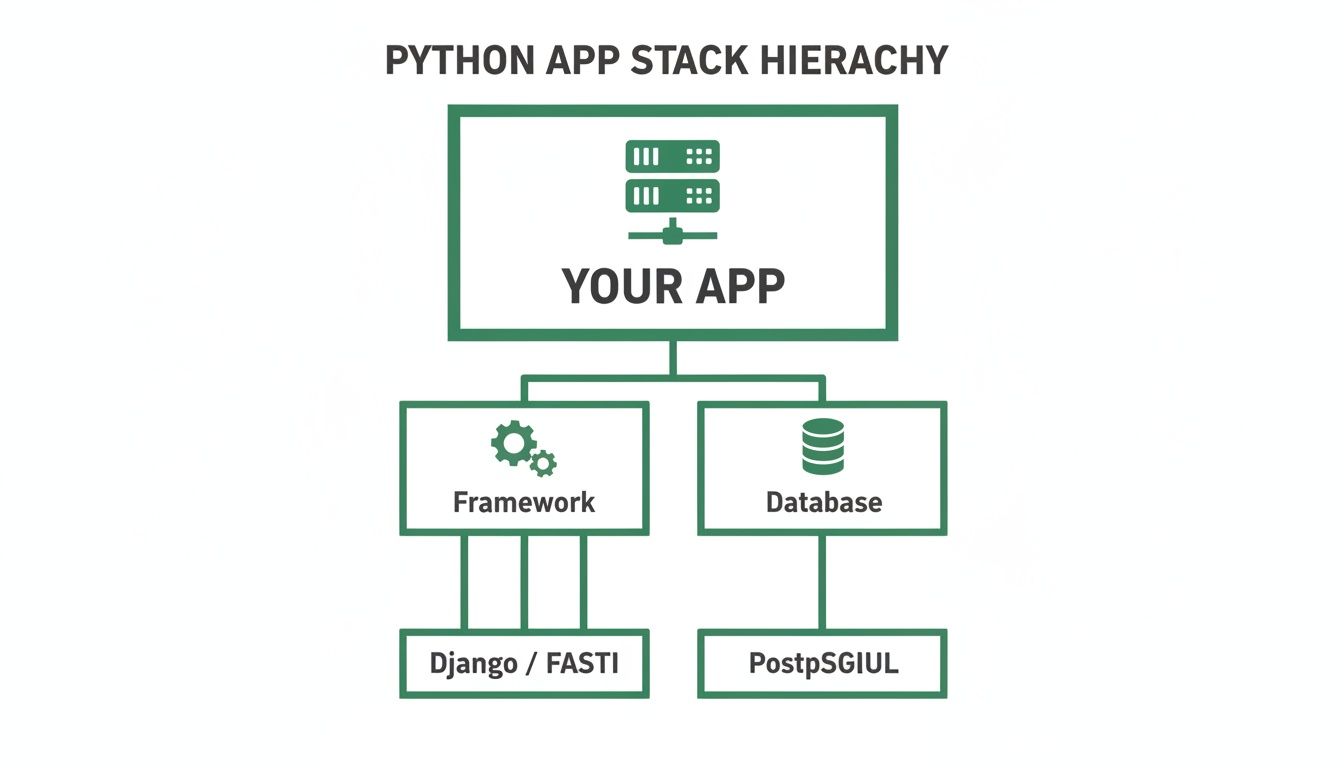
This kind of structure gives you a rock-solid and scalable foundation, letting your app grow without hitting the performance walls so common in no-code.
Setting Realistic Timelines for Migration
Migrating from a no-code MVP to a Python backend is often much faster than founders think. Why? Because you've already done the hard part of finding product-market fit. You know what your customers want, and you've mapped out the business logic—even if it's currently a tangled mess of automations.
Recent analyses have shown that Python's mature ecosystem makes it one of the most efficient choices for getting an app to market quickly. Its clean syntax and powerful frameworks like Django and FastAPI cut out a massive amount of repetitive work, letting expert teams ship products much faster. For founders replacing complex no-code workflows, this often means going from a brittle MVP to a production-ready Python backend in a matter of weeks, not quarters.
The biggest risk isn’t the cost of migration; it's the cost of delay. Every day you spend on a fragile platform is a day you risk losing customers to downtime, failing to build a key feature, or being unable to handle a sudden spike in traffic.
A focused, experienced team can pull off this migration with surprising speed. For example, our six-week migration service at First Radicle is built specifically for this situation. We use a sprint-based process to rebuild your core functionality on a robust stack, delivering a fully-owned, scalable product on a predictable schedule. To get a better sense of how design assets become working code in this process, check out our guide on translating web design to functional code. This approach gets your business onto a platform built for its next stage of growth with minimal disruption.
A Founder's Checklist for Migrating to Python
Thinking about moving off your no-code MVP can feel overwhelming, but a successful switch is all about good preparation. The great news is you've already cleared the biggest hurdle—you've proven your idea has legs. Now, it's just a matter of packaging that hard-won success into a clear brief for a development team.
This checklist isn't about code. It’s a strategic game plan to help you, the founder, get your ducks in a row and de-risk the entire migration. Nailing these steps means a faster, smoother, and more budget-friendly transition to a professional Python stack.
Think of it like creating the master blueprint for your company's new headquarters before the construction crew shows up. A solid plan from the start prevents costly changes and frustrating delays down the road.
1. Map Your Data Models
Before you can move your data, you have to know exactly what it is and where it lives. Your database, whether it's in Airtable, Bubble, or somewhere else, is the lifeblood of your business. The very first step is to create a simple map of this data.
You don't need a complex technical diagram. A simple document or spreadsheet that lists your main data "objects" is perfect. For instance:
- Users: What information do you actually store for each user? (e.g., name, email, subscription plan, last login date).
- Projects: What defines a "project" in your app? (e.g., project name, owner, due date, current status).
- Invoices: What are the key fields on an invoice? (e.g., amount, client, issue date, payment status).
This exercise forces you to take inventory of your most critical asset. It gives a development team an immediate, clear picture of what they need to build, allowing them to design a solid PostgreSQL database schema that mirrors your existing business logic.
2. Document Your Core Business Logic
The real magic of your no-code app isn't just the data; it's the unique workflows and automations you’ve painstakingly built. This is your secret sauce, and it needs to be written down before anyone writes a single line of code. Where does a Zapier workflow trigger a customer email? What, exactly, happens when a user upgrades their plan?
Your business logic is your intellectual property. Documenting it transforms it from a fragile collection of automations into a concrete set of requirements for your new, scalable backend.
Start by listing your most critical user flows. You can use simple, plain-English descriptions or even basic flowcharts to show the steps.
- User Onboarding: What happens from the moment someone signs up to their first "aha!" moment?
- Payment Processing: How does a subscription get created, billed, and eventually canceled?
- Core Feature Workflow: Detail the main thing a user does in your app, step-by-step.
This documentation is priceless. It guarantees that the logic making your business tick is faithfully rebuilt—and often improved—in your new Python backend. You can see how this logic becomes the foundation in our guide to custom backend development.
3. Ruthlessly Prioritize Your V1 Features
When you migrate, the goal isn't to rebuild every single bell and whistle from your no-code app all at once. The real goal is to get a stable, scalable V1 of your new application live as quickly as possible. This calls for some ruthless prioritization.
You need to identify the absolute "must-have" features that deliver 80% of the value to your customers. Everything else is a "nice-to-have" that can wait for a later phase. This tight focus is essential for keeping the scope, budget, and timeline under control.
A lean V1 scope lets your development partners deliver a production-ready system much faster, getting you off that brittle no-code platform and onto your new, scalable foundation with minimal friction.
4. Plan for the Customer Data Migration
Your existing customers and their data are precious. A seamless migration is completely non-negotiable. This means you need a clear plan for how this data will be pulled from your old system and loaded into the new one with zero downtime or data loss.
Start by thinking through these key questions:
- When will the cutover happen? (e.g., overnight on a Tuesday, during a low-traffic weekend).
- How will we notify users? A little communication goes a very long way in keeping customers happy.
- What's our rollback plan? If something goes sideways, how do we instantly revert to the old system?
A professional development team will handle the technical side, but having a clear business plan for the switchover makes the transition smooth for your users and far less stressful for you.
5. Consolidate All Your Assets
Finally, pull everything together. Gather your data map, business logic flows, feature priority list, and migration plan into a single, organized folder. This consolidated brief is the ultimate package you can hand over to a development partner like First Radicle.
It shows you're organized, you know your business inside and out, and you’re ready for a serious development project. This level of preparation is the single best thing you can do to guarantee a successful migration and set your business up for its next chapter of growth.
Unlocking Your Next Stage of Growth
Let's be clear: moving from a no-code MVP to a professional Python stack isn't just a tech upgrade. It’s a sign your business is evolving, shifting from a promising prototype into a durable, scalable company ready for the big leagues. This is the move that unlocks your next crucial phase of growth.
Imagine a world without the constant, nagging fear that your platform will buckle under pressure. With a production-grade backend, that’s exactly what you get. You gain the power to handle those massive, viral traffic spikes without crashing, giving the customers you fought so hard for a consistently reliable experience.
That stability changes everything. It frees you up to focus on real innovation instead of just putting out fires.
Building Your Defensible Moat
A custom Python backend is where you finally get to build the complex, proprietary features your customers keep asking for—the kind of stuff that was simply impossible on your old platform. This is how you carve out a real competitive advantage and create a product that’s incredibly difficult for anyone else to copy.
But it’s about more than just features. You're taking back control of your entire technology stack, which has some serious knock-on effects for your company's future:
- Strengthened Security: You can finally implement the robust, enterprise-grade security needed to protect user data. This is how you build the trust required to move upmarket and land larger clients.
- Total IP Ownership: Your code becomes a real, tangible asset on your balance sheet. This is a huge deal for investors, as it proves you own 100% of your technology and aren’t just renting it from someone else.
- Uncapped Scalability: You're now genuinely prepared for major milestones. Whether you're raising a seed round or onboarding your first million users, the tech won't be what holds you back.
Python app development isn't just about writing cleaner code. It's about building a more valuable and defensible company. It provides the foundation to support your ambition, turning your vision into a scalable reality.
If your business has outgrown the limits of no-code and you're ready to build for the long term, the path forward is clear. At First Radicle, we specialize in this exact transition, turning fragile MVPs into production-grade Python applications in just six weeks.
Ready to build a truly scalable company? Book an Unblock Session with us today and start your journey.
Common Questions We Hear from Founders
Even with a solid plan, it's natural to have a few questions swirling around. Let's tackle some of the most common ones we hear from founders who are thinking about making the jump from no-code to Python.
Do I need to hire a full-time Python developer right away?
Probably not, and that’s good news for your burn rate. Think of it this way: the migration project is an intense sprint to build the core product you need for your next phase of growth. Once that's launched, you'll likely shift into a maintenance-and-improvement phase.
This usually means adding features periodically, applying security updates, and general upkeep—not the kind of work that requires a full-time developer on payroll. That’s why we offer an optional $2k/mo scale support plan. It gives you access to an expert team when you need it, without the hefty commitment of a full-time salary. You can focus on growth and only bring on a full-time developer when your product roadmap truly demands it.
Is Python really fast enough for what I want to build?
Yes, absolutely. It's a common misconception that Python is "slow." While some languages might win in a raw, academic benchmark, that's not what determines real-world application speed. The things that actually slow you down are almost always inefficient database queries, network lag, or a poorly designed architecture.
Modern Python frameworks, especially something like FastAPI, are built for speed and are among the quickest options out there for APIs. Don't just take our word for it—Instagram, Netflix, and Spotify all rely on Python to handle massive scale, serving hundreds of millions of people. If it's fast enough for them, it's fast enough for you.
How hard is it to find good Python and React developers later on?
This is one of the biggest, and most underrated, advantages of choosing this tech stack. Python is consistently ranked as the most popular programming language on the planet. Similarly, React (and by extension, Next.js) is the undisputed king of the frontend world.
What does this mean for you? A massive global talent pool. Unlike trying to find a specialist for a niche no-code platform or an obscure language, you'll have a much easier time finding skilled developers to maintain or build upon your app. This accessibility is a huge long-term win, seriously de-risking your business and ensuring you're never stuck without the talent you need to grow.
If you're ready to build a scalable foundation for your business, First Radicle specializes in turning fragile no-code MVPs into production-grade Python applications in just six weeks.