
Mastering python application development: A Practical Founder's Guide
Your no-code app was a brilliant first step. It helped you validate your idea, find that elusive product-market fit, and build a base of users who genuinely love what you do. But now, the signs of your success are starting to feel like growing pains.
This isn't a setback. It’s a classic turning point that proves you’re ready to build something much bigger—a real, defensible business.
When Your No-Code App Hits a Wall

Think of your no-code MVP as the detailed architectural model that got your first stakeholders excited. It perfectly showcased the vision. Python application development is the next phase: laying the deep, steel-reinforced foundation for the actual skyscraper you plan to build.
It's about moving from a temporary blueprint to a permanent structure that can handle your ambition and user growth. You're not just renting space anymore; you're building and owning the entire building.
This is a common, and frankly, good problem to have. The very tools that allowed you to launch so quickly are now showing their natural limits under the stress of real-world demand.
The Telltale Signs You've Outgrown No-Code
Spotting these symptoms early can save you a ton of headaches. If these challenges sound familiar, it’s probably time to consider a custom software solution.
- Skyrocketing Subscription Costs: Are your monthly bills from Zapier, Airtable, and other services getting out of control? Each new user or feature adds another recurring charge, slowly eroding your profit margins without adding any real, long-term value to your company.
- Painful Performance Lag: The app used to feel fast and responsive, but now it’s slowing down. Airtable bases take ages to load, Bubble workflows are timing out, and you’re starting to hear from frustrated users. These are clear signs that your underlying architecture wasn't built for this kind of scale.
- Frustrating Feature Roadblocks: You know exactly what feature you need to build next, but your no-code platform just can't do it. You find yourself hacking together clunky workarounds, compromising on your vision simply because the tools are holding you back.
The moment you start building workarounds for your workarounds is the moment you've officially outgrown your no-code stack. It's a signal that your business requires a foundation built for complexity, not just simplicity.
Making this shift is about more than just fixing technical problems. It’s about unlocking your company's future. As we’ll explore, moving from a no-code web app builder to a custom Python backend is how you create a scalable, secure, and venture-backable product. You’re trading a clever assembly of rented tools for a valuable piece of intellectual property that you truly own.
So, Why Bet on Python for Your Startup's Future?
When it’s time to move beyond your MVP and build the real, scalable version of your app, the technology you choose is a huge business decision. Python isn't just a developer favorite; its whole philosophy is geared toward what a growing startup needs most: getting things done quickly, efficiently, and without building yourself into a corner.
Think of it this way: choosing Python is like building with high-quality, proven architectural plans instead of sketching everything from scratch. Its clean, readable style means developers can write code faster and with fewer bugs. That directly translates to shorter development cycles, a lower burn rate, and a quicker path to getting new features in front of your users.
Get to Market Faster with a Massive Ecosystem
One of Python's biggest wins is its enormous collection of libraries and frameworks. It's like walking into a massive, fully-stocked workshop where almost every specialized tool you could imagine is already built, tested by thousands, and ready to go. Instead of your team spending weeks building basic plumbing from scratch, they can just plug in powerful, pre-built solutions.
This makes a huge difference in your timeline. For example, common needs are already solved:
- User Authentication: Forget building sign-up, login, and social media integration from the ground up. Libraries like Django-Allauth handle all that complexity securely, right out of the box.
- Payment Processing: Integrating with Stripe or PayPal becomes straightforward, thanks to official and well-documented Python packages.
- Data Analysis and AI: This is where Python really shines. Tools like Pandas, NumPy, and Scikit-learn give you the power to build smart, data-driven features that are simply out of reach on most no-code platforms.
By not having to reinvent the wheel, you free up your engineering team to focus on what actually matters—the unique, value-creating features that your customers will love.
Python has cemented its place as the top language for building applications, especially for startups ready to scale past their no-code beginnings. The TIOBE Index consistently ranks it at the top, holding a 23.28% market share. A quick search on LinkedIn reveals over 1.19 million jobs requiring Python skills, and companies that migrate to a custom backend often see 40-60% cuts in operational costs by ditching expensive third-party tools. You can find more data on Python's market dominance and cost-saving potential.
De-Risk Your Future with a Deep Talent Pool
Beyond the code itself, Python gives you a massive strategic advantage: people. It's one of the most popular and widely taught programming languages on the planet, which means the pool of skilled Python developers is both massive and constantly growing.
This takes a lot of the risk out of your future hiring plans. As your company grows, you won't be stuck scrambling to find engineers who can work on your product. A bigger talent pool also means a more competitive hiring market, making it easier to build an amazing team without having to pay a fortune for some obscure, niche skillset.
At the end of the day, picking Python is a business move that pays off long after the first version is launched. It gives you the speed you need now and the stability, scalability, and access to talent you’ll need down the road. It sets you up for smart, sustainable growth.
Choosing Your Python Tech Stack
Once you've committed to Python, the next big conversation you'll have with your tech lead is about the "tech stack." It sounds technical, but it’s really just the set of tools they'll use to build your application. At the heart of this stack is the framework—the foundational blueprint for everything that follows.
Think of it like choosing the chassis for a car. The chassis dictates the vehicle's core purpose, how it's assembled, and what it’s good at. You wouldn't build a family SUV on a Formula 1 frame, and you wouldn't build a race car on a semi-truck base. This single decision shapes how fast you can build, how your app performs under pressure, and how painful (or easy) it will be to add features down the road.
It's a classic balancing act between speed, flexibility, and raw performance. Getting it right from day one is one of the most important technical decisions you'll make.
Django: The All-Inclusive SUV
Django is what we call a "batteries-included" framework. Imagine walking into a dealership and buying a fully-loaded SUV. It has the navigation, the heated seats, the advanced safety features, and a powerful engine all built-in and designed to work together flawlessly. You just get in and drive.
That’s Django in a nutshell. It comes with a ton of functionality right out of the box:
- A full-featured Admin Panel: An automatic, production-ready interface for managing all your app's data. This feature alone saves a staggering amount of development time.
- A powerful ORM (Object-Relational Mapper): This is a fancy way of saying developers can talk to your database using simple Python code instead of writing complex SQL queries. It's faster and less error-prone.
- Built-in Security: It comes pre-loaded with protections against common web vulnerabilities like Cross-Site Scripting (XSS) and SQL injection.
Because of this, Django is the go-to for complex, data-heavy applications where getting to market quickly without sacrificing quality is the top priority. It's perfect for e-commerce platforms, social networks, and big content management systems. Its structured, "opinionated" nature guides developers toward best practices, which keeps the codebase clean and secure, especially when you have a growing team.
Flask: The Customizable Sports Car Frame
If Django is the SUV, then Flask is the nimble, lightweight frame of a kit car. It shows up with just the essentials: a powerful engine and a solid frame. Everything else—the seats, the stereo, the paint job—is entirely up to you. You get total freedom to build a machine perfectly tuned to your exact needs.
Flask is a "microframework," which means it gives you the core tools for handling web requests and leaves the rest to you. This minimalist philosophy offers incredible flexibility. Your team will choose exactly which libraries and components to plug in, meaning your app has zero unnecessary bloat.
This unopinionated approach makes Flask a fantastic choice for smaller applications, single-purpose APIs, or projects with very specific, unique requirements that just don't fit into a standard box. It puts the developer in complete control, but that freedom comes with the responsibility of making more architectural decisions from the ground up.
FastAPI: The Modern Electric Supercar
FastAPI is the new kid on the block, and it was engineered from the ground up for one thing: pure, unadulterated speed. Think of it as a state-of-the-art electric vehicle chassis. It’s built on modern principles to deliver mind-blowing performance, instant acceleration, and seamless integration with the latest tech.
Its main superpower is its asynchronous architecture. This lets the application juggle many tasks at once without slowing down, making it an absolute beast for high-throughput APIs that need to serve thousands of requests per second. The recent explosion in Python's popularity for web development is heavily driven by frameworks like FastAPI, which are letting startups build for massive scale. In fact, Python now accounts for over 25% of GitHub repositories and is the choice for 60% of new backend projects, in part because its modern libraries can slash issue resolution times by 50%. You can learn more about Python's growth in backend development statistics.
Developers also love FastAPI because it automatically generates interactive API documentation, which dramatically simplifies testing and makes it easier for other services to connect to your app. It’s the obvious choice for building high-performance APIs, real-time services like chat apps, or for serving machine learning models where every millisecond of response time counts.
Python Framework Comparison for Founders
To make this choice a bit clearer, here’s a high-level look at how these three frameworks stack up from a founder's perspective. Think of this as a quick-glance guide to help you understand the fundamental trade-offs.
| Framework | Best For | Analogy | Key Feature |
|---|---|---|---|
| Django | Complex, large-scale applications (e-commerce, social networks). When speed-to-market is key. | The Fully-Loaded SUV | "Batteries-included" with a built-in admin panel, ORM, and security. |
| Flask | Smaller apps, microservices, or projects with unique requirements. When flexibility is paramount. | The Customizable Kit Car | Minimalist and unopinionated, giving developers maximum control and flexibility. |
| FastAPI | High-performance APIs, real-time applications, and asynchronous tasks. When raw speed is the goal. | The Electric Supercar | Blazing-fast performance and automatic, interactive API documentation. |
Ultimately, the right framework depends entirely on what you’re building. A well-rounded agency or development partner will help you navigate this decision, ensuring the technical foundation they lay is perfectly aligned with your business goals, both for your MVP and for your future growth.
Building a Scalable and Secure Application Architecture
Once you've settled on a framework, it's time to zoom out and look at the bigger picture: your application's architecture. This isn't about the nitty-gritty of coding; it's the strategic blueprint. A solid architecture is the difference between a house that stands firm in a storm and one that crumbles at the first sign of pressure.
For any founder, getting your head around these core principles is a game-changer. It means you can ask the right questions, demand a high-quality build, and end up with a valuable, defensible piece of intellectual property. This is about building a rock-solid foundation for the future, not just shipping features.
Your Database: The Central Nervous System
If your app were a business, the database would be its central ledger—the single source of truth for everything. While tools like Airtable are fantastic for getting an MVP off the ground, they're essentially a sophisticated collection of spreadsheets. As you grow, you need a true relational database.
For modern Python applications, PostgreSQL is the undisputed champion. Think of it as a highly organized, infinitely scalable digital warehouse. It’s built to handle millions of transactions with incredible speed, but more importantly, it's designed to maintain data integrity. This means it enforces strict rules to keep your data clean, consistent, and reliable, preventing the kind of tangled-up data mess that often kills no-code projects when they try to scale.
A well-structured database is one of the absolute cornerstones of what we call a well-architected framework.
Automated Testing: Your Quality Control Assembly Line
How do you make sure that adding one new feature doesn't accidentally break three old ones? The answer is automated testing.
Imagine every piece of new code has to pass through a rigorous, fully automated quality control line before it's allowed anywhere near your live product. This process instantly checks its functionality against a whole battery of predefined rules and scenarios.
This isn’t some optional extra; it’s a non-negotiable part of professional software development. An app without a strong testing suite is fragile and unpredictable. Automated tests give your team the confidence to build and deploy new features quickly, knowing this digital safety net will catch any bugs before your users ever see them.
A core principle in quality software engineering is "Don't Repeat Yourself" (DRY). This idea states that every piece of knowledge must have a single, unambiguous representation within a system. A well-architected, well-tested application embodies this by creating reusable, modular code that is easy to maintain and difficult to break.
CI/CD: The Automated Deployment Pipeline
So, the new code has passed all its tests. How does it actually get into your live application? That’s where Continuous Integration and Continuous Deployment (CI/CD) comes in.
Think of it as the conveyor belt that takes a fully inspected product from the quality control line and seamlessly places it on the store shelf, ready for customers.
CI/CD is a fully automated pipeline that takes new code, runs all the tests, and—if everything passes—deploys it to your servers without a human ever touching it. This completely eliminates manual, error-prone deployment processes and lets your team release updates and bug fixes multiple times a day with total confidence. For a startup, that means you can iterate and respond to user feedback at lightning speed.
This flowchart helps visualize how your choice of framework sets the initial architectural path.
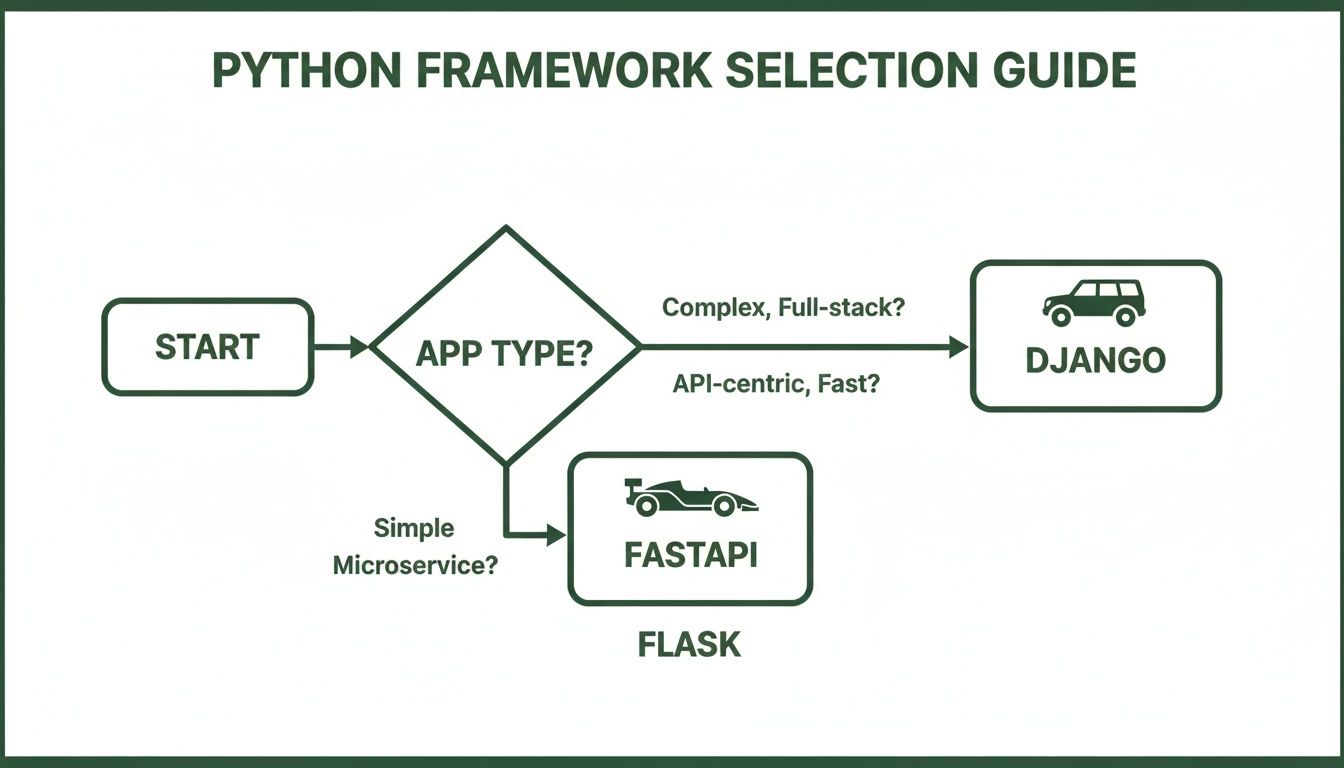
As you can see, the complexity and performance needs of your app point you directly toward either a feature-rich framework like Django or a high-speed specialist like FastAPI.
Security: The Digital Locks and Alarms
Finally, security can't be a feature you tack on at the end. In a custom Python app, security is baked in from day one. This boils down to a few fundamental practices:
- Input Validation: The golden rule is to never, ever trust user input. The system must rigorously check everything a user submits to prevent malicious code from being injected.
- Authentication and Authorization: This is all about securely managing who can log in (authentication) and what they are allowed to see or do once they're inside (authorization).
- Dependency Scanning: Your app relies on dozens of third-party libraries. Automated tools constantly scan these for known security holes and alert your team to update them immediately.
These pillars—a robust database, automated testing, CI/CD, and foundational security—are what make up a scalable and secure architecture. They all work together to create an application that is not just functional but resilient, maintainable, and ready for whatever growth comes next.
The Migration Playbook From No-Code to Python
Moving from a no-code platform to a custom Python backend sounds intimidating, but it's far less of a leap of faith than you might think. We break the entire project down into clear, manageable phases. It's not a black box where you hand over your idea and hope for the best; it’s a structured journey with clear milestones and regular check-ins, keeping you in complete control.
The goal here is a collaborative effort. You're in the driver's seat from start to finish, with full visibility into the process. We're not just aiming to replicate what you built on Bubble—we're aiming to improve it dramatically.
Phase 1: Handover and Schema Mapping
First things first, we need a complete handover. The development team will roll up their sleeves and dive deep into your current Bubble, Webflow, or Airtable setup. They need to understand every workflow, every data relationship, and every user interaction to get to the heart of your business logic.
With that knowledge, they’ll create a professional database schema. Think of your no-code database as a rough sketch on a napkin. A proper schema is the formal, engineered blueprint. It meticulously maps out every piece of data, defines how it all connects, and lays the groundwork for a powerful, scalable system built on a real database like PostgreSQL.
For a deeper dive, check out our guide on how to create a database designed to grow with you.
Phase 2: Sprint-Driven Development
Once the blueprint is approved, the real python application development kicks off. We don’t disappear for months and come back with a "big reveal." Instead, the work is broken down into agile, two-week cycles known as sprints.
At the end of each sprint, you get a live demonstration of the progress on a staging server. This isn't just a status update; it's a look at a working piece of your new application. This approach has some huge advantages:
- Total Transparency: You see real, tangible progress every two weeks. No guesswork.
- Immediate Feedback: You can give input right away, ensuring the project stays aligned with your vision.
- Reduced Risk: We catch any misunderstandings or necessary pivots early, which saves a ton of time and money down the line.
A critical piece of this phase is migrating your data. We carefully and securely transfer all your user data from the old system to the new PostgreSQL database. This is planned with military precision to ensure zero downtime, so your existing users won't even notice the switch.
The sprint-based model is all about de-risking the project. By building and delivering functional pieces of the app in short, predictable cycles, we eliminate surprises and make sure the final product is exactly what your business needs.
Phase 3: Final Code Transfer
When the last sprint is done and you’ve given the final thumbs-up on your new application, it’s time for the final handover. This is where you see the true value of your investment.
You receive 100% of the intellectual property. No strings attached. This includes the complete, clean, and well-documented codebase, which is transferred to a private GitHub repository that you own. All the cloud infrastructure—servers, databases, and deployment pipelines—is set up in your own cloud account, whether that's AWS or Google Cloud.
This isn't just a software delivery; it's a transfer of ownership. You’re no longer renting a platform. You own the asset, giving you the freedom to scale, innovate, and build a truly defensible business.
How Python Powers Modern AI and Data-Driven Apps
Moving to a custom backend isn’t just about making your app more stable. It’s about unlocking a completely different level of product capabilities. While no-code tools are fantastic for getting a simple workflow off the ground, they hit a hard wall when you need to do anything with artificial intelligence or serious data analysis. This is where python application development gives founders a real competitive edge.
Think of your data as crude oil. In a no-code world, you can basically just store it and show it to people. With Python, you can build the refinery. It gives you the tools to process that raw data into incredibly valuable insights, power intelligent features, and create a product that actually learns and adapts to your users.
This isn't some abstract idea—it translates directly into features that build a powerful, defensible moat around your business. You’re not just building a static app anymore; you’re building a dynamic, intelligent one.
Unlocking Innovation Beyond No-Code
A Python backend opens up a world-class ecosystem of AI and machine learning libraries. All of a sudden, features that felt like a distant dream become totally achievable.
- Intelligent Recommendation Engines: You can build systems like Netflix or Amazon that look at user behavior and suggest relevant content or products. This is a proven way to dramatically increase engagement and sales.
- AI-Powered Chatbots: Forget clunky, scripted bots. You can implement sophisticated customer service assistants that understand and resolve user issues in real-time, which can massively reduce your support overhead.
- Predictive Analytics: Imagine analyzing your historical data to forecast future trends. This helps you make much smarter decisions about everything from inventory and marketing spend to predicting user churn.
- User Behavior Analysis: Go deeper than simple analytics to understand why your users do what they do. You can spot patterns that reveal clear opportunities for making your product better.
This move toward AI-driven features isn’t just a nice-to-have; it's a core driver of value. Python’s central role in AI is supercharging startup valuations, as it now powers an estimated 70% of production machine learning models worldwide. We're seeing companies that make this migration report revenue lifts of 35% from enhanced personalization alone. You can find more insights about Python's impact on business growth at abbacustechnologies.com.
From Simple App to Intelligent Asset
For founders, this is a game-changer, especially when talking to investors. Owning your Python backend shows you’re not just building another SaaS tool; you’re building a proprietary data asset. It’s hard proof that you have a clear roadmap for innovation that goes far beyond what your competitors can do with off-the-shelf platforms.
By choosing Python, you are truly future-proofing your product. It provides the foundation to not only handle today’s user load but also to build the intelligent, data-driven features that will define your market tomorrow.
Common Questions About Python Application Development
Taking the leap from a no-code setup you know inside and out to custom software is a big decision. It's only natural to have some major questions. For most founders, it all boils down to time, money, and control.
Let's tackle those concerns head-on. The whole process is a lot more straightforward and empowering than you might think, especially when you have a clear roadmap.
How Long Does a Migration Really Take?
A full-stack migration sounds like this massive, drawn-out project that will drag on for months, but that's rarely the case. For a typical no-code app with a well-defined scope, we can get you to a production-ready Python stack in as little as six weeks.
How is that even possible? It comes down to a few key things:
- You've Already Built the Blueprint: Your existing no-code app gives us a perfect map. There’s no guesswork about what features you need or how the logic should flow.
- Modern Tools Are Fast: Frameworks like Django and FastAPI have tons of pre-built components that handle the heavy lifting, which seriously cuts down on development time.
- We Work in Sprints: We build in focused, two-week cycles with regular demos. You see progress constantly, which keeps momentum high and ensures there are no nasty surprises at the end.
What Is the True Cost Compared to No-Code Subscriptions?
Okay, the upfront investment for a custom build is higher than your monthly no-code subscription. There's no getting around that. But you have to look at the total cost of ownership over the long run.
Those recurring fees for Bubble, Zapier, and Airtable might seem manageable now, but they can spiral out of control as your user base and complexity grow. It becomes a major operational drag.
A custom Python backend is an investment in a permanent asset you own, not a recurring rental expense. Many companies that make the switch cut their operational "integration sprawl" costs by 40-60%, turning a monthly liability into long-term value.
Ultimately, you're trading ever-increasing rental fees for a one-time investment in your own valuable, proprietary technology. That shift is fundamental to building a truly defensible and profitable business.
Will I Lose Control if I Can't Code Myself?
This is probably the biggest fear for non-technical founders, but the reality is the complete opposite. A professionally built Python application gives you more control, not less.
With no-code, you're always stuck within the platform's walls. You can't escape their feature limitations, pricing changes, or ecosystem.
With a custom build, you own 100% of the intellectual property, all neatly organized in a private code repository. A good development partner will build a clean, modular architecture, which means any developer in the future can easily jump in, understand it, and build on top of it. Through transparent processes like weekly check-ins and clear communication, you are always the one guiding the vision—without ever having to write a single line of code.
Ready to transform your no-code MVP into a scalable, venture-backable asset? At First Radicle, we specialize in migrating fragile no-code projects to production-grade Python in just six weeks. Learn more and book a consultation at https://www.firstradicle.com.