
7 Best React JS Alternatives for Startups in 2026

For years, React has been the undisputed king of frontend development, powering countless startups from MVP to scale. Its vast ecosystem, component-based architecture, and massive talent pool offer undeniable advantages. But as the web platform matures, the "default choice" isn't always the best one. Startups scaling from no-code platforms like Bubble or Webflow, or those hitting the limits of Zapier and Airtable, face unique challenges where React's boilerplate and performance overhead can hinder momentum.
This comprehensive guide is built for founders and product leaders in exactly that position. We will move beyond abstract comparisons and provide a practical breakdown of the most viable React JS alternatives available today. For each framework, we'll dive into the specific details you need to make an informed decision, covering:
- Core Strengths & Weaknesses: A clear-eyed view of what makes each framework shine and where it falls short.
- Performance & Ecosystem: How fast is it, and is the community support robust enough for a growing startup?
- Migration Complexity: What does it actually take to move from a no-code MVP or an existing codebase?
- Ideal Use-Cases: Pinpointing which framework aligns best with specific business needs, from content-heavy sites to complex, data-driven applications.
We’ll explore powerful options like Vue, Svelte, Solid, Angular, Preact, and Qwik. This article is your strategic roadmap to choosing a frontend framework that not only solves your immediate technical problems but also serves as a long-term competitive advantage. Let's find the right tool for your specific journey.
1. Vue.js: The Progressive Framework for a Smooth Transition
Vue is often lauded as the most approachable of the major frameworks, making it a stellar choice for teams migrating from simpler stacks or those without deep front-end expertise. Its official documentation is famously clear, and its progressive nature allows you to use it as a simple library or a full-blown Single Page Application (SPA) framework. For a no-code startup transitioning to code, Vue's gentle learning curve and excellent developer experience mean you can build robust features faster.
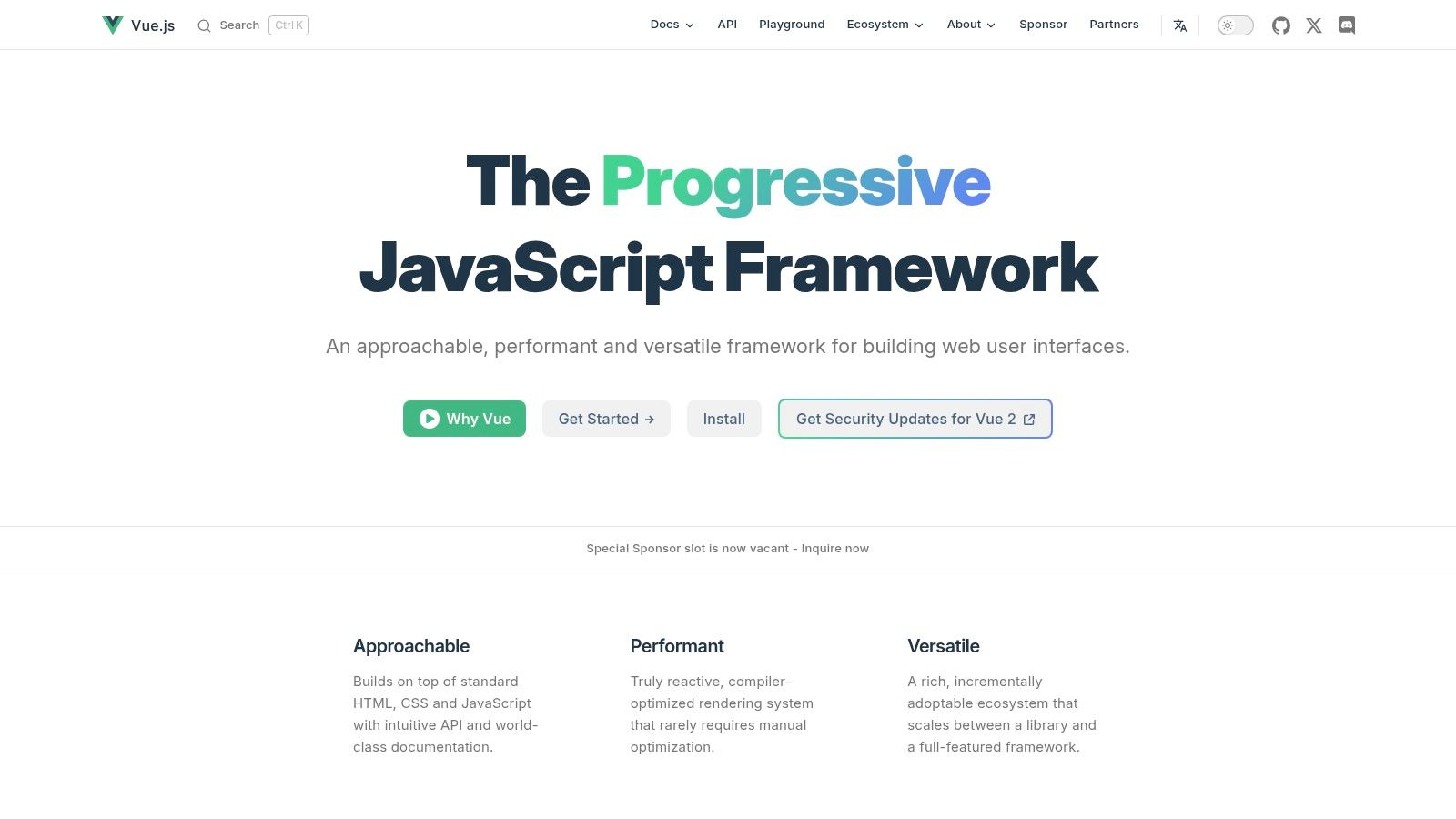
Vue.js stands out among react js alternatives for its familiar HTML-based template syntax, which feels intuitive to anyone with basic web development knowledge. This makes onboarding new developers, especially those coming from a jQuery or vanilla JavaScript background, significantly smoother. Its core library is focused on the view layer only, but it is surrounded by a rich ecosystem of officially supported libraries like Vue Router for routing and Pinia for state management, providing a cohesive and well-integrated development experience.
Key Differentiators & Use Cases
What makes Vue unique is its "progressive" adoption model. You can sprinkle Vue into an existing multi-page application to add interactivity to just one part of a page, or you can build a complex, enterprise-level SPA from the ground up. This flexibility is invaluable for startups migrating incrementally from a platform like Webflow, allowing them to enhance their existing site before committing to a full rewrite.
- Best For: Teams seeking a balance between power and simplicity, rapid prototyping, and projects where developer experience and speed are paramount. It's an excellent choice for a startup's first major foray into a JavaScript framework.
- Performance: Vue 3, with its Composition API and improved virtual DOM, offers performance on par with React. It is lightweight and generally very fast for most web application needs.
- Ecosystem: While not as vast as React's, Vue's ecosystem is robust, mature, and well-maintained. You’ll find high-quality libraries for virtually any need, from UI components with Vuetify to server-side rendering with Nuxt.
Migration & Next Steps
Migrating from React to Vue involves a conceptual shift from JSX to templates and from hooks to the Composition API. The logic is similar, but the syntax and structure are different. For a team transitioning from a no-code MVP, the first step is often to identify a contained, high-impact feature to build with Vue. This approach lets you see immediate value and learn the framework without overhauling your entire platform at once. Exploring how to package your web application can also be a crucial next step; get a deeper understanding of how to turn your site into an app with modern frameworks.
Expert Insight: For founders concerned about hiring, Vue's popularity is growing steadily. Its approachable nature means a competent JavaScript developer can become productive in Vue in a matter of days, not weeks. When planning a full-scale migration, engaging a specialist agency like First Radicle can de-risk the process and ensure your architecture is built for long-term scalability.
2. Svelte: The Radical Compiler for Ultimate Performance
Svelte takes a fundamentally different approach to building user interfaces, making it a powerful contender among react js alternatives. Instead of doing the bulk of the work in the browser (like React's virtual DOM), Svelte is a compiler that shifts that work to the build step. This results in highly optimized, vanilla JavaScript code that runs incredibly fast, with smaller bundle sizes and no runtime overhead, a perfect goal for a startup focused on lean, high-performance applications.
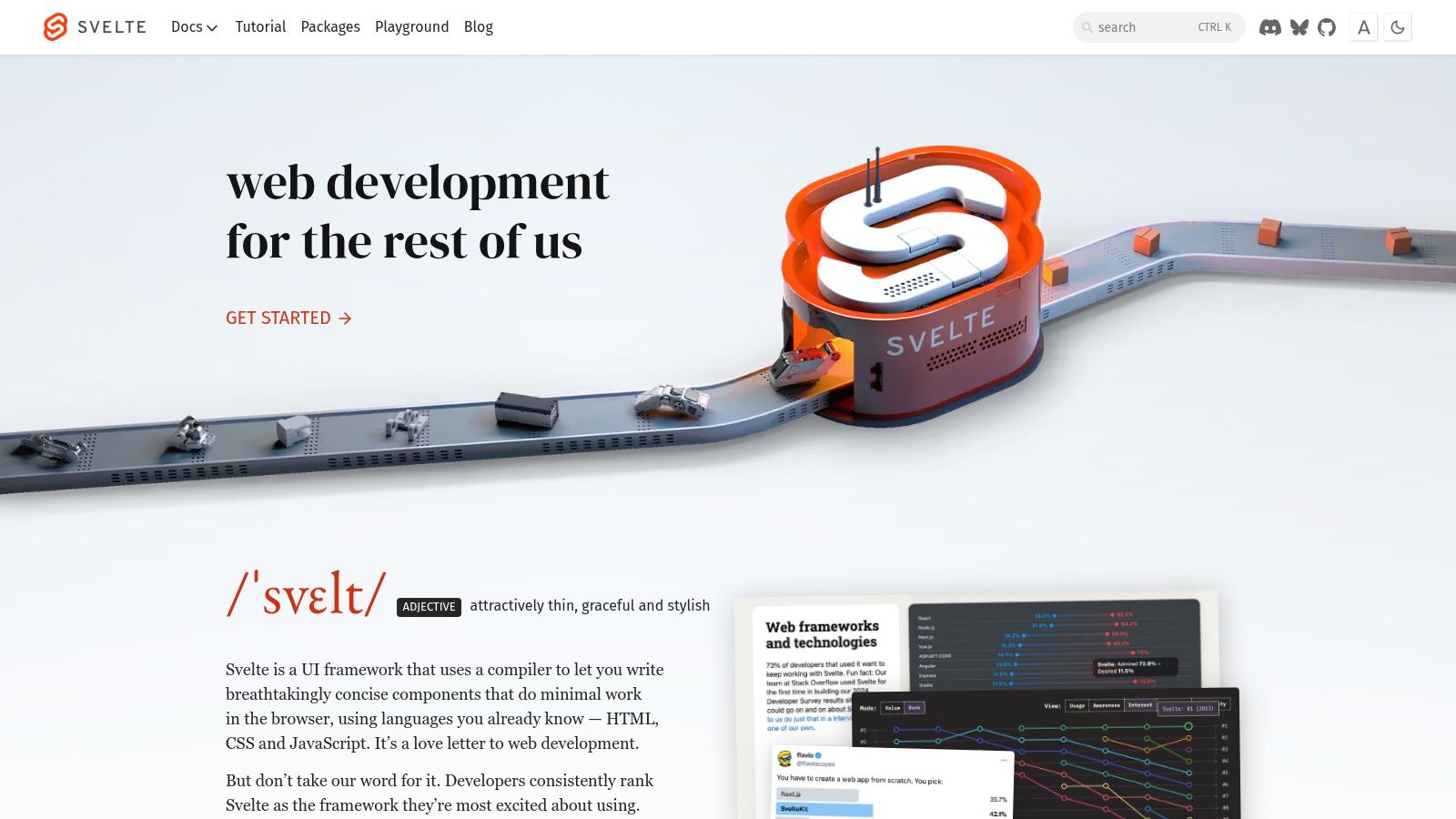
This compile-time strategy makes Svelte feel more like writing traditional web code. Its component syntax is clean and concise, closely resembling HTML, CSS, and JavaScript, which dramatically lowers the barrier to entry for developers. For a startup founder moving away from a no-code platform, the simplicity of Svelte's single-file components means your team can become productive almost immediately, focusing on building features rather than wrestling with framework-specific boilerplate.
Key Differentiators & Use Cases
Svelte's biggest differentiator is its lack of a virtual DOM. By surgically updating the real DOM only when state changes, it achieves blazing-fast performance that is especially noticeable on low-powered devices or in highly interactive applications. Its first-party framework, SvelteKit, provides a seamless, full-stack development experience with file-based routing, server-side rendering, and API endpoints, making it a comprehensive solution out of the box.
- Best For: Performance-critical projects, interactive visualizations, and teams that value simplicity and developer ergonomics. It is an ideal choice for startups building products where speed is a core competitive advantage.
- Performance: Svelte is often a top performer in framework benchmarks due to its compiler-first approach and minimal runtime. The small bundle sizes lead to faster initial load times and a snappier user experience.
- Ecosystem: While younger and smaller than React's, Svelte's ecosystem is growing rapidly. With modern Vite-based tooling and an active community in places like the Svelte Society, you can find solutions for most common needs, from UI libraries to state management.
Migration & Next Steps
Transitioning from React to Svelte involves unlearning the virtual DOM mental model and embracing Svelte's reactive declarations. The syntax is far less verbose, replacing hooks and JSX with a more direct, assignment-based reactivity. For a startup migrating from Webflow or Bubble, a great first step would be to rebuild a single, dynamic component or a specific interactive page with Svelte. This allows you to witness the performance gains and developer experience benefits on a small scale before committing to a larger migration.
Expert Insight: Founders often worry about the hiring pool for newer technologies. However, Svelte's intuitive syntax makes it exceptionally easy for any competent JavaScript developer to pick up. The speed and joy of development often lead to higher team morale and productivity. For a strategic migration that ensures your new stack is performant and maintainable, partnering with an agency like First Radicle can provide the architectural guidance needed to leverage Svelte's full potential.
3. Angular: The Enterprise-Grade Framework for Scalability
Angular, backed by Google, is less a library and more a complete platform for building ambitious web applications. It's an opinionated framework, meaning it comes with a prescribed way of doing things, from routing and state management to dependency injection. For a startup planning for massive scale or dealing with complex business logic, this "batteries-included" approach can be a significant advantage, ensuring consistency and long-term maintainability across a growing development team.
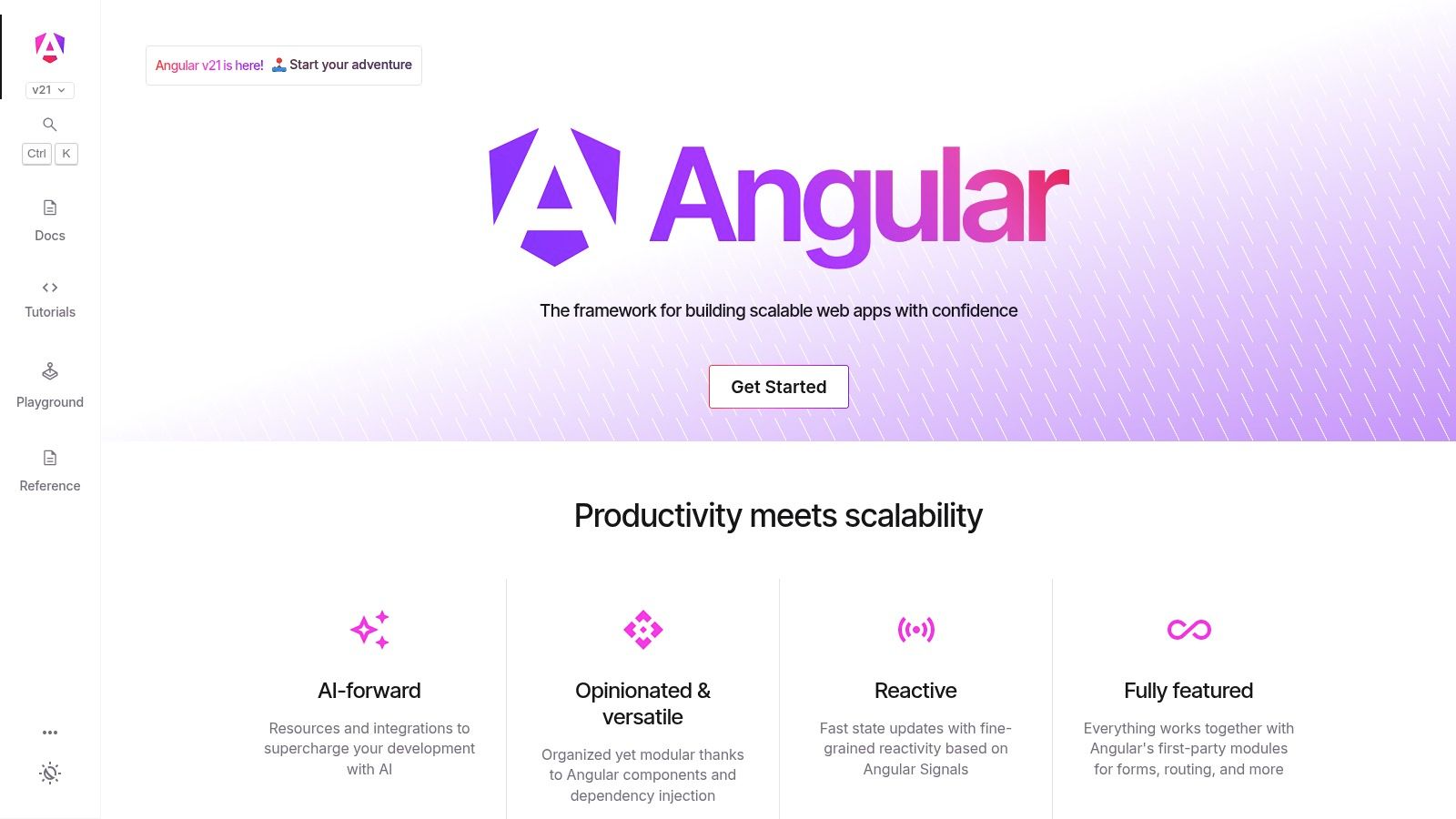
As one of the most mature react js alternatives, Angular provides an end-to-end toolchain right out of the box. Its powerful Command Line Interface (CLI) automates everything from project setup and component generation to updating dependencies, drastically reducing boilerplate code. This structured environment is ideal for teams that value clear conventions and want to avoid the "decision fatigue" that can come with piecing together a frontend stack from dozens of smaller libraries.
Key Differentiators & Use Cases
Angular's primary differentiator is its all-in-one, opinionated nature. While React provides the view layer and leaves architecture up to you, Angular provides a comprehensive solution. It uses TypeScript by default, enforcing type safety that helps catch errors early and makes large codebases easier to refactor and understand. This makes it a formidable choice for complex, data-intensive applications where stability is non-negotiable.
- Best For: Enterprise-level applications, large teams requiring standardized architecture, and projects with complex requirements like banking platforms or CRMs. Startups needing to build a robust, scalable system from day one will find its structure invaluable.
- Performance: Modern Angular, with its new Signals-based reactivity and improved change detection, offers excellent performance. Its built-in support for server-side rendering (SSR) and ahead-of-time (AOT) compilation ensures fast initial load times and a smooth user experience.
- Ecosystem: The framework itself contains most of what you need, including a router, HTTP client, and forms module. For UI components, libraries like Angular Material provide a comprehensive suite of well-tested, accessible components that follow Google's Material Design principles.
Migration & Next Steps
Migrating from React to Angular is a significant undertaking due to their fundamentally different philosophies. It involves adopting TypeScript, learning Angular's specific module and component structure, and understanding concepts like dependency injection. For a business scaling up from a no-code tool, the steep learning curve means it’s crucial to invest in proper training or expert guidance. The first step is to establish a solid foundation by understanding software architecture best practices that align with Angular's structured approach.
Expert Insight: The "ceremony" of Angular is often its greatest strength and biggest hurdle. For a founder, this means a slower start but a more predictable and scalable path forward. It enforces a discipline that pays dividends as your team and application grow, preventing the architectural drift that can plague more flexible frameworks. For a mission-critical application, this built-in rigor is a feature, not a bug.
4. SolidJS: Blazing-Fast Performance with a Familiar Feel
SolidJS is the dark horse of modern front-end frameworks, offering the raw performance of vanilla JavaScript while retaining the declarative, component-based development model that makes React so popular. It achieves this through fine-grained reactivity, which updates the DOM directly when data changes, completely eliminating the need for a Virtual DOM. For a startup obsessed with speed and efficiency, SolidJS presents a compelling case for building interfaces that are incredibly fast and lightweight.
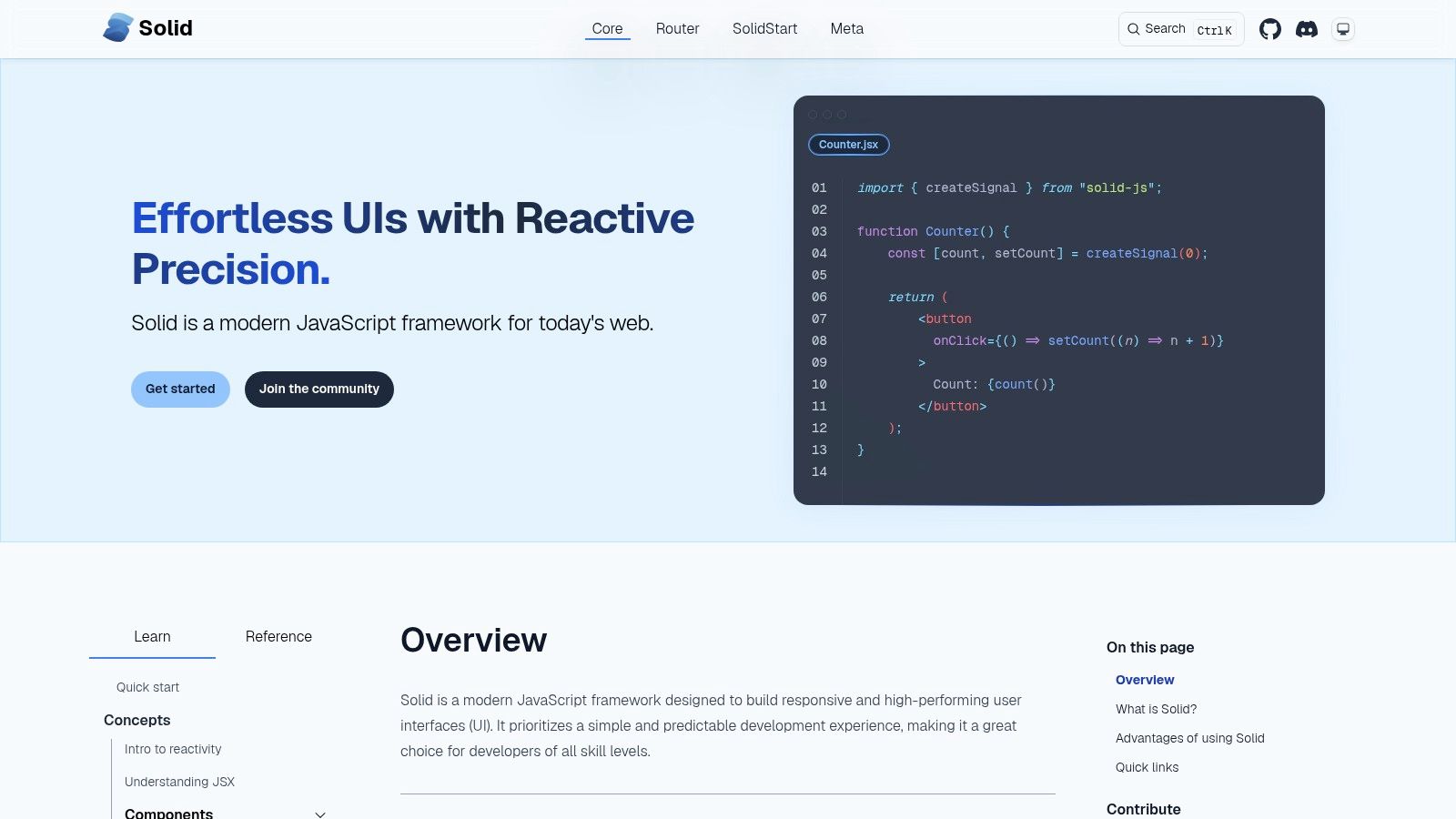
The primary reason SolidJS stands out among react js alternatives is its ability to provide top-tier performance without a steep learning curve for React developers. It uses JSX, so your components look and feel almost identical to React components. However, its compilation-based reactivity system means it sidesteps the performance overhead of re-renders and diffing, leading to smaller bundle sizes and a snappier user experience, especially on low-powered devices.
Key Differentiators & Use Cases
SolidJS’s core philosophy is "disappearing components." After the initial render, your components are just functions that have set up reactive relationships; they don't re-run like in React. This fundamental difference is what unlocks its performance gains. It makes SolidJS a perfect choice for highly interactive applications like dashboards, real-time data visualizations, or complex editors where every millisecond counts.
- Best For: Performance-critical applications, teams with strong React experience looking for a faster runtime, and projects where bundle size is a major constraint. It's ideal for a startup building a data-intensive product that needs to feel instantaneous.
- Performance: SolidJS consistently tops performance benchmarks for JavaScript frameworks. Its fine-grained reactivity and lack of a Virtual DOM make it one of the fastest options available for rendering and updates.
- Ecosystem: The ecosystem is young but growing rapidly. While it doesn't have the sheer volume of libraries as React, you can find ports of popular UI libraries like SUID (Material-UI) and solid-headless (Headless UI). For many common needs, the community has provided solid solutions.
Migration & Next Steps
For a team coming from React, the transition to SolidJS is remarkably smooth. The main conceptual shift is understanding that components only run once, and reactivity is handled by primitives like createSignal. A good starting point for a no-code startup would be to rebuild a single, performance-sensitive feature, like a filterable table or an interactive chart, using SolidJS. This isolates the learning process and demonstrates the immediate performance benefits. The official documentation at docs.solidjs.com provides clear tutorials for getting started.
Expert Insight: The primary challenge with SolidJS is its smaller ecosystem and talent pool. However, its similarity to React significantly lowers the hiring barrier. A proficient React developer can become productive in SolidJS very quickly. When planning a migration, a firm like First Radicle can help evaluate if the performance trade-offs are right for your product and assist in architecting a solution that leverages Solid’s unique strengths while mitigating any ecosystem gaps.
5. Qwik: The Resumable Framework for Instant Performance
Qwik introduces a radical new approach to web performance by eliminating the expensive process of hydration. It's built on a concept called "resumability," which allows an application to instantly become interactive without re-executing its initialization code on the client. For a startup focused on lightning-fast landing pages, e-commerce sites, or content-heavy platforms, Qwik offers a game-changing performance advantage right out of the box.
As one of the most innovative react js alternatives, Qwik stands apart by delivering only the absolute minimum JavaScript needed for user interaction, loading additional code on the fly as needed. This "fine-grained lazy-loading" is automatic and transparent to the developer. For teams familiar with React, the learning curve is surprisingly gentle, as Qwik uses JSX and a component-based architecture that will feel immediately familiar.
Key Differentiators & Use Cases
Qwik’s core differentiator is its focus on resumability, which directly translates to near-zero JavaScript execution on page load. While other frameworks optimize hydration, Qwik sidesteps it entirely. The server serializes the application's state and component listeners into the HTML, allowing the client to resume where the server left off without re-running any code. This makes it perfect for applications where Time to Interactive (TTI) is a critical business metric.
- Best For: E-commerce sites, marketing landing pages, documentation sites, and any application where initial load performance is paramount to user conversion and retention.
- Performance: Unmatched startup performance. Qwik applications can achieve perfect or near-perfect Google Lighthouse scores with minimal effort due to their unique architecture.
- Ecosystem: As a newer framework, Qwik's ecosystem is still developing. However, its meta-framework, Qwik City, provides a solid foundation with file-based routing, data loading, and server-side rendering, similar to Next.js.
Migration & Next Steps
Transitioning from React to Qwik is less of a syntactic leap and more of a conceptual one. Developers will need to grasp the principles of resumability and how Qwik's optimizer breaks the application into tiny, lazy-loadable chunks. For a startup with a no-code MVP, a great first step would be to rebuild a single, high-traffic landing page in Qwik to measure the performance impact directly. This isolated project allows your team to understand the framework's core concepts without committing to a full-stack migration.
Expert Insight: The primary challenge with adopting Qwik is its relative youth, which means fewer third-party libraries and community resources compared to established players. For mission-critical projects, partnering with a specialized agency like First Radicle can help navigate the new ecosystem and ensure your application architecture is robust and built to leverage Qwik's unique performance benefits for long-term growth.
6. Preact: The Drop-In Replacement for a Lighter Footprint
For startups already invested in the React ecosystem but struggling with performance bottlenecks or large bundle sizes, Preact presents a compelling and pragmatic solution. It's not a full-fledged framework to learn from scratch but a fast, 3kB alternative to React with the same modern API. This makes it one of the most unique react js alternatives because it often requires minimal code changes to implement, offering immediate performance gains.
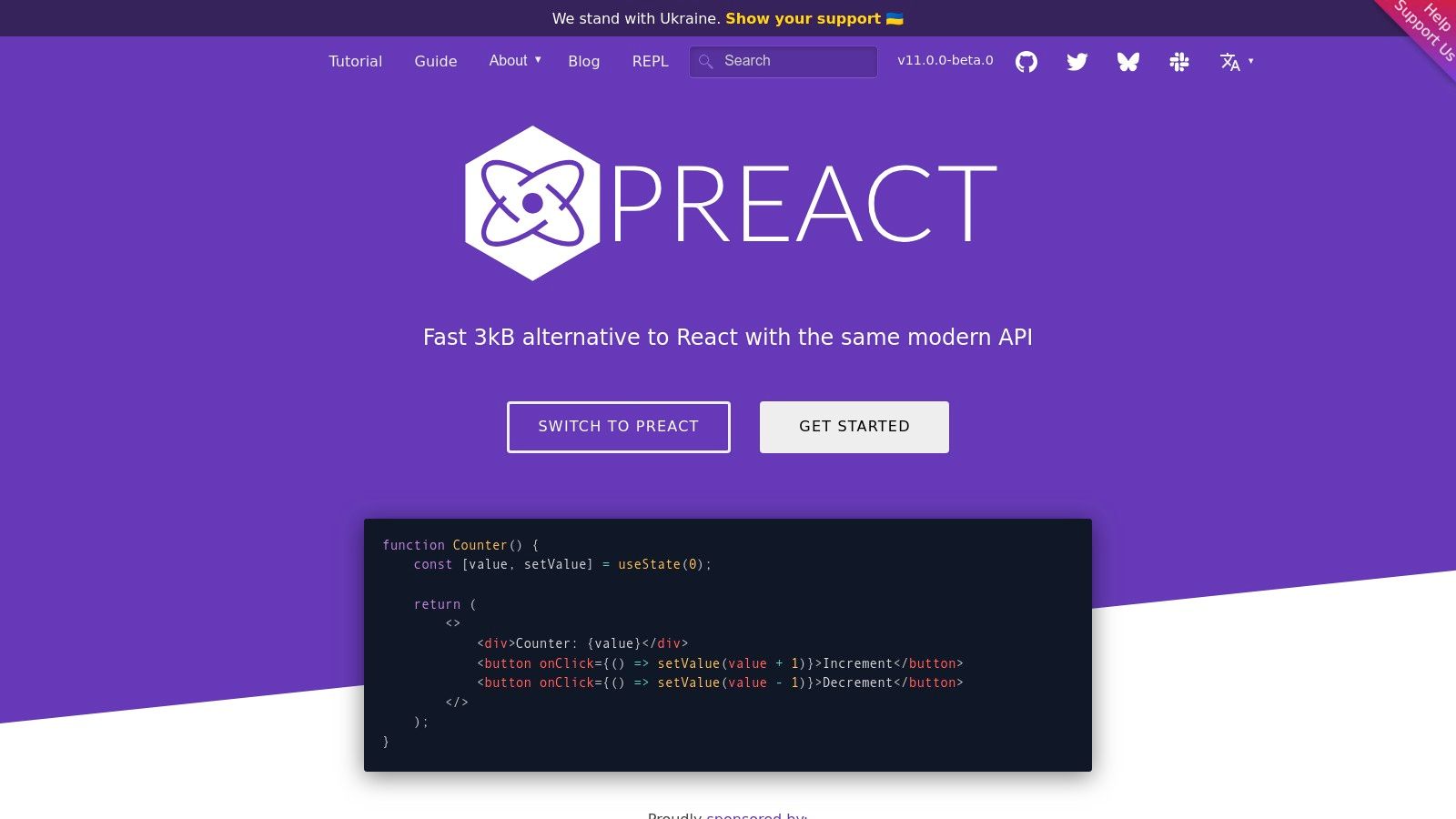
Preact’s primary value proposition is its near-identical API to React, made possible through an official compatibility layer called preact/compat. This clever package aliases React to Preact, allowing you to use the vast majority of existing React libraries, like react-router or react-redux, directly in a Preact project. For a team that has built a prototype in React and now needs to optimize for load times on mobile or in emerging markets, this compatibility is a game-changer. It means you can shrink your application's core library size dramatically without rewriting component logic or retraining your development team.
Key Differentiators & Use Cases
The defining feature of Preact is its focus on size and speed. By stripping out some of React's more niche features and legacy baggage (like synthetic events), Preact achieves a tiny footprint that translates directly to faster page loads and a snappier user experience. This is especially critical for e-commerce sites, marketing landing pages, or any application where initial load time directly impacts conversion rates.
- Best For: Existing React projects needing a significant performance boost, resource-constrained applications (e.g., for low-powered devices), and teams wanting to optimize without a costly migration. It's the perfect choice for a startup that loves the React way of building but needs to be leaner.
- Performance: Exceptional. Preact is consistently one of the top performers in web framework benchmarks due to its small size and efficient diffing algorithm. The browser has less JavaScript to download, parse, and execute, resulting in a quicker time-to-interactive.
- Ecosystem: Because it can tap into the React ecosystem via
preact/compat, its ecosystem is effectively massive. While some edge cases or libraries with deep reliance on React's internal APIs might face compatibility issues, the most popular and well-maintained libraries work seamlessly.
Migration & Next Steps
Switching from React to Preact is less a migration and more of an optimization step. For many projects built with tools like Vite or Webpack, it can be as simple as installing preact and aliasing react and react-dom to preact/compat in the build configuration. No component rewrites are necessary. This low-friction transition allows a startup to test the performance impact with minimal risk and engineering effort. You can swap in Preact, measure the improvements, and decide whether to commit fully, all within a single development sprint.
Expert Insight: The beauty of Preact is its simplicity as a business decision. If your application is slow and your bundle size is a key culprit, Preact offers a direct, low-risk path to improvement. For founders presenting to investors, being able to demonstrate a faster, more optimized application without diverting months to a rewrite is a powerful story. For a more structured migration, an agency like First Radicle can help audit your existing React codebase for compatibility and implement the switch smoothly.
7. StackShare: Community-Driven Due Diligence
Before committing to a technical direction, savvy founders survey the landscape to see what technologies successful companies are actually using. StackShare isn't a framework itself, but an indispensable research platform. It provides a community-curated view of tech stacks, allowing you to see which react js alternatives are gaining traction in real-world applications. For a founder moving from a no-code MVP, it’s a fast way to gather social proof and data before investing heavily in a new framework.
The platform’s React alternatives page lists frameworks like Vue.js, Angular, and Svelte side-by-side, complete with votes, stack counts (the number of companies using the tool), and links to official documentation. This aggregated data provides powerful signals about a technology's maturity, hiring viability, and overall popularity. You can quickly filter out niche or declining frameworks and focus your deep-dive research on the ones with proven momentum and robust community support.
Key Differentiators & Use Cases
What makes StackShare unique is its focus on real-world adoption rather than just technical benchmarks. While official docs explain what a tool can do, StackShare shows what it is doing in production at companies like Uber, Airbnb, and thousands of startups. This perspective is crucial for de-risking your technology choices. You can see which frameworks pair well with other tools in your potential stack, from databases to hosting providers.
- Best For: Early-stage technology evaluation, competitive analysis, and validating framework choices based on community adoption and real-world usage data. It's the first stop for a non-technical founder aiming to understand the technology landscape.
- Data Quality: While the community-driven pros and cons can sometimes be subjective or outdated, the stack counts and company usage data are invaluable signals. Always cross-reference insights with official documentation.
- Ecosystem: StackShare essentially maps out the entire tech ecosystem. You can explore not just front-end frameworks but also backend, database, and DevOps tools, helping you plan your entire architecture.
Migration & Next Steps
Using StackShare is the first step in your migration research. Identify 2-3 promising alternatives based on their popularity and use cases that align with your product goals. Then, use the links provided to dive into their official documentation and tutorials. For a startup founder, this research helps you have more informed conversations with potential technical hires or development agencies. This initial diligence is a key part of building scalable web applications that can grow with your business.
Expert Insight: StackShare is a powerful tool for pattern recognition. If you notice dozens of companies similar to yours are choosing Svelte over Vue, it’s a strong signal worth investigating. Use this data not as a final answer, but as a guide to focus your research and ask smarter questions when you engage with technical experts or a migration partner like First Radicle.
Top 7 React Alternatives Comparison
| Item | Implementation complexity | Resource requirements | Expected outcomes | Ideal use cases | Key advantages |
|---|---|---|---|---|---|
| Vue.js | Low–Moderate — incrementally adoptable, gentle learning curve | Moderate — official libraries (Router, Pinia) and community packages | Productive development, maintainable SPAs or progressive enhancements | Teams migrating from simpler stacks, progressive web apps | Strong docs and ecosystem, easy onboarding |
| Svelte | Low — compile-time reactivity, simple syntax | Low–Moderate — SvelteKit for full-stack, smaller ecosystem | Very small bundles, excellent runtime performance | Lean front ends, performance-sensitive single-page apps | Compile-time optimizations, concise components |
| Angular | High — opinionated, CLI, DI and more ceremony | High — extensive toolchain, larger team training and tooling | Predictable, scalable enterprise applications | Large enterprise projects, long-term stable codebases | Batteries-included framework, mature docs and tooling |
| SolidJS | Moderate — React-like patterns with fine-grained reactivity | Moderate — growing ecosystem, may need adapters | Very high runtime performance, tiny runtime | React migrations needing better performance, interactive UIs | Fine-grained reactivity, familiar JSX patterns |
| Qwik | Moderate–High — resumability model and lazy execution patterns | Moderate — Vite tooling, newer ecosystem and examples | Instant interactivity, minimal startup/hydration cost | Marketing pages, e‑commerce landers, performance-critical sites | Resumability for exceptional startup performance |
| Preact | Low — near drop-in React replacement via preact/compat | Low — ~3–4 kB core, can leverage React ecosystem | Much smaller bundles, faster parse/execute times | Shrinking bundle size in existing React apps without full rewrite | Very small footprint, high React compatibility |
| StackShare | Low — research/comparison tool, no implementation required | Low — web access, community data | Quick due diligence, signals of maturity and popularity | Early-stage evaluation and tool selection | Aggregated community feedback, links to real-world stacks |
Making the Right Choice: From Frameworks to a Scalable Future
Navigating the landscape of React JS alternatives can feel overwhelming, especially when you're moving from the perceived simplicity of a no-code platform to the power of a custom codebase. As we've explored, the choice isn't just about picking a popular technology; it's a critical business decision that directly impacts your product's performance, your team's productivity, and your startup's ability to scale effectively. There is no universal "best" framework, only the one that best aligns with your immediate needs and long-term vision.
Let's distill the key takeaways from our exploration. We've seen how each framework carves out its own niche, offering a unique blend of features, philosophies, and trade-offs. Your final decision should be a reflection of a careful, strategic analysis of your specific context.
A Strategic Framework for Your Decision
Making the right choice requires moving beyond feature comparisons and asking deeper, business-oriented questions. Before you commit to a technology stack, your team should have clear, documented answers to the following:
What is our team's current skill set? If your team has a background in HTML and vanilla JavaScript, the gentle learning curve of Vue.js or the compiler-centric approach of Svelte might offer the smoothest transition. Conversely, if you have developers familiar with object-oriented programming or enterprise systems, the structured, opinionated nature of Angular could be a perfect fit.
What are our primary performance bottlenecks? For startups whose success hinges on initial page load speed and an exceptional user experience, Qwik's resumability and SolidJS's fine-grained reactivity are compelling. If you're looking for a quick, low-effort performance boost for an existing React-like codebase, Preact offers an almost drop-in solution that can significantly trim your bundle size.
How complex is our application's state management? A simple marketing site or blog has vastly different needs than a complex SaaS platform with real-time data and collaborative features. Frameworks like SolidJS and Svelte handle state with elegant simplicity out of the box, while Angular and Vue offer robust, mature solutions for managing complexity at scale.
What does our long-term hiring roadmap look like? The massive ecosystem and talent pool for Vue and Angular make it easier to find experienced developers. While Svelte and SolidJS are growing rapidly, their talent pools are comparatively smaller. Your choice today influences your ability to build and grow your engineering team tomorrow.
Beyond the Framework: The Migration Hurdle
Choosing a framework is just the first step. The real challenge, especially for founders moving away from tools like Bubble, Webflow, or Airtable, is the migration itself. This process is fraught with risks: data loss, extended downtime, scope creep, and the immense opportunity cost of your team being focused on a rebuild instead of shipping new features.
This is where the conversation shifts from which tool to how to implement it successfully. The transition from a no-code MVP to a scalable, production-grade application requires expertise not just in the chosen framework, but in database architecture, backend development, secure authentication, and cloud infrastructure.
Key Insight: A successful migration is not just about rewriting the front end. It involves a holistic re-architecting of your entire system, from how data is stored in a real PostgreSQL database to how APIs are designed and how your infrastructure is deployed and maintained.
The analysis paralysis in choosing among the many excellent React JS alternatives, combined with the complexity of the migration, is often where startups get stuck. Weeks turn into months of debate and planning, all while your no-code solution strains at the seams, costing you in performance, scalability, and expensive Zapier bills. The ultimate goal is to own your intellectual property and build a defensible tech asset that can attract VC funding and support future growth. Getting there requires a clear, efficient, and expert-led path forward.
The transition from no-code to a scalable stack is a make-or-break moment for many startups. At First Radicle, we specialize in de-risking this exact process, migrating your application to a modern, production-grade codebase in a guaranteed six-week timeline. If you're ready to build a scalable future on a framework that’s right for you, book an Unblock Session on First Radicle to chart your path from limitation to launch.