
Software Architecture Best Practices for Scalable Startups
Good software architecture isn't just for FAANG companies. For a founder with a successful no-code MVP, it's the literal blueprint for turning a clever idea into a scalable, fundable business.
It’s about building a foundation that can handle real growth, not a fragile structure that cracks the second you get a spike in traffic. This is the conversation we need to have when your user traction proves your idea has outgrown its first home.
Why No-Code Tools Hit a Scaling Wall

Think of your no-code MVP like a wildly popular pop-up shop. You launched it fast, it drew a crowd, and you proved people want what you're selling. Fantastic. But now the line is around the block, your ad-hoc systems are overheating, and the duct-taped solutions are starting to peel apart.
You've validated the market. Now you need to build the flagship store, and that requires a real architectural plan—not just more tape.
This is the exact moment many founders find themselves in. The very tools like Bubble, Webflow, or Airtable that powered your early wins start creating painful bottlenecks. What once felt like speed now feels like a straitjacket. The simple automations that were so magical at first become brittle, expensive workflows that drive up your burn rate and kill your ability to ship new features.
The Limits of Off-the-Shelf Solutions
Here’s the core problem: no-code platforms are built for the average use case, not your specific, evolving business logic. As your user base climbs and your roadmap gets more ambitious, you start slamming into invisible walls.
These limitations usually show up as:
- Performance Degradation: Your app gets sluggish under load. Clicks take seconds, not milliseconds. Your user experience tanks.
- Costly Integrations: You're leaning on a dozen different tools like Zapier to glue your core logic together. This creates a complex, expensive, and fragile system where one small change can break everything.
- Lack of IP Ownership: You’re building your entire business on rented land. Investors fund defensible assets, and a subscription to someone else’s platform isn't one of them.
Adopting sound software architecture isn't a tech-debt chore; it's a strategic business decision. You're building a reliable, cost-effective, and defensible asset that investors actually want to fund.
Making the Strategic Leap to Custom Code
This guide is for founders standing at that critical crossroad. We're going to demystify the move from a no-code stack to a production-grade solution—think a React/Next.js frontend, a Python backend, and a PostgreSQL database.
We’ll lay out a clear blueprint for this migration, showing you how to scale your operations without losing momentum. The goal is a system that not only fixes today's problems but is ready for where you're going next year.
For founders already deep in this process, exploring detailed guides on no-code migration can offer specific tactics for the challenges you're facing. This is your next step in turning a promising MVP into a durable, long-term business.
Understanding Core Architecture Principles
Stepping up from no-code tools means you have to start thinking like an architect. You don't need to be the one writing the code, but understanding the blueprints of good software is critical for leading your technical team and making smart business decisions. These principles ensure your app is stable, scalable, and won't turn into a mess six months down the road.
Think of it this way: anyone can stack bricks. An architect, however, knows how to arrange them to build a skyscraper that can withstand an earthquake. The exact same logic applies to software. These core practices are your guide to building something that actually lasts.
Embrace Modularity Like Lego Bricks
At its core, modularity is just a fancy word for building with reusable components. Imagine your software is a massive Lego castle. Instead of gluing it all together into one giant, inseparable blob, you build smaller, independent sections—a turret here, a drawbridge there. You can then swap out, upgrade, or fix one piece without having to tear down the entire castle.
In software, these "Lego bricks" are self-contained modules of code that handle one specific job. You might have one module for user authentication, another for processing payments, and a third for sending email notifications.
This isn’t just a neat technical trick; it has direct business benefits:
- Faster Development: Your team can work on different modules in parallel without tripping over each other.
- Easier Maintenance: If a bug pops up in the payment module, you can isolate and fix it right there, confident that you haven't accidentally broken the user login system.
- Code Reusability: That slick email notification module you built? You can just drop it into your next product, saving a ton of time and money.
Master the Separation of Concerns
A close cousin to modularity is the separation of concerns. This principle dictates that your application should be divided into distinct sections, each with its own specific responsibility. It's just like a well-run kitchen where prep cooks, line cooks, and dishwashers all have their own stations and jobs. Nobody's trying to do everything at once.
A typical web application is broken down into three main layers:
- Presentation (Frontend): This is the user interface (UI) your customers see and click on—all the buttons, forms, and pages, usually built with something like React or Next.js.
- Business Logic (Backend): This is the engine running on a server, hidden from the user. It handles all the heavy lifting like data processing, calculations, and core business rules, often written in a language like Python.
- Data Storage (Database): This is where all your user data, product info, and other records are kept safe and organized, typically in a database like PostgreSQL.
When these layers are kept separate, your application becomes far more manageable. You can give your frontend a complete visual overhaul without touching the backend logic, or you can optimize your database without forcing a UI redesign.
Leverage Microservices for True Scalability
As your application grows, even a well-organized system can become a clunky giant. This is where a more advanced pattern, microservices architecture, becomes a game-changer. Imagine your MVP on Bubble is taking off, users are pouring in, but you're constantly hitting performance walls. A microservices approach is the answer. It breaks your single, large application (a "monolith") into a collection of small, independent services.
Let's go back to the restaurant analogy. Instead of one chef trying to cook everything, a microservices kitchen has a dedicated chef for appetizers, another for main courses, and a pastry chef for desserts. If the dessert station gets slammed, you can hire more pastry chefs without disrupting the rest of the kitchen. This is exactly what you need when viral growth hits, because most no-code tools simply can't keep up.
In fact, McKinsey reports that companies who adopt modern architecture patterns like this see 60% faster time-to-market, turning fragile prototypes into production-ready software.
A microservices architecture lets you scale individual parts of your application independently. If your user sign-up process gets a massive traffic spike, you can throw more resources at just that service, ensuring the rest of the app stays fast and responsive.
This granular control is why understanding application scaling strategies is so vital for any founder focused on growth. It’s about building a system that can handle success without catching fire. For a deeper dive, these 10 actionable data architecture best practices for scalable systems are an excellent resource for designing robust, forward-looking data systems. By embracing these principles, you build a tech stack that isn't just powerful—it's investor-ready.
Your Migration Blueprint: From No-Code to a Custom Stack
Making the leap from a no-code platform to a custom-coded solution feels massive, but it doesn't have to be a chaotic mess. Think of it less like a blind jump and more like a carefully planned expedition. With the right blueprint, you can de-risk the entire project, keep your business goals in sharp focus, and methodically turn a fragile MVP into a robust, scalable application.
This isn't just about writing code; it's about building a solid foundation. You wouldn't start a cross-country road trip without a map, and you shouldn't start a migration without a clear plan. You need to know your destination (the final product), the key stops along the way (milestones), and the route you'll take (development sprints).
This process flow is our go-to map for building a strong architecture from day one.
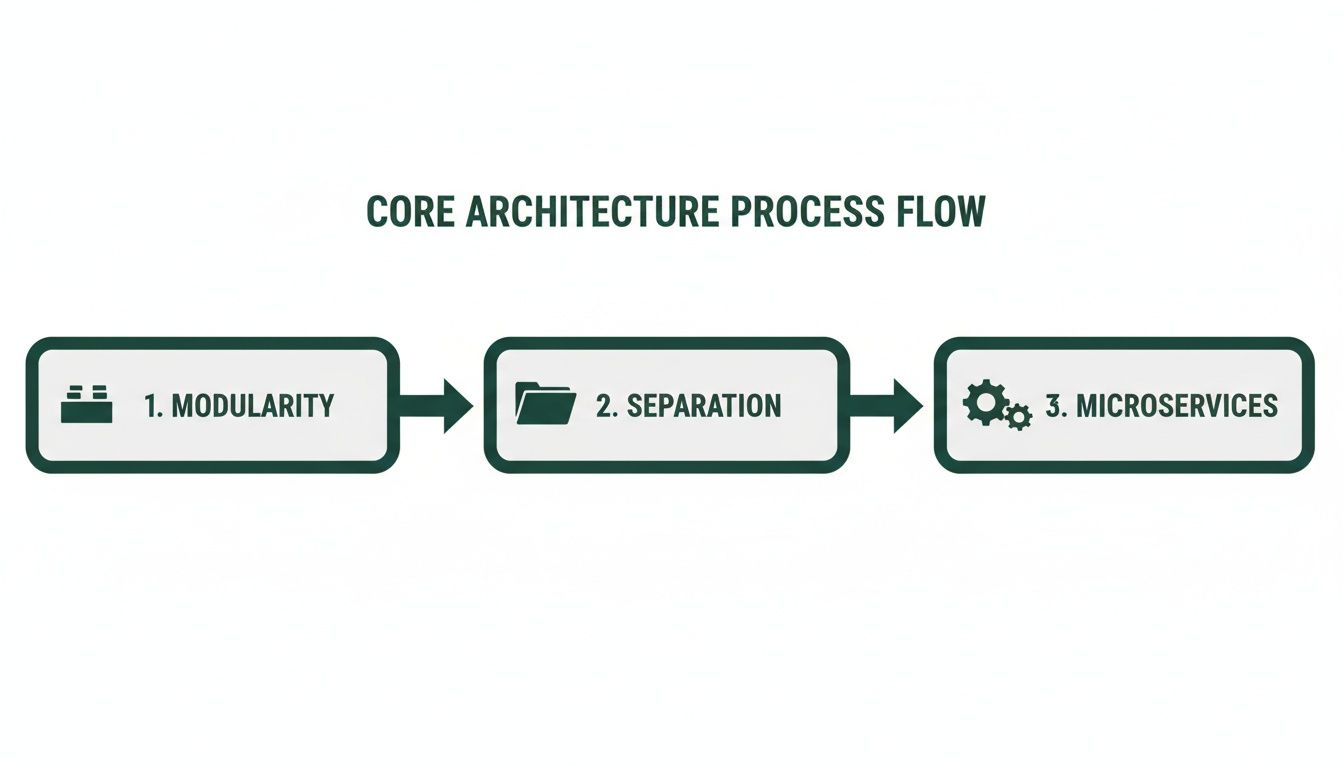
It boils down to a simple philosophy: build with modular "Lego bricks," keep your code organized in separate, logical folders, and prepare for growth with a service-oriented mindset. Get these fundamentals right, and everything else falls into place.
Phase 1: Define and Map Your Architecture
The first—and most critical—step is to translate your existing no-code setup into a structured plan. This means mapping out a real database schema and a clean folder structure for your new application. This is where you lay the groundwork for everything that follows.
If your data is currently trapped in something like Airtable, you'll map those fields and relationships into a formal PostgreSQL schema. This isn’t a simple copy-paste job; it's a golden opportunity to clean house. No-code databases often become messy over time with inconsistent data types and loose connections. A proper migration lets you enforce consistency and build a rock-solid data foundation.
For a deep dive into this crucial step, check out our guide on database migration best practices, which is packed with actionable strategies for a smooth transition.
Here’s a glimpse of a clean, separated folder structure for a Next.js and Python project:
/my-awesome-app
├── /frontend # Next.js/React code
│ ├── /pages # Routes for the application
│ ├── /components # Reusable UI components
│ ├── /styles # Global CSS styles
│ └── ...
├── /backend # Python (e.g., FastAPI or Django)
│ ├── /app # Core application logic
│ ├── /models # Database models (e.g., SQLAlchemy)
│ ├── /routes # API endpoints
│ └── main.py # Application entry point
└── README.md
This kind of clean separation makes the codebase intuitive to navigate and a breeze to maintain—a hallmark of great software architecture.
Phase 2: Sprint-Based Development and Demos
With the blueprint locked in, development kicks off in focused, weekly sprints. This agile approach breaks the project into manageable chunks, preventing the team from getting bogged down in an endless build cycle. Each sprint targets a specific set of features, like user authentication, payment processing, or a core dashboard component.
The secret weapon here? The weekly demo. At the end of each sprint, the dev team presents their progress on a live staging server. This isn't just a formality; it's your most vital feedback loop.
Weekly demos ensure there are no surprises. As a founder, you see tangible progress every single week and can provide immediate feedback, keeping the project perfectly aligned with your business vision from start to finish.
This iterative rhythm means the final product is exactly what you envisioned. It also forces early planning for critical integrations, like hooking up Stripe for payments or a third-party authentication service. Figuring these out from the start prevents costly rework down the road.
Phase 3: Data Migration and Final Handover
The final phase is the transfer of power. This is where we move all of your live data from the old no-code platform to your new, shiny PostgreSQL database. It’s a delicate operation that demands meticulous planning to ensure zero data is lost or corrupted.
Once the data is safely across and the application passes a final round of rigorous testing, the entire codebase and infrastructure are handed over to you. The key deliverable here is a private GitHub repository. This is non-negotiable. It represents your complete ownership of the intellectual property—a critical asset for investor readiness and the future of your company.
The handover isn't complete without these essentials:
- Documentation: Clear, concise instructions on how to run, maintain, and deploy the application.
- Automated Tests: A solid suite of tests that verify the app's core functionality and prevent future regressions.
- Infrastructure Access: Full control over the cloud accounts (e.g., AWS, Vercel) where your app is deployed.
By following this phased blueprint, migrating from no-code to custom code transforms from a daunting challenge into a strategic, organized project. It’s the process that sets your startup up for serious, long-term success.
How Event-Driven Architecture Boosts Scalability

As your app grows, you need a way to juggle complex workflows and real-time interactions without everything grinding to a halt. One of the most powerful software architecture best practices for this is event-driven architecture (EDA). It’s a total shift in how different parts of your software talk to each other.
Think of your application as an orchestra. In a typical setup, the conductor (your main application logic) has to run around tapping each musician on the shoulder to tell them exactly when to play their note. It’s slow, inefficient, and the conductor is a massive bottleneck.
Event-driven architecture flips this entirely. Each musician (a specific service) listens for their cue (an event) and plays their part the instant they hear it. The conductor just announces the cues, and the orchestra responds in perfect, real-time harmony.
Moving Beyond Brittle Automations
If you’re coming from the no-code world, you've probably relied on a web of Zapier connections to stitch services together. While great for simple tasks, these point-to-point integrations create a fragile and expensive mess. When one part breaks, the entire chain of actions can fail silently.
EDA is a far more robust and scalable alternative. Instead of creating direct, rigid connections between services, it uses a central message bus or "event broker."
- Producers: These are services that create events (e.g., a new user signs up).
- Consumers: These services listen for and react to those events (e.g., the email service sends a welcome message).
This "publish-subscribe" model means your services are completely decoupled. The user sign-up service doesn't need to know anything about the email service; it just shouts, "Hey, a new user just registered!" Any service interested in that fact can subscribe and take action, letting you add new features without touching existing code.
By decoupling your services, event-driven architecture allows your application to handle thousands of simultaneous actions with incredible efficiency. It's the secret sauce behind real-time dashboards, complex order processing, and systems that can absorb massive traffic spikes without failing.
The Real-World Impact of EDA
This isn't just an abstract technical pattern; it delivers huge business advantages, especially for a scaling startup. That beautiful Webflow site might be struggling as Airtable limits throttle your data and the Zapier bill eats into your runway. This is exactly where EDA shines, enabling instant responsiveness.
In 2025, EDA is a top trend for distributed systems, built for scenarios where low latency is critical for keeping users. Startups that adopt EDA can process 10x more events per second than traditional monolithic apps.
Let’s look at a classic e-commerce example:
- Event: A customer places an order.
- Producer: The
Order Servicepublishes anOrderPlacedevent. - Consumers React:
- The
Inventory Servicehears it and immediately decreases stock levels. - The
Notifications Servicehears it and sends an order confirmation email. - The
Shipping Servicehears it and creates a new shipment record.
- The
All of this happens instantly and in parallel, without the Order Service getting bogged down coordinating every single step. For a deeper look at how this all works under the hood, check out this technical deep-dive into event-driven architecture. Adopting EDA isn't just a tech upgrade; it's a strategic move to build a more reliable, cost-effective, and superior user experience that’s ready for success.
Securing Your IP for Investor Readiness
Solid software architecture does more than make your app work; it’s a core business asset that directly impacts whether you can raise money. When investors dig in during due diligence, they aren't just glancing at your user growth charts. They're scrutinizing the tech itself, asking one simple question: is this a defensible, proprietary asset, or just a messy collection of rented tools?
This is where the line between a no-code MVP and a real, custom-coded application becomes crystal clear. Investors fund companies that own their intellectual property (IP). They're buying a piece of your unique solution, not your subscription to a third-party platform that any competitor can sign up for tomorrow.
Why IP Ownership Is Non-Negotiable
For any startup looking for serious funding, complete ownership of your source code is a deal-breaker. This means your entire codebase—frontend, backend, and infrastructure scripts—needs to be locked down in a private GitHub repository that you, and only you, control.
That repo is more than just a folder for code; it's tangible proof of your company's value. It shows you've built something real, something that de-risks their investment and gives you a moat. A no-code setup, on the other hand, is like building on rented land. It’s a massive red flag for any investor who needs to see long-term, independent value.
An investor’s nightmare is funding a company whose core tech could vanish overnight because a third-party platform pivots, jacks up its prices, or simply shuts down. Owning your code in a private repo kills that risk entirely.
Baking Security into Your Foundation
Beyond just owning the code, you have to prove you can protect it. A single data breach can vaporize a startup's reputation before it even gets off the ground. That’s why building to established security standards isn't optional—it's a critical part of creating a fundable asset. The gold standard here is the OWASP Top 10.
OWASP (the Open Web Application Security Project) publishes a list of the most critical security risks facing web apps. Designing your architecture to defend against these threats from day one is just good practice.
This means building in safeguards against common attacks, like:
- Injection Attacks: Shielding your database from malicious SQL or other commands.
- Broken Authentication: Making sure user sessions and login credentials can't be easily hijacked.
- Sensitive Data Exposure: Encrypting customer data everywhere—while it's moving and while it's stored.
- Security Misconfiguration: Hardening your servers and cloud services so there are no open doors for attackers.
When you can show investors you’re building to OWASP standards, you’re telling them you’re serious about managing risk and protecting your most valuable assets: your data and your users' trust.
Proving Reliability with Automated Testing
A secure app that’s constantly crashing is worthless. Investors need to see that your platform can stand up to real-world use without falling over. This is where automated testing becomes your best friend.
Instead of a developer manually clicking around to see if things work, automated tests are scripts that verify every part of your application is behaving as expected. A good test suite acts like a safety net, catching bugs long before they ever reach a user. It proves that new features don't break old ones, letting your team ship code faster and with confidence. That kind of proven reliability is a powerful signal that you’ve built a mature, stable product.
Shifting Costs and Strengthening Your Valuation
Finally, moving to a custom architecture changes the story you tell about your spending. It reframes your costs from a messy, unpredictable operational expense into a strategic, fixed-cost investment. The scaling costs of a dozen different SaaS tools and brittle Zapier integrations are a chaotic mess that can spiral out of control.
A custom build, however, has a clear, upfront cost that results in a tangible asset on your books. That clarity is far more attractive to investors. You’re no longer just paying bills; you’re investing in an asset that directly increases your company’s valuation. By securing your IP, baking in security, and proving reliability through testing, you transform your technology from a potential liability into a cornerstone of your investment pitch.
Common Questions About Scaling Your Architecture
Moving away from the cozy familiarity of no-code tools brings up some tough questions. It's a huge strategic shift, and it’s totally normal to wonder about timing, cost, and your role in it all as a non-technical founder. Let's tackle the big ones head-on so you can plan your next move with confidence.
These aren't academic answers. They're direct, practical responses to the real-world doubts that come with building something that lasts.
When Is the Right Time to Migrate From No-Code?
The best time to make the jump is when your no-code platform starts creating "good problems." These are issues that pop up because of your success, sending a clear signal that you’ve outgrown your first toolkit. Move too early, and you're just burning cash. Wait too long, and you risk losing frustrated users and stalling out.
Keep an eye out for these triggers:
- Performance Lags: Your app is getting noticeably sluggish as more users sign on, making for a clunky, frustrating experience.
- Platform Limits: You're constantly bumping up against API rate limits or database row caps in tools like Airtable, forcing you to build janky, inefficient workarounds.
- Blocked Roadmap: You simply can't build the next big, revenue-driving feature because your platform doesn't support the custom logic you need.
- Fundraising Prep: You're getting ready to raise a round, and you know savvy investors will pop the hood and scrutinize your tech stack's ability to scale.
If your team is spending more time fighting the platform than building your product, it’s the perfect time to start planning your migration.
What Does Owning Your IP Really Mean?
Owning your intellectual property (IP) is about having complete, unrestricted control over the source code that runs your business. When you build on a no-code platform, you're just licensing their tech; you don't own the engine. This is a critical distinction, and it has massive implications for fundraising.
Investors are not investing in your subscription to a third-party tool. They are investing in a unique, defensible asset that your company exclusively controls. A private GitHub repository with your custom code is the ultimate proof of that ownership.
This ownership dramatically de-risks their investment. It proves your company’s core value isn't shackled to a platform that could jack up its prices, get acquired, or even shut down entirely. For any serious capital raise, it's a non-negotiable part of passing technical due diligence.
How Can I Manage a Migration Without a Technical Co-Founder?
You don't need to be a developer to lead a successful migration. As a founder, your most crucial job is to be the product visionary—you are the undisputed expert on the "what" and the "why" of your application. Your responsibility is to nail down the business goals and user needs.
The key is to bring in an expert technical team to handle the "how." A good development partner will give you a transparent, structured process that always includes:
- Clear Milestones: The project is broken down into small, manageable phases.
- Regular Communication: You get weekly demos and check-ins to make sure everyone is aligned.
- A Fixed Scope: There's a rock-solid agreement on exactly what will be delivered.
Your role is to give feedback and steer the ship. Their job is to translate your vision into a robust, scalable architecture. They become your dedicated technical team for the project, guiding you from the first planning session to a successful launch.
What Are the Hidden Costs of Staying on No-Code Too Long?
The obvious costs are the monthly subscription bills for your platform and the dozen other tools you've duct-taped together. But the hidden costs are the ones that can really damage your startup’s long-term health.
These insidious costs start with technical debt. Every workaround adds another layer of fragility, making the whole system more likely to break. Then there's the opportunity cost—every hour your team spends fighting platform limitations is an hour they're not spending on features that actually make you money.
Finally, there's the scalability risk. Imagine a sudden traffic spike from a viral post crashing your application. That kind of failure at a critical moment of growth can do lasting damage to your brand's reputation.
Ready to build a scalable, fundable asset you actually own? First Radicle specializes in migrating successful no-code MVPs to production-grade software in just six weeks. Schedule your Unblock Session today and turn your scaling pains into a strategic advantage.